







By Lucy Ogalue
Experts have called on African governments to invest more in agriculture, rural infrastructure and trade reforms as sustainable pathways to end hunger and strengthen food security across the continent.
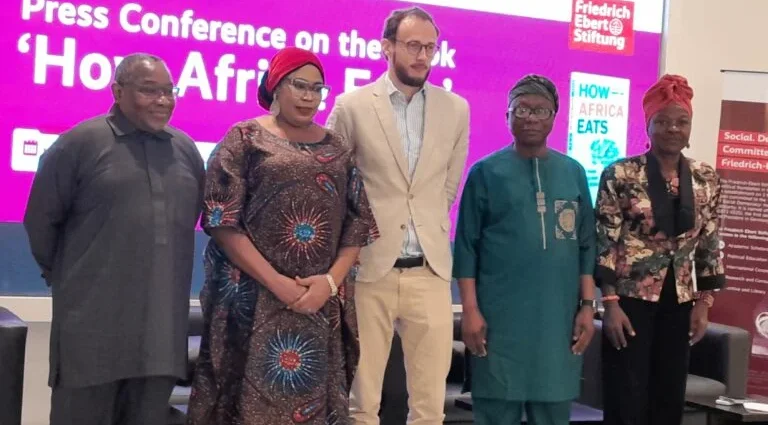
They made the call in Abuja, at the public presentation of a book “How Africa Eats”, authored by Prof. David Luke.
Luke who led discussions at the event, is a Professor of Practice and Strategic Director at the Firoz Lalji Institute for Africa, London School of Economics.
He said that the book highlights the urgent need for Africa to rethink its agricultural and trade systems, as the continent had potentials to become a global agricultural powerhouse if properly supported.
“The amount of knowledge that you need for successful agricultural production is as sophisticated as what you need for manufacturing.
“Today, you need to know something about soil chemistry, rainfall, seeds, adaptation and how to combat climate change.
“There is so much knowledge that young people can bring, but this is not to say they can replace our smallholder farmers.
“Young people working with smallholder farmers who also have long experience in traditional methods could be a win-win situation. The key message is that we can be an agricultural powerhouse on this continent,” he said.
He emphasised that agriculture remained viable and dynamic, capable of generating employment across the production and processing value chains.
“You have major economies like Australia, Canada and New Zealand; these are economies built on agriculture.
“So, agriculture is viable, it can generate jobs all across the value chain. Agriculture is not something to shun,” he said.
On policy direction, Luke urged governments to invest more in agriculture, explaining that such investments must cover rural infrastructure, inputs, machinery and post-harvest facilities.
“Agriculture is different from any other kind of activity. When it comes to manufacturing, you can leave that to the private sector, but when it comes to agriculture, that is food which we all need to survive.
“Governments must be involved. Everywhere in the world, governments are very much involved in agriculture,” he said.
Luke said that in spite of commitments under the Comprehensive Africa Agriculture Development Programme (CAADP), our governments were not putting as much into agriculture as they should.
He regretted that food insecurity in Africa had become normalised.
“It is surprising that with the high numbers of hunger that we have on this continent, we have normalised it. That’s not right. No one should go hungry.
“The fact that we are nowhere close to attaining the SDG2 target of ending hunger is an indictment on all of us as Africans,” he said.
On foreign aid and investment, he explained that only about eight per cent of foreign aid goes into agriculture, describing it as an opportunity for Africans to develop the sector themselves.
“Foreign investors are not prioritising agriculture; they prefer minerals and other commodities. But that is an opportunity for us, we can grow this sector on our own,” he said.
Luke added that crops such as yam and cassava, which are native to Africa, had done well globally in spite of limited support from governments, showing that with the right policies, other crops could perform equally well.
“The reason yam and cassava have done well is because they are not subsidised elsewhere and this is their natural habitat.
“So, in spite of little support, they perform well and that tells you that other products can do as well with the right kind of support,” he said.
In his contribution, Prof. Emmanuel Ogunkola of the University of Ibadan, said that government intervention remained crucial to addressing market failures in agriculture.
“The first question we should ask is why governments should support agricultural production.
“It has so many contributions to social life, to poverty, to employment, to livelihood. These are the reasons why governments all over the world will not leave agriculture to demand and supply only,” he said.
He recalled the decline of agricultural extension services and stressed the need to revive them.
“Some years ago, we used to do better. What happened to agricultural extension services in this country?
“Apart from teachers, the next set of people we knew were extension workers advising farmers when to plant or apply fertiliser. Where are they now?” he asked.
Ogunkola called for better coordination among agencies and research institutions to improve production and value addition.
“If government wants to promote the cocoa value chain, intervention should start from the seedling, to the chemicals used, the process, the transformation, all the way to consumption.
“Beyond production, adding value to agricultural commodities will help us a lot. For instance, we export cocoa beans and import chocolate. If we can process our cocoa beans here, we can export chocolate instead,” he said.
Also speaking, Dr Dayo Kusa, Conflict Transformation Strategist and former Director, Institute for Peace and Conflict Resolution, said that insecurity and corruption were major obstacles to agricultural development in Africa.
“If you look at West Africa, there is hardly any country that is not bedevilled with insecurity. When there is conflict, nothing can happen, not agriculture, not trade.
“We cannot move to agricultural subsidy or reform without solving insecurity. You cannot sit down to do anything tangible without solving the problem of insecurity,” she said.
Kusa, however, commended ongoing efforts to integrate climate adaptation across sectors, urging continued investment in climate-smart agriculture.
Also, Dr Blessing Irabo-Oza, National President, Organisation of Women in International Trade (OWIT), commended the author for connecting food, trade and climate change in the book.
“What strikes me most in this book is how clearly you have connected food, trade and climate, showing that hunger in Africa is not just about what we grow, but how we trade and who is participating in that trade.
“We must change how Africans trade. It means strengthening intra-African trade under the African Continental Free Trade Area (AfCFTA)
“It means building regional value chains and ensuring women and SMEs are at the centre of the food system, not at the margins,” she said.
Irabo-Oza stressed the importance of gender inclusion in agriculture, describing women as “the heart of agriculture in Africa.
“When you talk about agriculture, it is the women that form more than half of the population engaged in farming, processing, buying and selling.
“Women should be properly captured for the role they play and how they can be supported at every step,” she said.
She urged stronger implementation of the African Continental Free Trade Area to encourage Africans buying from Africa and supporting Africa.
Earlier, Mr Lennart Oestergaard, Resident Representative of FES Nigeria, while welcoming participants at the event commended Prof. Luke on his achievements.
Oestergaard then reaffirmed FES’s commitment to supporting research and dialogue that connect trade unions, policymakers and the private sector toward sustainable and equitable food systems. (NAN)(www.nannews.ng)
Edited by Francis Onyeukwu