









By Funmilayo Adeyemi
Experts have called for stronger collaboration among government institutions, financial service providers, community leaders and development partners to deepen financial inclusion in Northern Nigeria.
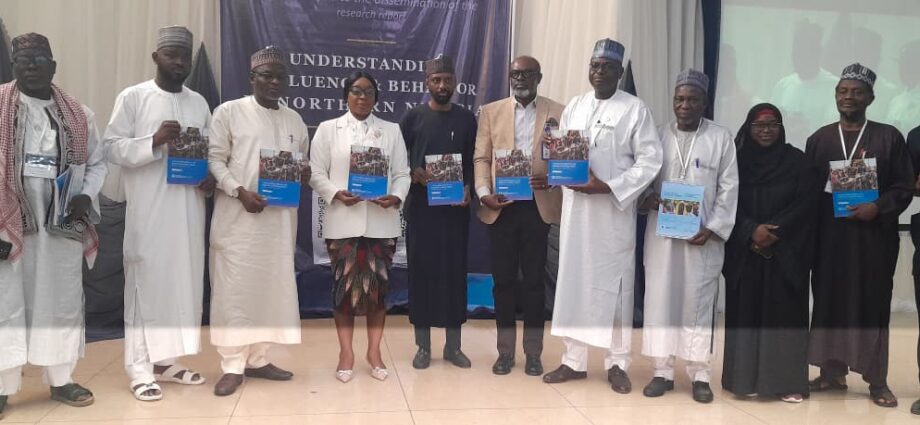
They made the call on Wednesday in Abuja during the public presentation of a research report titled ‘Understanding Influence and Behaviour in Northern Nigeria’.
The News Agency of Nigeria (NAN) reports that the research was conducted by the Aminu Kano Centre for Democratic Studies, Bayero University, Kano (BUK).
They said achieving meaningful progress will require not only policy reforms but also behavioural change, improved trust in financial systems and context-specific interventions that reflect local realities.
The Vice-Chancellor of BUK, Prof. Haruna Musa, said research institutions and policy centres must take ownership of such studies and translate their findings into practical solutions for Nigerians.
Musa, represented by the Director of Academic Planning at the university, Prof. Yusuf Garba, said the report focused largely on behavioural change within Northern Nigeria’s social structure, where a large proportion of the population was covered in the study.
He said understanding behavioural patterns among residents was key to designing effective development policies.
“The research focuses on the demography of the North, where a large proportion of the population resides across the 19 northern states.
“Given the social structure, the major finding relates to behavioural change, which is a significant part of the study,” he said.
Also speaking, Prof. Habu Fagge, Director of the Aminu Kano Centre for Democratic Studies, said the research examined socio-economic behaviours affecting financial inclusion, especially gender disparities.
He said financial inclusion remained a critical indicator of economic development, stressing that bridging the gender gap in bank and fintech registration would strengthen grassroots development.
Fagge explained that the study was divided into three volumes covering social norms and behaviours, access to and usage of financial services, and gender mapping across communities.
According to him, findings showed gradual improvement in financial inclusion across Northern states, although disparities persist due to cultural and social norms.
“In states such as Benue and Nasarawa, women show higher financial participation, compared to Jigawa and Kebbi where cultural limitations restrict women’s public engagement,” he said.
Fagge added that trust within communities was largely driven by interpersonal relationships rather than institutions, making traditional rulers, community leaders and household heads key drivers of financial behaviour.
He said leveraging such social influencers could promote entrepreneurship, income generation and increased bank account ownership.
The Principal Investigator of the research, Prof. Ismaila Zango, said the study provided baseline data needed by policymakers and programme implementers to design more impactful interventions.
Zango noted that many government programmes fail due to inadequate understanding of community realities.
He said the study also revealed low institutional trust, driven by weak transparency, unfulfilled promises and poor accountability mechanisms.
According to him, unemployment in the region stands at about 37 per cent, while poverty levels average nearly 80 per cent, with Sokoto State recording the highest poverty rate.
He stressed the need for sustainable economic empowerment rather than short-term financial handouts to reduce poverty.
Zango advocated a holistic and continuous approach to development interventions rather than fragmented programmes.
In her remarks, the Chief Executive Officer of Enhancing Financial Inclusion and Advancement (EFInA), Foyinsolami Akinjayeju, said the findings aligned with existing evidence from national financial access surveys.
She noted that these surveys highlight structural barriers limiting access to financial services in Northern Nigeria.
Akinjayeju outlined three priority actions needed to drive inclusive finance.
These include policy action, institutional commitment, and collaboration among stakeholders.
She said governments, development partners and financial institutions must align policies with local realities while ensuring sustained commitment to inclusive economic growth.
“Financial inclusion is not only a moral imperative; it also makes business sense, because expanding access allows more citizens to participate and contribute to the economy,” she said. (NAN) www.nannews.ng
Edited by Tosin Kolade