



















By Jessica Dogo
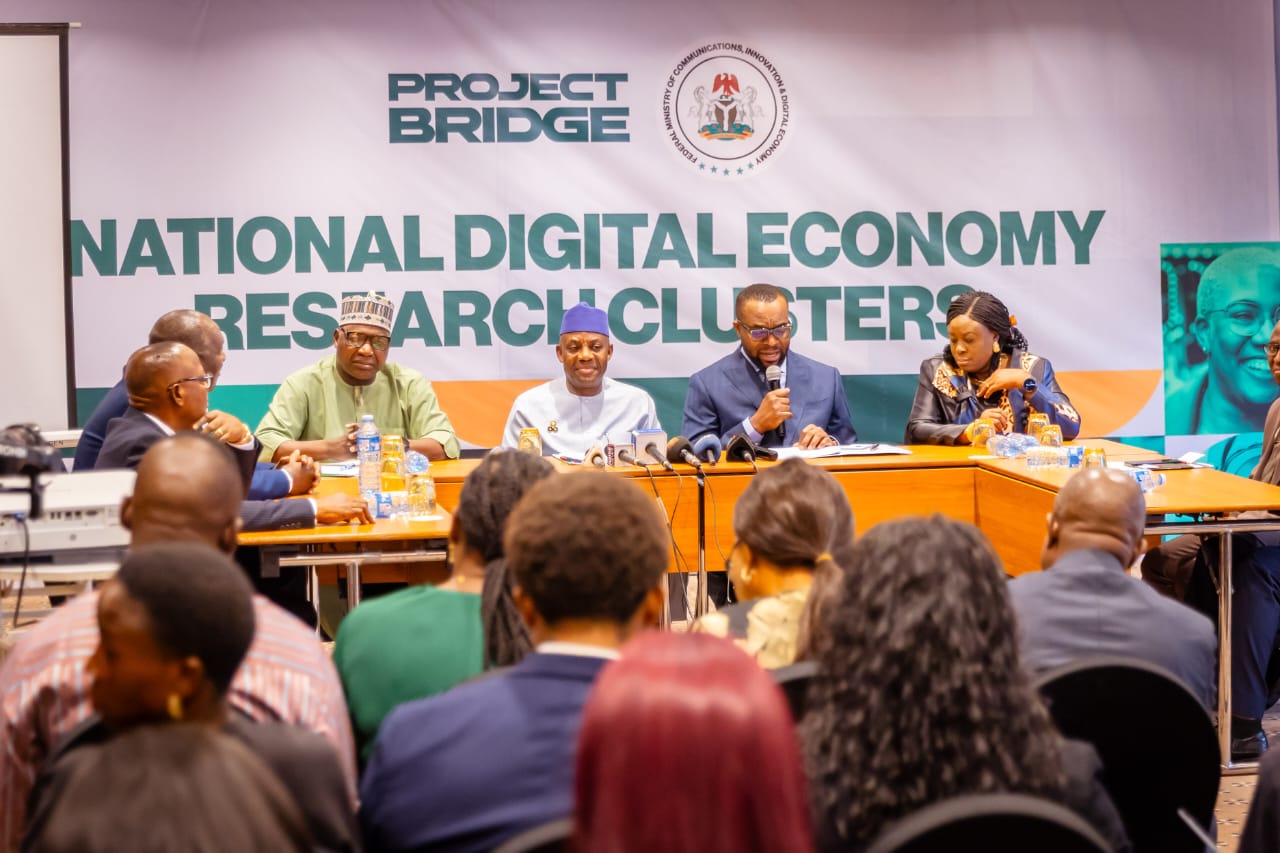
The Federal Government has inaugurated a nine million dollar digital economy research clusters to boost innovation in academia.
The Minister of Communications, Innovation and Digital Economy, Bosun Tijani, unveiled the research clusters on Tuesday in Abuja.
Tijani said that it was a flagship initiative under Project BRIDGE (Building Resilient Digital Infrastructure for Growth).
The News Agency of Nigeria (NAN) reports that Project BRIDGE, financed by the Word Bank, will engage university-led research consortia to deliver high-quality, policy-relevant research across six thematic clusters.
Tijani said that the progress driven by deliberate policies under the leadership of President Bola Tinubu, was also laying strong policy foundations through such initiatives.
He said that the policies were Digital Economy Bill, the National Data Exchange System, the National Artificial Intelligence (AI) Strategy, and the Alphanumeric Digital Postcode System.
He, however, said that Nigeria must develop homegrown knowledge to sustain growth in the sector.
“The digital economy is a knowledge-driven sector. We can not rely only on ideas developed elsewhere. We must generate our own insights rooted in our realities.
“We are building talent through the Three Million Technical Talent (3MTT) programme, and expanding infrastructure through Project BRIDGE and NUCAP.
“We are also strengthening our space and communications capacity with the approval of two new satellites,” he said.
Tijani called on universities to go beyond teaching and become centres of research and problem-solving for the country.
He said that in 2023, the ministry funded 45 research projects in AI, which had already produced over 27 peer-reviewed publications in reputable international journals.
“This is not just about output, but about building credibility, strengthening our research base, and contributing to global knowledge,” he said.
The minister also said that initiatives such as the AI Collective and N-ATLAS, Nigeria’s indigenous large language model project, were key milestones in advancing research and innovation.
He cited improvements in Nigeria’s global standing, noting that the country climbed from 103rd position in 2023 to 72nd out of 195 countries in the 2025 Oxford Government AI Readiness Index.
According to him, Nigeria now ranks 35th globally in Policy Capacity and 49th in Development and Diffusion, reflecting growth in talent, research and innovation.
Tijani said the newly launched Digital Economy Research Clusters would bring together universities, researchers and global partners to focus on key areas.
He listed the areas to include connectivity and meaningful access, digital public infrastructure and government services, skills and human capital.
Others are jobs and the digital economy, trust and consumer protection, as well as AI and emerging technologies.
He said the clusters were designed to drive collaboration, generate policy-relevant insights and strengthen long-term research capacity.
“These research clusters are practical and impactful. They will deepen Nigeria’s ability to adopt, shape and deploy technology effectively,” he said.
The minister reiterated the government’s commitment to positioning Nigeria as a key player in the global digital economy.
“Our ambition is clear. We want Nigeria to contribute to shaping the global digital economy, and this requires new thinking, evidence and talent.
“This initiative places our universities and researchers at the centre of that ambition,” he said.
In his remarks, the Minister of Education, Dr Tunji Alausa, said that Nigerian universities needed to evolve beyond theoretical learning centres into institutions that nurture innovators, entrepreneurs and problem-solvers capable of competing globally.
Alausa said that the newly introduced research clusters would help institutionalise the gains of expanded connectivity by focusing on key areas such as digital infrastructure, governance, skills development, and emerging technologies.
“These clusters will help us build innovators and develop solutions that can transform lives in Nigeria and globally,” he said.
Earlier, the Vice-Chancellor, Olabisi Onabanjo University, Prof. Ayodeji Agboola, who spoke on behalf of other universities, said that this initiative needed more awareness to enable the youths key into it.
Agboola commended the minister and expressed commitment to the research project. (NAN)(www.nannews.ng)
Edited by Ifeyinwa Okonkwo/Kadiri Abdulrahman