










By Abigael Joshua
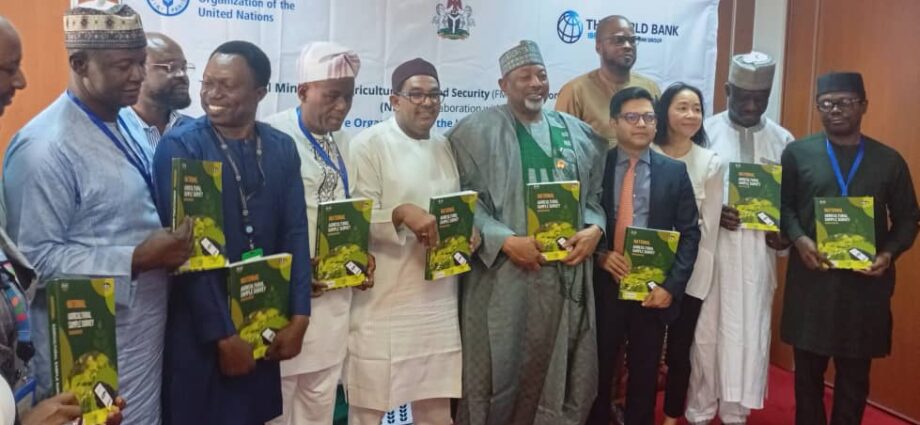
The Federal Government has launched the National Agricultural Sample Survey (NASS) 2023 Report, towards developing data-driven policies to achieve food security and economic diversification.
The News Agency of Nigeria reports that Food and Agriculture of the United Nations (FAO) in collaboration with the Federal Ministry of Agriculture and Food Security, National Bureau of Statistics and the World Bank compiled the report.
It was presented by Sen. Abubakar Kyari, Minister of Agriculture and Food Security, on Tuesday in Abuja.
He said the ministry would apply the findings across the core levers of agricultural transformation, ensuring that programmes remain data-driven, impact-focused and aligned with the aspirations of the Renewed Hope Agenda.
“A nation that measures well governs well. And food security begins with information security.
“This report should be seen as a practical tool for decision making, one that guides policy choices, informs investment priorities and accelerates the reforms required across Nigeria’s agricultural sector.
“In a country of more than 232 million people, the strength of our food system depends on the quality of the data that guides national decisions,” he said.
Kyari said that without credible evidence, interventions risk being misdirected and investments may fail to reach the areas of highest need.
He said the report provides reliable, sector-wide data that helps the agriculture sector track production, understand emerging trends, and guide policy decisions.
“The 2023 edition, produced through collaboration between the National Bureau of Statistics, the Federal Ministry of Agriculture and Food Security, the FAO, and the World Bank, presents detailed information on crops, livestock, fisheries, and forestry across all 36 States, the Federal Capital Territory, and 767 Local Government Areas.
“This breadth of coverage ensures that national planning and sector interventions are grounded in credible evidence.
“Every effective agricultural system rests on two pillars: the work of our farmers and the quality of the data that directs national policy,” he said.
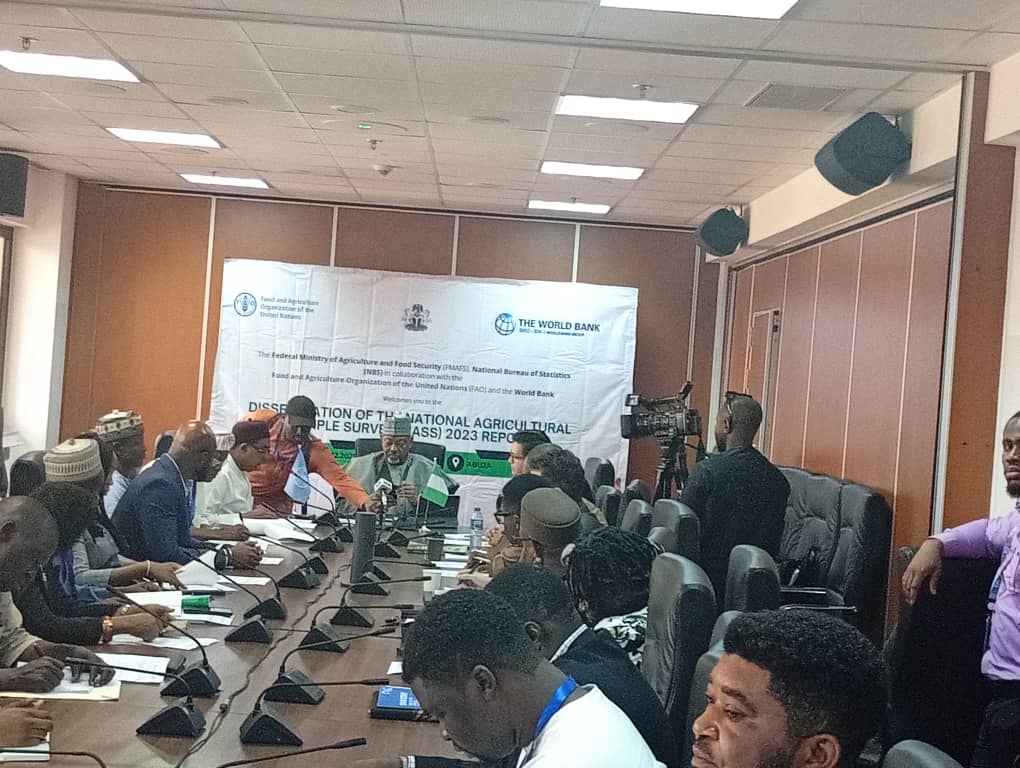
According to Kyari, the launch and dissemination of the National Agricultural Sample Survey 2023 represents an important step in ensuring that our national choices are informed, targeted, and grounded firmly in evidence.
“This report therefore represents more than statistical outputs; it reflects our commitment to transparency, disciplined planning, and the sustainable development of Nigeria’s agricultural sector.
“The findings of the National Agricultural Sample Survey 2023 present a clear and compelling picture of national production.
“The data we are presenting today is central to that mandate because it gives us the precision required to target interventions, close gaps, and drive the reforms needed to secure our nation’s food system.
“These data points also remind us that every figure reflects real activity across the country, from production to processing to marketing.
“With these digital foundations in place, insights from the NASS move from static data to operational intelligence, enabling a more transparent, efficient and connected agricultural system,” the Minister said.
Dr Hussein Gadain, Director-General, FAO, said the report is not just a presentation of data but a celebration of collaboration, commitment, and progress towards building a stronger, more resilient agricultural sector in Nigeria.
He said the event represents a major milestone in shared efforts to strengthen Nigeria’s agricultural statistics system, foster evidence-based policymaking, and promote transparency and accountability in the sector.
“Reliable data is the foundation upon which sound policies are built, and the NASS 2023 report provides exactly that, a comprehensive and credible picture of Nigeria’s agricultural landscape.
“The report offers detailed insights into critical components of the sector, including crop production, livestock, fisheries, land use, farm inputs, post-harvest losses, farming systems, and socio-economic indicators of agricultural households,” Gadain said.
Also, Adeyemi Adeniran, Statistician General, National Bureau of Statistics (NBS), said the report provides critical information on crop production, livestock, aquaculture, labour amongst all.
Represented by David Babalola, an official of NBS, Adeniran said that data is essential for shaping effective policies and driving sustainable growth.
“The findings from the NASS Report 2023 represents a significant milestone in strengthening our national data system.
“The collaboration between the NBS, FAO and the World Bank have been instrumental in strengthening our capacity to generate credible, timely and policy-relevant agricultural statistics.
“Today’s event underscores our collective commitment to improving the quality of agricultural data and ensuring that evidence-based insights guide national planning, food security, interventions, and the broader transformation of the agricultural sector,” Adeniran said.
He highlighted that the survey reaffirmed the national bioscience commitment to upholding global best practices in data production through improved methodologies, enhanced field operations, rigorous quality data assurance processes and development of modern digital tools, in Nigeria.
Henry Karshima, Assistant Chief Forest Officer, Ministry of Environment, said the role of agriculture cannot be overemphasised in food security, especially with the launch of the survey.
Abdulhameed Umar, National Project Coordinator, Agro-Climatic Resilience in Semi-Arid Landscapes (AReSAL), expressed satisfaction with the project in the line of restoring land degradation through data collection.
On his part, Asad Alam, Senior Economist and Project Lead, 50×2030 Initiative World Bank Nigeria Development Data Group, Economic Division, commended the initiative of making data a priority in agricultural activities to ensure food security. (NAN)(www.nannews ng)
Edited by Sadiya Hamza