



















By Rukayat Moisemhe
Mr Gbemi Adelekan, President, Money Lenders Association, says Nigeria’s licensed digital lenders are playing a crucial role in empowering women by helping to close the credit gap for female entrepreneurs through faster and more accessible financing for small businesses.
Adelekan, also Chief Client Officer, KwikPay Credit, said this in an interview with the News Agency of Nigeria (NAN) on Sunday in Lagos to commemorate the 2026 International Women’s Day (IWD).
NAN reports that the theme for the 2026 IWD annually celebrated on March 8 is: “Rights. Justice. Action. For ALL Women and Girls” (UN Women), with the campaign theme as “Give to Gain.”
The IWD 2026 theme, “Rights. Justice. Action. For ALL Women and Girls”, calls for action to dismantle all barriers to equal justice: discriminatory laws, weak legal protections, and harmful practices and social norms that erode the rights of women and girls.
The digital lending expert said improved access to digital loans for women would not only support women’s rights but also enhance economic productivity and improve livelihoods across the country.
He noted that in spite of government efforts to promote gender inclusion, many women entrepreneurs, particularly those running Small and Medium Enterprises (SMEs) still face significant barriers in accessing formal credit.
According to him, most women-owned businesses in Nigeria operate within the informal sector, making it difficult for them to access loans from traditional financial institutions.
“Many women run micro-enterprises from their homes and often find it difficult to separate household finances from business finances.
“Because of the informal nature of their businesses, they also tend to borrow from informal sources and lack proper credit histories.
“They are also less likely to own physical assets in their own names, which limits their ability to provide collateral for loans,” Adelekan said.
He noted that digital lenders were helping to address these challenges by offering inclusive financial products tailored to the needs of small-scale entrepreneurs.
According to him, digital lending platforms provide fast, flexible and collateral-free loans that require minimal documentation, making them more accessible to women in business.
“This helps address the challenge of lack of collateral, which is particularly acute for women entrepreneurs,” he said.
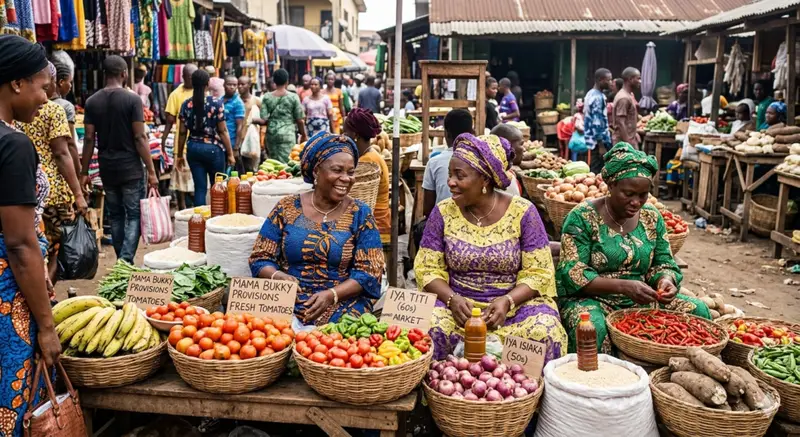
Adelekan described market women as the real engine of Nigeria’s economy, noting that they play a central role in trade and commerce across communities.
According to him, in spite of their economic contributions, many market traders often struggle with short-term cash flow challenges that affect their ability to purchase stock or meet urgent business needs.
“In markets, timing is everything. A trader may suddenly need cash to restock goods or take advantage of a good buying opportunity.
“This important cash gap is increasingly being filled by money lenders who provide fast and simple access to short-term loans,” Adelekan said.
He explained that unlike conventional bank loans, which often involve lengthy processes and rigid structures, many traders prefer short-term credit with flexible repayment options.
He added that most banks, and even some microfinance institutions, provide generic loan products that do not align with how market businesses operate.
“A trader may not need a year-long loan worth millions of naira; she may only need a small amount for a few days or weeks,” he said.
Adelekan also noted that some digital lenders deployed field agents within markets to provide support services and facilitate access to loans for traders.
He said increasing the number of female agents in such operations could further improve women’s participation in digital financial services.
“According to World Bank studies, ensuring sufficient representation of women agents can help promote the use of digital financial services by women entrepreneurs.
“In many markets, which are largely female-dominated, the presence of female agents helps to build trust and encourages more women to take advantage of available credit services,” he said.
He also said the use of data-driven credit assessment systems by digital lenders could help reduce human bias in loan approval processes.
According to him, many digital lending platforms rely on data-driven machine learning tools to make credit decisions, which helps remove potential human bias from the process.
He emphasised, however, that loans should be used as tools to strengthen businesses rather than as long-term financial solutions.
According to him, small loans can help traders manage cash flow, buy stock at better margins or repair essential equipment needed for their operations.
“Digital money lenders are filling an important financial gap for women entrepreneurs.
“Our loan services are more than just financial products; they support ambition, independence and better decision-making,” he said.
Adelekan advised women entrepreneurs to use accessible digital loans primarily to expand their businesses rather than fund avoidable consumption.
“The goal is to use these quick and easy-to-access loans to grow businesses and strengthen financial independence,” he said. (NAN)
Edited by Vivian Ihechu