By Adebayo Gbeja/Ibironke Ariyo
The Chairman, National Drug Law Enforcement Agency (NDLEA), retired Brig.-Gen. Buba Marwa, says while Nigeria may celebrate milestones recorded over the past five years, the country must also confront the sobering reality of a mutating drug threat.
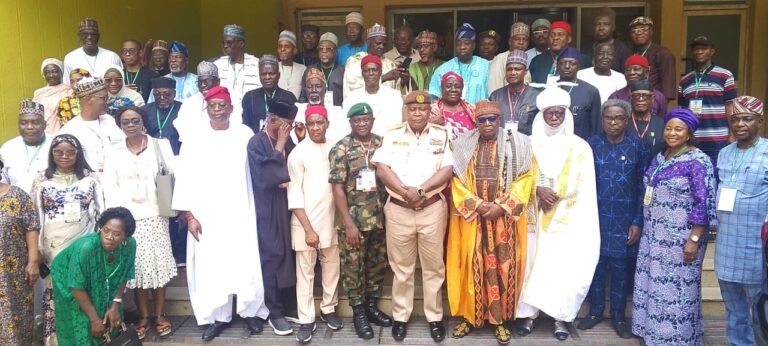
Marwa said this at the opening session of a two-day National Drug Control Master Plan (NDCMP) Consultative Forum organised by the agency on Monday in Abuja.
He said that UNODC projections suggest a 40 per cent spike in drug use across Africa by 2030.
He also said that recent reports from the Global Initiative Against Transnational Organised Crime (GI-TOC) confirmed that West Africa remains a high-pressure corridor for cocaine flows between Latin America and Europe.
He added that Nigeria drug landscape was becoming increasingly complex as it battles the surge of synthetic substances and prescription drug abuse.
This, he said, included the rise of poly-drug use and New Psychoactive Substances (NPS), the digitalisation of the drug trade, where encrypted platforms and dark-web operations shield illicit assets from traditional law enforcement.
“As Africa’s most populous nation and largest economy, Nigeria cannot afford to be a passive observer. The risks to our youth, our workforce, and our national security are too high.
“This forum is, therefore, our battle room for the next five years. Our primary objective is to finalise the Zero Draft of the NDCMP 2026–2030, a roadmap built on the rigorous summative evaluation of our previous cycle.
“The new plan introduces two critical pillars to our strategy, that is: the Alternative Development and Sustainable Livelihoods that addresses the socio-economic drivers of the drug trade.
“This is also as well as disrupting the illicit drug economy, using financial intelligence to choke the lifeblood of trafficking networks,” he said.
Marwa acknowledged the support of local and international partners especially the UNODC and ECOWAS in the production of the 2026-2030 NDCMP draft.
The NDLEA boss urged the gathering of experts and participants to remember that the drug problem was not an abstract concept or a set of statistics but a daily reality in the homes, the schools, and the streets.
“We are here not just as policy-makers and experts, but as parents, citizens, and guardians of the next generation. Despite our different backgrounds, our goal is singular and that is a drug-free Nigeria.
“I urge you to use the next two days to think boldly. Challenge the status quo, Propose innovations. Your inputs will determine the trajectory of our nation’s safety for the next half-decade.
“I look forward to a final NDCMP 2026–2030 that stands as a roadmap of hope and promise for a safer, healthier Nigeria,” Marwa added.
In his goodwill message, Mr Cheikh Toure, Country Representative, United Nations Office on Drugs and Crime (UNODC), called for stronger community-based participation in Nigeria’s drug control efforts.
Toure said that effective response to drug abuse and trafficking cannot be achieved from the centre alone.
The country representative commended the NDLEA for its leadership in driving the consultative process, noting that Nigeria’s drug challenge was becoming increasingly complex and expanding in scope.
He said drug control in a country with 36 states, the FCT and 774 local government areas must be driven at the community level for it to be effective.
“State and local governments must take ownership of the response by providing funding, integrating drug control priorities into development plans, and ensuring services reach grassroots communities,” he said.
The UNODC chief described the NDCMP as an opportunity to align responsibilities across all levels of government and improve coordination for real impact at community level.
He stressed that without such commitment, even the strongest national strategy might not deliver the desired impact.
The UN official also emphasised the need to involve young people in the design and implementation of drug control policies, describing them not only as a vulnerable group but also as key partners in prevention and response efforts.
He further called for stronger gender inclusion in drug control strategies, noting that women and girls face unique vulnerabilities but remain central to prevention, treatment and community resilience.
In her remarks, Minister of State for Education, Prof. Suwaiba Ahmad, commended the NDLEA for its sustained commitment, professionalism, and proactive approach in tackling the menace of drug abuse and illicit trafficking in Nigeria.
Ahmad said that the agency’s efforts in advocacy, enforcement, rehabilitation, and stakeholders’ collaboration continued to make a meaningful impact in protecting communities and restoring hope to affected individuals and families.
“As we work collectively to develop a robust and responsive National Drug Control Master Plan, it is important that we adopt a holistic and multi-sectoral approach that integrates education, healthcare, law enforcement, community engagement, and social support systems.
“Such collaboration is essential to addressing both the root causes and consequences of substance abuse in our society.
“I, therefore, urge participants at this forum to engage constructively, share valuable insights, and develop practical recommendations that will strengthen Nigeria’s drug control framework and ensure a sustainable outcome for future generations,” she said.(NAN) (
www.nannews.ng)Edited by Yakubu Uba




Comments