
















By Emmanuel Oloniruha
Vice-President Kashim Shettima on Thursday said Nigeria is back from the economic brink and now on a trajectory that leads to renewal, stability, and shared prosperity.
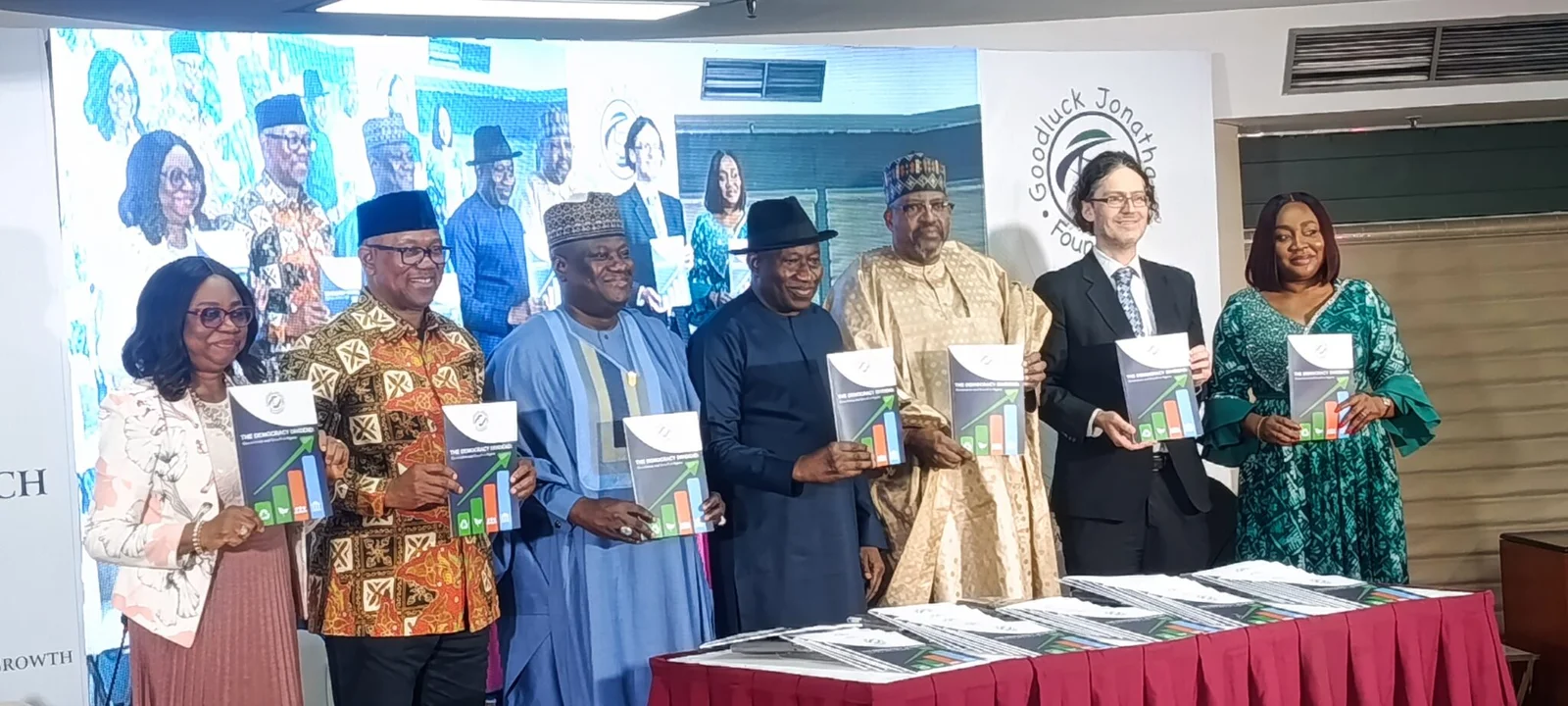
Shettima stated this in Abuja at the national convening and report launch on “Strengthening the Nexus Between Democracy and Economic Growth in Nigeria,” organised by the Goodluck Jonathan Foundation (GJF).
The vice-president, who was the Special Guest of Honour at the event, was represented by his Special Adviser on General Duties, Dr Aliyu Modibo.
Shettima noted that while the reforms of the President Bola Tinubu-led administration came with inevitable pains, they were necessary actions to save the country from avoidable ruin.
He explained that the administration inherited an economy weighed down by structural distortions, including a heavy fiscal burden from the fuel subsidy regime and a foreign-exchange system distorted by arbitrage.
According to him, confronting realities of such scale required a willingness to act where previous caution had allowed dangerous imbalances to harden.
“President Tinubu’s reforms have been guided by the recognition that an economy cannot be made stronger by feeding the practices that are draining it.
“The effort to restore fiscal space, improve transparency, and re-establish credibility in economic management belongs to that larger duty of rescue.
“Yet it would be wrong, and indeed unfair, to discuss these reforms without acknowledging the pain that accompanies adjustment.
“But today, I can assure each of us that Nigeria is back from the economic brink, and the trajectory we are on is one that leads us to renewal, stability, and shared prosperity,” he added.
Shettima maintained that democratic leadership must combine courage with empathy.
He highlighted various welfare interventions by the Federal Government, including the Nigerian Education Loan Fund (NELFUND), expanded social investment programmes, and the national consumer credit system.
He also reiterated the president’s commitment to strengthening local governance, following the judicial affirmation of the constitutional rights of local governments.
“We are going nowhere unless the rural and remote parts of the nation enjoy the same democratic benefits as their urban counterparts. Democracy must not be a privilege of the city alone,” he said.
The vice-president further stated that the test of democracy is whether the choices made in government are truly for the survival and wellbeing of the people.
“Growth figures can ring hollow where they do not yield what they promise. It is about ensuring that democratic governance has the discipline, courage, and intelligence to produce stability, productivity, and trust,” he said.
He commended former President Goodluck Jonathan for his role in nation-building and for convening a dialogue that addressed the “distance between economic logic and public acceptance.”
In his remarks, Secretary to the Government of the Federation (SGF), Sen. George Akume, also said that the socio-economic reforms under President Tinubu were showing encouraging signals that democratic governance could deliver.
Akume, represented by the Permanent Secretary on General Services in the SFG Office, Ibrahim Kana, said that was being done even as the government recognised the daily challenges faced by citizens.
He said that the event underscored the need for a maturing democracy to evolve into a system that delivers to the citizens.
To strengthen the link between democracy and development, Akume proposed building confidence in democratic institutions through electoral credibility and trusted dispute resolution mechanisms.
He also emphasised the need for a legislative environment that enabled effective oversight and representation for all citizens.
Akume also called for focus on improving the quality of public spending by strengthening procurement integrity and using data to monitor results.
According to him, the government is committed to a culture where public institutions solve problems faster and more fairly to make reforms concrete in the lives of Nigerians.
While commending former President Jonathan and the GJF for the study, Akume assured stakeholders that the government welcomed evidence-led engagement.
He pledged that the Federal Government would continue to work with the National Assembly, GJF and other partners to ensure democratic governance served as the foundation for inclusive economic growth.(NAN)(www.nannews.ng)
Edited by Gregg Mmaduakolam/Maureen Atuonwu