

















By Philomina Attah
International development partners and anti-corruption agencies have urged the National Assembly to decentralise the Code of Conduct Tribunal (CCT) through zonal panels.
They said the reform would enhance efficiency, reduce case backlog, and ensure faster adjudication of corruption and misconduct cases involving public officials across Nigeria.
Mr Danladi Plang, Head of Programme, Rule of Law and Anti-Corruption Programme Phase Two (RoLAC Phase II), made the call on Monday in Abuja.
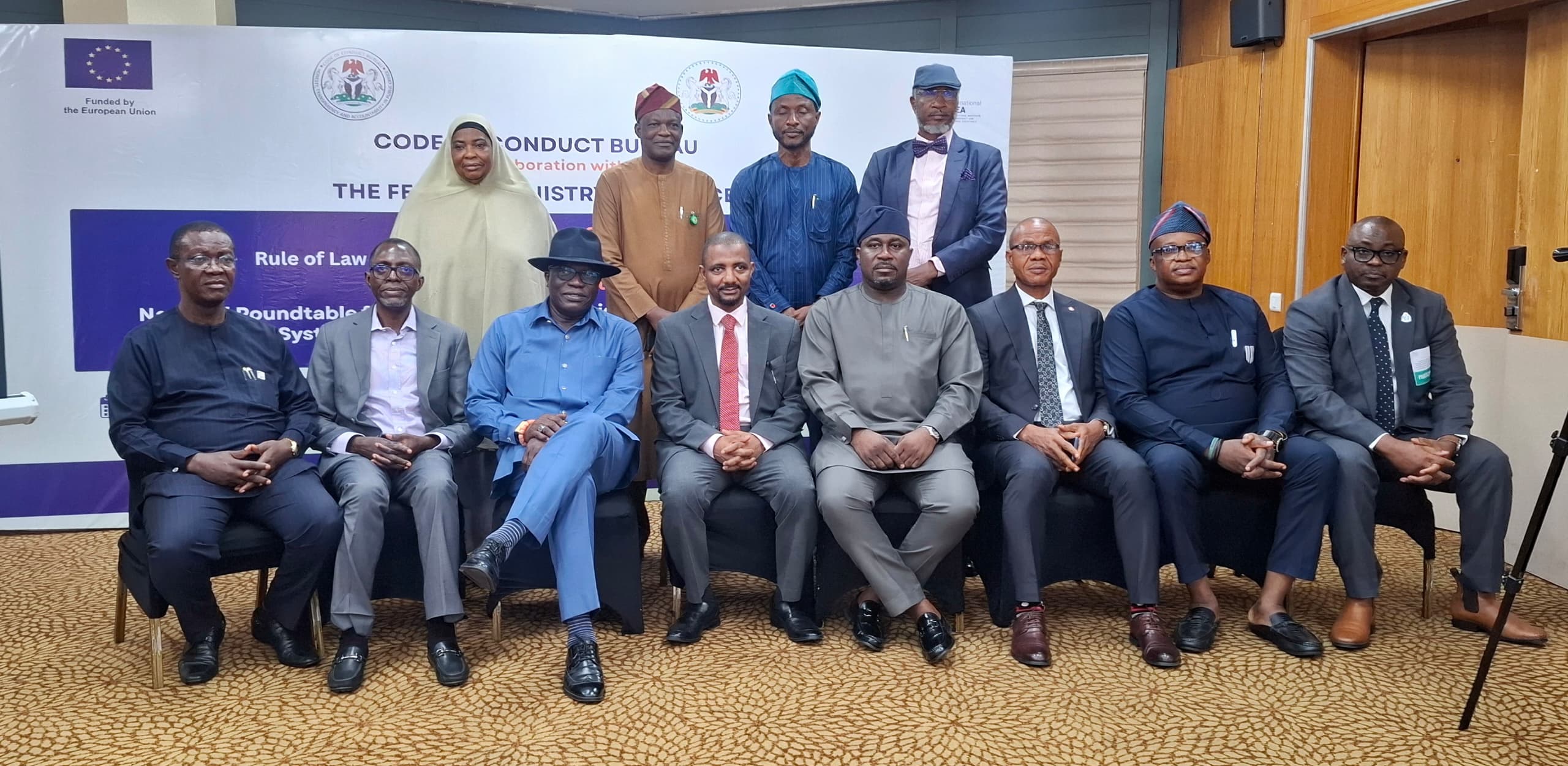
He spoke during a National Stakeholders Engagement with State Heads of Service, focusing on strengthening transparency, accountability, and compliance within Nigeria’s public service architecture.
The engagement was organised by the Code of Conduct Bureau (CCB), Nigeria’s constitutional body responsible for enforcing ethical standards among public office holders.
Discussions centred on the Online Assets and Liabilities Declaration System (OALDS) and the National Anti-Corruption Strategy (NACS), both key pillars of ongoing governance reforms.
Plang noted that his programme was implemented by the International Institute for Democracy and Electoral Assistance (International-IDEA), an intergovernmental organisation supporting democratic governance worldwide.
He argued that operating a single Code of Conduct Tribunal panel for Nigeria’s population exceeding 200 million citizens was impractical and ineffective.
“I think at this moment, having just one panel for a country of over 200 million people is clearly inadequate.
“If it is possible to decentralise or create additional panels, ideally one per geopolitical zone, it would greatly improve operational efficiency,” he said.
Plang said decentralisation would bring justice closer to citizens, reduce delays, and strengthen enforcement of ethical standards among public officers.
He commended the Code of Conduct Bureau for ongoing institutional reforms, describing them as critical steps towards strengthening the fight against corruption and illicit financial practices.
He further stressed the importance of sub-national participation, noting that International-IDEA was already supporting seven states in developing anti-corruption strategies.
According to him, these initiatives also include building accountability frameworks at local government level to deepen transparency and citizen trust in governance.
Corroborating this position, Chairman of the Economic and Financial Crimes Commission (EFCC), Mr Ola Olukayode, endorsed the digital transformation of asset declarations.
Olukayode described the transition from manual to digital declaration processes as “revolutionary” in strengthening transparency and accountability mechanisms.
Represented by the Director of Public Affairs, Mr Wilson Uwujaren, he said the digital system would eliminate human interference in data handling.
He added that it would also create reliable digital footprints, enabling real-time monitoring and verification of asset declarations submitted by public officials.
“The sustainability of the anti-corruption framework rests squarely on consistent and well-implemented reforms.
“We in law enforcement rely on digital footprints to verify declarations, but success depends on the commitment of state-level authorities,” he said.
Similarly, Chief Executive Officer of the Nigeria Financial Intelligence Unit (NFIU), Hajiya Hafsat Bakari, praised the inclusion of emerging financial instruments.
Represented by Chief Operating Officer, Intelligence, Mr Abdulrahman Mustapha, she said modern corruption required modern regulatory responses.
She noted that the inclusion of virtual assets and digital financial instruments reflected an understanding of evolving global financial systems.
“By recognising digital and virtual assets in wealth holdings, the bureau is strengthening the credibility of asset disclosure,” she said.
She added that this step would improve Nigeria’s capacity to detect illicit wealth and align its systems with international best practices.
On his part, Acting Chairman of the Fiscal Responsibility Commission (FRC), Mr Charles Abana, pledged sustained institutional collaboration.
Abana said the commission would continue working closely with the Code of Conduct Bureau to deepen transparency in public finance management.
He acknowledged the support of the European Union and the Rule of Law and Anti-Corruption Programme Phase Two (RoLAC Phase II) in facilitating the engagement.
He emphasised that effective inter-agency coordination remained essential for achieving meaningful and measurable anti-corruption outcomes in Nigeria.
The News Agency of Nigeria (NAN) reports that the workshop brought together Heads of Service from the 36 states and the Federal Capital Territory.
Participants were urged to strengthen compliance with the Code of Conduct for Public Officers and support the successful implementation of reform initiatives nationwide. (NAN) (www.nannews.ng)
Edited by Kamal Tayo Oropo