












R
By Ijeoma Olorunfemi
Stakeholders in the space and engineering sectors have called for renewed commitment, more investment and improved coordination to achieve the country’s space development goals.
They made the call at the inaugural Colloquium of Fellows and Fellowship Conferment of the Nigerian Institution of Space Engineers (NISEng) in Abuja on Thursday.
The colloquium had its theme “Auditing and Assessing the Nigerian Space Roadmap.”
The National Chairman of NISEng, Mr Kayode Babalola, said Nigeria’s space roadmap, conceived under former President Olusegun Obasanjo, was a bold declaration of the country’s intention to become a major player in the global space sector.
“The Nigerian space roadmap, as articulated by former President, Chief Olusegun Obasanjo, GCFR, was not merely a policy document.
“It was a statement that Nigeria would not remain a spectator in the global space arena, but would rise to become a serious space-faring nation,” Babalola said.
According to him, Nigeria’s space programme is not just about satellites, it is about national capacity, technological independence and about inspiring a new generation of scientists and engineers.
The President, Nigerian Society of Engineers (NSE), Mr Ali Rabiu, said the colloquium would strengthen professional excellence and enhance national relevance in the engineering sector.
“This initiative will go a long way in reinforcing the mandate of the division to promote engineering education, professional practice and sustainable development in our country,” he said.
Sen. Ajayi Boroffice, pioneer Director-General of the National Space Research and Development Agency (NASRDA), emphasised that inadequate funding remained one of the biggest challenges facing Nigeria’s space programme.
“Science and technology is a social sector, not an economic sector and should be the mainstream of national development.”
Boroffice stressed that meaningful progress in space technology required consistent and adequate investment and a presidential will.
Also speaking, the pioneer chairman of NISEng, Michael Agu, urged engineers to reflect on their own contributions to the implementation of the roadmap rather than placing the blame solely on government.
Agu also called for improved institutional coordination, noting that Nigeria’s space-related agencies were currently spread across different ministries.
The Chief of Defence Space Administration, Maj. Gen. Philip Ilodibia, represented by the Deputy Chief of Defence, AVM John Laoye, said Nigeria’s space assets must align with the operational needs of end users such as the military.
“You may have a satellite in space, but it cannot be used effectively by the military or telecommunications operators because of specification gaps.”
Ilodibia noted that modern defence operations require advanced satellite technologies capable of functioning regardless of weather conditions or environmental limitations.
Also speaking, Dr Sadiq Umar, Director of the Centre for Satellite Technology Development at NASRDA, stressed that infrastructure and research facilities were essential for indigenous satellite development.
Umar said Nigerian scientists and engineers possessed the required expertise but lacked the enabling environment.
In his keynote address, Dr Taiwo Tejumola of the University of Southampton in the United Kingdom stressed that space investments must translate into tangible benefits for citizens.
Also, the Managing Director, Space in Africa, Dr Temidayo Oniosun, said Africa’s growing space ecosystem showed strong potential but required stronger private sector participation.
He added that encouraging engineers to transition into private sector ventures would unlock the economic potential of the space industry.
The News Agency of Nigeria (NAN) reports that the 2005–2030 Nigeria Space Roadmap, launched in 2005, set out key targets including building and launching a satellite from Nigerian soil and sending a Nigerian astronaut into space, among other objectives.
President Bola Tinubu had also on Tuesday, directed relevant authorities to immediately release funds for the maintenance of Nigeria’s space assets, in line with relevant national space policies.
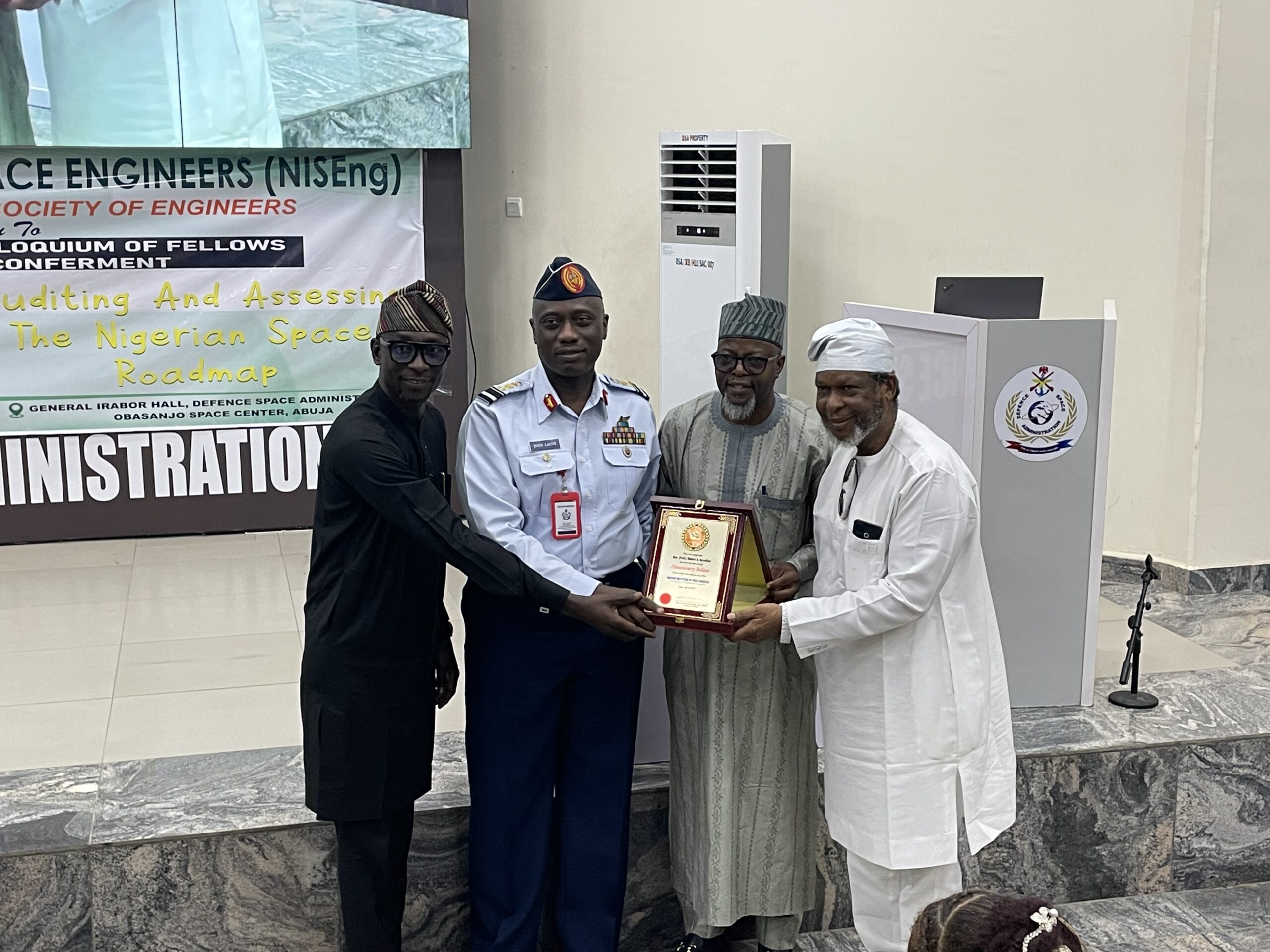
Highlight of the event was conferment of fellowships to Sen. Boroffice and other space engineers as well as recognition of those who had made remarkable impact on the institution and the space ecosystem.(NAN)(www.nannews.ng)
Edited by Funmilayo Adeyemi