

















By Sumaila Ogbaje, News Agency of Nigeria (NAN)
By many accounts, India is strengthening its national security framework by prioritising self-reliant manufacturing, technological advancements, and enhanced joint operations across the armed forces.
This strategic shift aims to build a modern, cohesive defense ecosystem, fostering indigenous innovation and reducing reliance on imports.
Recent briefings by senior officials of the Indian Army, Indian Navy and Indian Air Force during a familiarisation visit for foreign defence journalists highlighted how New Delhi is pursuing self-reliance while maintaining robust international cooperation.
The engagements, organised by the External Publicity Division of the Government of India, provided a rare inside look at how one of the world’s largest militaries is restructuring for emerging multi-domain threats.
The emphasis on self-reliance echoes broader national policy under India’s “Atmanirbhar Bharat” (self-reliant India) initiative, which seeks to strengthen domestic defence manufacturing while positioning the country as an emerging exporter of military hardware.
Opening the Army interaction, Vice Chief of Army Staff, Lt.-Gen. Pushpendra Singh, said the service was undergoing a “significant structural transformation” to remain ahead of evolving threats.
He emphasised that modernisation, indigenisation and integration form the central pillars of the army’s ongoing reforms.
According to him, the force is focused on building a technologically empowered, network-enabled and agile military capable of operating across diverse terrains — from high-altitude mountains and deserts to dense jungles.
Singh noted that India’s complex security environment, marked by rapid technological change and dynamic geopolitical shifts, required continuous adaptation.
“Our challenge is to transform and deter adversaries faster than emerging threats can materialise,” he said.
Senior Army planners, including Deputy Chief of Army Staff (Strategy), Lt.-Gen. Rajiv Ghai, Director General of Military Operations, Lt.-Gen. Manish Luthra, and other principal staff officers, outlined the Army’s restructuring roadmap leading up to 2032.
Top officials said India’s land borders stretched roughly 14,000 kilometres across highly varied terrain and seven neighbouring countries, creating enduring operational demands.
“The western front along the Line of Control remains sensitive, with concerns over infiltration using drones, narcotics and weapons.
“On the northern frontier, the Army continues to manage a long and partially undemarcated boundary with China, requiring sustained high-altitude deployments and long-range patrols,” they said.
In spite of these pressures, the army reports that violence levels in Jammu and Kashmir have reduced significantly from peak levels around 2000, although sporadic high-visibility attacks and drone usage remain concerns.
One of the most notable indicators of India’s indigenisation push is the raising of new technology-focused formations, including a dedicated drone regiment.
Officials identified key capability gaps in combat drones, air defence and precision targeting-areas now receiving priority investment.
According to them, the year 2026 has been designated by the army as the “Year of Networking and Data-Centric Operations,” underscoring the shift toward information-driven warfare.
“Beyond combat roles, the Army continues to maintain strong humanitarian credentials.
“In 2025 alone, army columns responded to 77 disaster locations and assisted about 45,000 people, reinforcing its dual military-civil role,” the officials said.
India’s push for self-reliance is being supported by a rapidly expanding domestic defence industrial base involving public sector companies, private manufacturers and a growing number of technology start-ups.
During earlier engagements with defence industry stakeholders, officials highlighted how Indian firms are increasingly producing advanced platforms ranging from artillery systems and armoured vehicles to naval vessels, drones and missile technologies.
Several defence technology incubators and innovation hubs are also supporting start-ups focused on artificial intelligence, robotics, autonomous systems and cyber security.
Industry experts say the integration of these emerging technologies into military platforms is helping accelerate India’s transition toward network-centric and multi-domain operations.
They say that the government’s procurement reforms and incentives for local production have significantly increased indigenous content in many new defence projects.
Providing the maritime perspective, Rear Adm. Srinivas Maddula, Assistant Chief of Naval Staff, said indigenous capability development forms the “foundation of maritime strength.”
Maddula described the Indian Ocean Region (IOR) as the epicentre of global maritime activity, home to about 2.9 billion people across 25 nations and carrying a substantial share of global trade.
According to him, the maritime environment is becoming increasingly contested, with intensified state competition across surface, subsurface and air domains.
He said the Navy was pursuing a balanced strategy combining credible combat capability with cooperative security frameworks.
One of the strongest indicators of India’s maritime self-reliance is its shipbuilding record.
Maddula disclosed that more than 170 warships had been constructed in Indian shipyards over time, with 51 currently under construction as the service works toward a 175-ship force level.
He said there was a “strong and steady push” toward higher indigenous content in weapons, sensors and platforms.
“Operationally, the navy has maintained sustained deployments in the Red Sea since October 2023, ensuring safe passage for nearly 400 merchant vessels carrying about 16.5 million metric tonnes of cargo bound for India,” he said.
The strategic importance of maritime capability was also underscored during the recent International Fleet Review hosted by India.
In her address to participating navies, President Droupadi Murmu described the Indian Ocean as a vital lifeline for global trade and emphasised the need for stronger maritime cooperation to ensure stability and prosperity.
She noted that India’s naval modernisation reflected both national security priorities and a broader commitment to safeguarding international sea lanes.
According to her, the growing participation of friendly foreign navies in exercises and fleet reviews demonstrates shared responsibility in maintaining a rules-based maritime order.
Murmu added that India’s expanding indigenous shipbuilding capacity and technological innovation were helping strengthen the navy’s ability to operate effectively across the Indo-Pacific region.
In spite of the strong indigenisation drive, the Indian officials repeatedly emphasised that self-reliance does not mean strategic isolation.
According to them, India seeks to position itself as a preferred maritime security partner through initiatives such as MAHASAGAR and SAGAR.
The top naval official disclosed that the Indian Navy was training more than 20,000 personnel from 45 countries and offering over 1,100 training slots in the 2025–26 cycle alone.
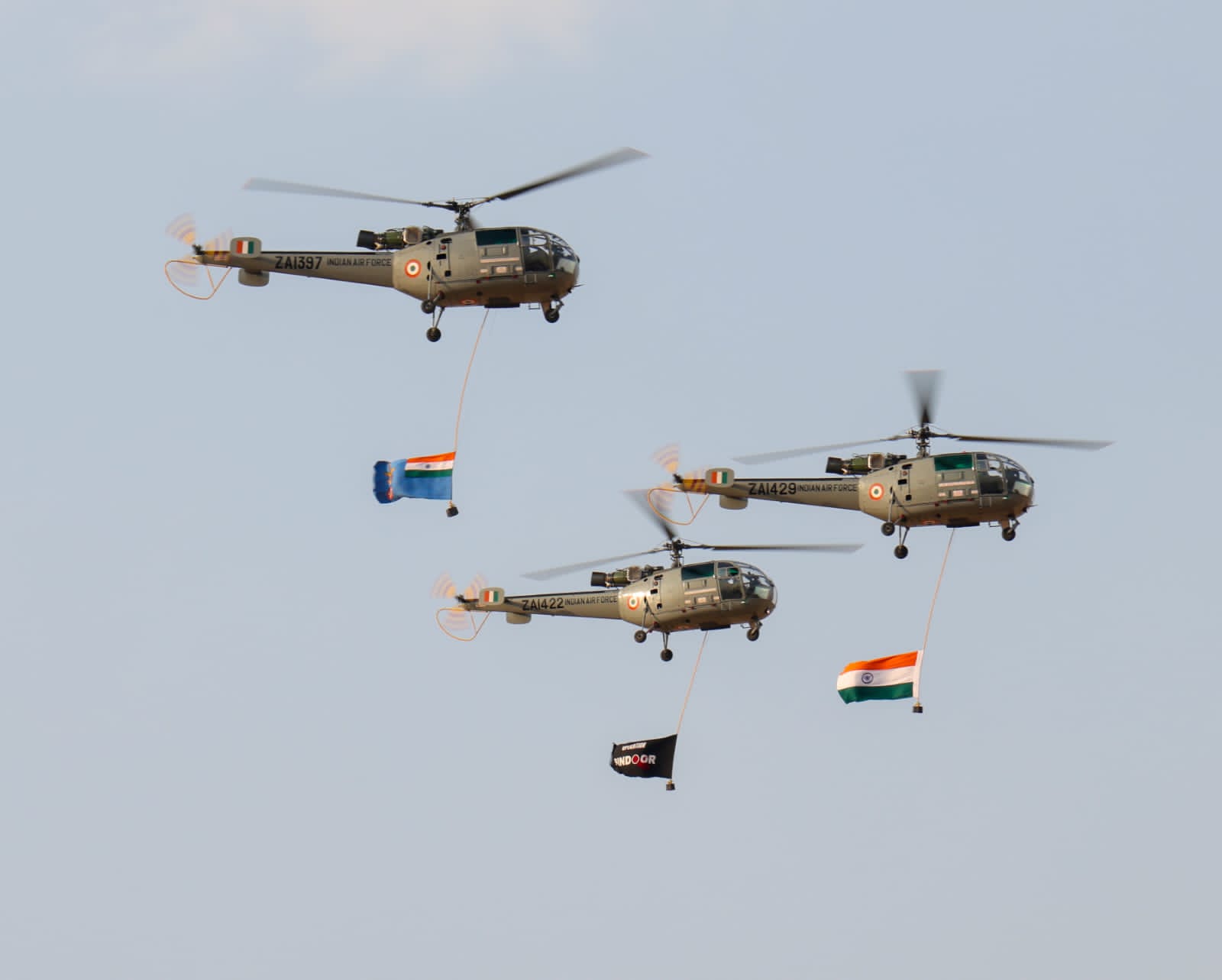
From the air power perspective, Director-General of Operations, Indian Air Force, Air Marshal George Thomas, said India’s self-reliance trajectory mirrors a broader global trend and identified four major drivers shaping current security dynamics.
These, according to him, are: investment-led geopolitical expansion, evolution of defense industrial bases toward exports, energy security concerns, and growing competition over largely untapped ocean resources.”
Thomas stressed that India’s military modernisation was guided by two complementary pillars: threat-based capability development and cooperative mechanisms for trade protection and crisis response.
“With expanding trade and commerce, India has a responsibility to safeguard its maritime and air interests,” Thomas said.
He added that the country maintained a range of operational options — from presence missions to escort operations — while continuously assessing the strategic environment.
Across all three services, a clear pattern is emerging.
India is pursuing self-reliance not as an inward-looking policy but as part of a broader effort to build credible, technology-driven and partnership-ready armed forces.
Defence analysts accompanying the delegation observed that India’s model reflects a calibrated balance between autonomy and cooperation — a path many emerging powers are attempting to navigate.
India’s experience suggests that strengthening national defence architecture increasingly depends on domestic industrial capacity, sustained technological investment and institutional integration across services.
For countries seeking to reduce external dependence while maintaining strategic partnerships, the Indian approach offers a practical template: build at home, collaborate abroad and modernise continuously.
Amid intensifying global security competition and the rapid technological evolution of warfare, military planners worldwide are closely monitoring India’s steady push toward defense self-reliance. (NANFeatures)
***If used, please credit the writer and the News Agency of Nigeria.