


















By Rukayat Moisemhe/ Funmilola Gboteku
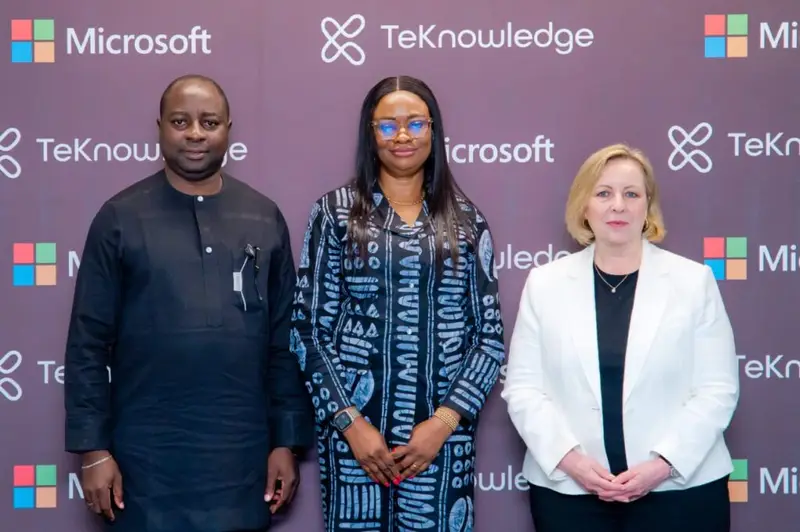
TeKnowledge and Microsoft have expanded their partnership to accelerate Nigeria’s national Artificial Intelligence (AI) skills development to position the country for stronger global competitiveness.
Ms Aileen Allkins, the President of TeKnowledge, said at a news conference this on Thursday in Lagos.
Allkins at the conference detailed the company’s expanded role as a delivery partner for Phase 2 of Microsoft’s AI National Skilling Initiative in Nigeria.
She said AI capability had become a defining measure of national economic competitiveness, with the gap widening between countries that invest early and those that delay.
Allkins noted that AI was projected to contribute trillions of dollars to the global economy over the next decade.
“For Nigeria, with a population exceeding 200 million and one of the youngest workforces globally, AI capability development represents a strategic economic lever.
“Expanding practical AI skills at scale strengthens employability, drives innovation and accelerates digital prosperity across sectors,” she said.
She noted that half of TeKnowledge’s global technical workforce of over 4,000 experts were based in Lagos, underscoring Nigeria’s strategic importance to the company’s global operations.
According to her, countries leading in AI are those investing in inclusive skills development across all levels, from students to public sector workers and corporate leaders.
“Nigeria, given its youthful and fast-growing workforce, can be central to Africa’s AI story. But national ambition must be matched with structured execution.
“This programme is about measurable outcomes, not just announcing intent,” she said.
Allkins reaffirmed TeKnowledge’s long-term commitment to Nigeria, describing the country as being at an inflection point where decisions on AI adoption and workforce readiness will shape economic competitiveness for decades.
Mr Olugbolahan Olusanya, Territory Director for Africa, TeKnowledge, said the expanded partnership builds on groundwork laid in 2025, when the company helped design and deliver one of Nigeria’s most extensive AI capability-building programmes.
He said Phase 2 included a fresh commitment to train at least 10,000 Nigerians under the Microsoft AI National Skilling Initiative.
Olusanya described the development as part of a broader effort to strengthen national workforce readiness and support inclusive AI adoption.
He noted that TeKnowledge has trained over 100,000 professionals globally in AI, cloud computing and cybersecurity, and has partnered with governments to establish national digital academies.
In Nigeria, he said the company supported programmes such as the 3 Million Technical Talent (3MTT) initiative, sponsored by Microsoft, contributing to the training of thousands of participants with measurable productivity outcomes.
He stressed that with Nigeria’s population of over 200 million and a median age of 18, AI capability was a strategic economic imperative.
“Globally, about 80 per cent of AI investments fail due to poor adoption strategies, not poor technology. For us, adoption is key.
“We embed change management models to ensure organisations not only learn AI, but apply, sustain and scale it.
“The question is not whether AI will reshape Nigeria’s industries; it is already happening in financial services and telecommunications. The question is whether our workforce will lead the transformation or simply respond to it,” he said.
Ms Olatomiwa Williams, Chief Growth and AI Officer for Microsoft Middle East and Africa, said the initiative aligned with Microsoft’s mission to empower every person and organisation to achieve more, particularly in the AI era.
She said Phase 1 of the programme was delivered nationwide, reaching over 50,000 Nigerians with foundational and intermediate AI skills through Microsoft-accredited learning pathways.
“More than 3,000 participants completed advanced training and earned Microsoft AI certifications across multiple tracks under our direct delivery,” she said.
Williams added that the programme featured AI hackathons where developers built identity solutions using Microsoft technologies, with use cases in document verification, risk assessment and fraud detection in the financial sector.
She said career fairs were also organised to connect trained participants with employers, with some securing immediate employment.
According to her, Phase 2 will focus on structured, employment-linked skilling, targeting undergraduates, National Youth Service Corps (NYSC) members, women, underrepresented communities, developers, 3MTT fellows, as well as business and executive leaders.
A key addition, she said, was the in-person AI training for NYSC members to embed AI literacy at an early stage in their careers.
“The NYSC engages hundreds of thousands of graduates annually. Reaching them physically ensures AI literacy is embedded in their career trajectory while it is still being shaped,” she said.
Williams said the second phase would also include in-person engagements across three Nigerian universities, gender-focused inclusion strategies, a national career fair, Copilot and AI fluency tracks, as well as cybersecurity awareness initiatives.
“Nigeria stands at a defining moment in its digital journey. AI is no longer a future concept; it is a present opportunity.
“This next phase is about scale, depth and measurable impact.
“Microsoft’s AI Skilling Initiative plays a critical role in enabling Nigeria’s national digital skilling efforts. By deepening AI skills and diffusing AI adoption throughout the economy, Nigeria and the African continent stand to benefit,” she said. (NAN) (www.nannews.ng)
Edited by Chinyere Joel-Nwokeoma