









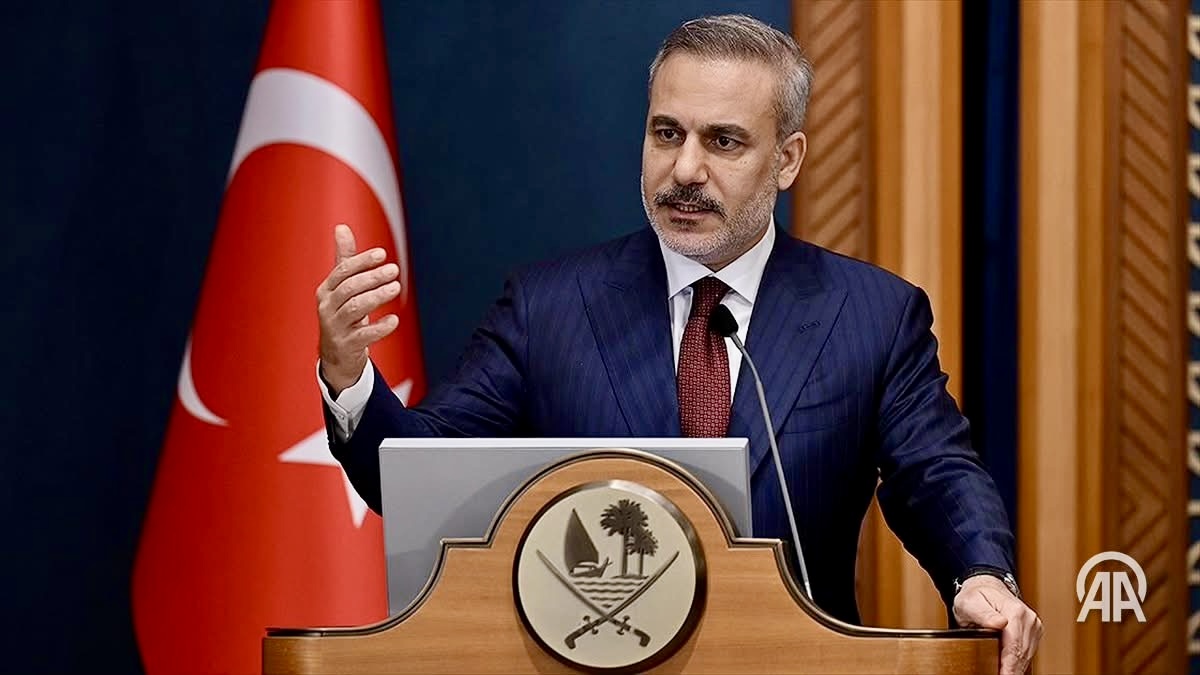










Turkish Foreign Minister Hakan Fidan says Gulf countries may have to take action if the current situation in the Middle East conflict persists, stressing the increased risk level.
The minister, who said this on Saturday while fielding questions from journalists, said that the Gulf leaders mulled the action during a meeting in Saudi Arabia’s capital, Riyadh.
Fidan also answered some questions regarding his regional tour of Saudi Arabia, Qatar, and the United Arab Emirates (UAE).
He said that Gulf countries evaluated that the war would continue for another two or three weeks in duration, and stressed the importance of the U.S. in resolving the conflict.
The minister added that the Gulf countries said they had declared from the outset that they would not allow their airspace or the bases on their territory to be used against Iran and that they would not be part of the war.
He said that the countries also said Iran had deliberately carried out attacks not only on military bases but also on civilian infrastructure and economic targets.
“Israel will try to influence the U.S. and will seek to prevent a ceasefire or the achievement of peace in the near term.
“There has been a growing assessment that the U.S. and Israel’s initial positions are drifting apart.
“This, in turn, could lead to a longer war,” he told reporters in the Turkish capital of Ankara.
Fidan said that negotiations while the war was ongoing did not appear very likely.
He added, however, that one possibility to consider was that, following a short-term ceasefire, “the parties could begin negotiations during that period while also keeping open the option of resuming the war if the talks failed.”
“Israel may adopt a policy of prolonging the war as much as possible in order to inflict greater damage on Iran,” Fidan further said.
Noting that Tel Aviv initiated the war, Fidan said the issue was not the absence of plans to end the war, but rather Israel’s lack of willingness to pursue peace.
“After the war, many changes may happen in Gulf countries,” said Fidan, adding that the countries may begin seeking new options in the field of defense.
“After the war ends, Gulf countries may clearly set out their expectations of Iran, and if certain conditions are met, the focus could shift to economic cooperation.
“Iran, too, may come forward with certain demands regarding U.S. bases in the Gulf,” he said.
“We see that confidence in Türkiye has increased after this war. From the very beginning, we did not adopt an ambiguous stance.
“Everyone sees that we have clearly told all sides what was wrong.
“We have raised, in the strongest and clearest terms, that what was done to Iran and what was done to the Gulf countries were both wrong,” he stated.
Stressing that they did not in any way want the situation to “turn into a prolonged war that would draw in the entire region,” Fidan said Ankara would continue to make use of all diplomatic channels.
“Particularly, regional initiatives, such as the meeting held in Riyadh yesterday, in order to bring the war to an end as soon as possible,” he said.
Regarding the meeting in Riyadh on March 19, under Saudi Arabia’s hosting, Fidan said the Gulf countries organised the meeting with a single agenda item.
“The meeting was held to gather the regional countries’ assessments regarding the attacks carried out by Iran against these countries.
“All regional countries, directly or indirectly affected by the war, were around the table.
“It was intended as an effort to seek common ground,” he said.
Fidan said that everyone at the meeting underscored the urgency of the situation, adding that the meeting had a single-item agenda and that the joint statement reflected this as well.
“We are maintaining our principled stance. We oppose both Israel’s aggression and expansionism and Iran’s actions aimed at spreading the war across the region.
“Although the Riyadh meeting was organised solely around the Iran agenda, we emphasised Israel’s role in the emergence of this war.
“Moreover, we ensured that the joint statement referred to the threat posed by Israel’s expansionism in the region,” he said.
“They voiced these criticisms at the highest level on every platform and took steps accordingly,” Fidan said, stressing that Türkiye has been the country criticising Israel most strongly from the very beginning.
On the issue of mediation, Fidan said: “The proposals we are putting forward from where we stand are in fact part of a search for stability, something that is in everyone’s interest.
“But when the parties prioritise gain, victory, or domination over stability, the matter moves to a different point.
“In that case, talks are held merely for the sake of talking.
“They are conducted in order to advance the main agenda in a different way. We are receiving indications to that effect,” he said.
Highlighting President Recep Erdogan’s stance on relations with the EU, Fidan said that “we also expect the emergence of political will in Europe to carry out the membership process with us,” drawing attention to the fact that Türkiye’s objective has not changed.
Fidan said maintaining good relations with the EU remained very important in every respect in any case, adding that the modernisation of the Customs Union and visa liberalisation were important issues and that talks on these matters were continuing.
“We are maintaining a certain degree of stability in relations. They are not deteriorating, and they could improve further,” he added.
The minister noted that the EU requires Türkiye in an array of areas, including combating illegal migration and terrorism.
“They are also constantly knocking on our door on issues such as the evacuation of their citizens from Iran, the Middle East, and elsewhere.
“We are providing the necessary support in these matters as well. Our military capabilities are already clear.
“Work by the relevant institutions is continuing on the remaining six criteria concerning visa liberalisation,” he added.(NAN/AA)(www.nannews.ng)
Edited by Mark Longyen