


By Emmanuel Oloniruha
Independent National Electoral Commission (INEC) has stressed the need for its public affairs officers (PAOs) to sharpen their skills in information management and responsible use of technology to combat AI-generated misinformation on the 2027 general elections.
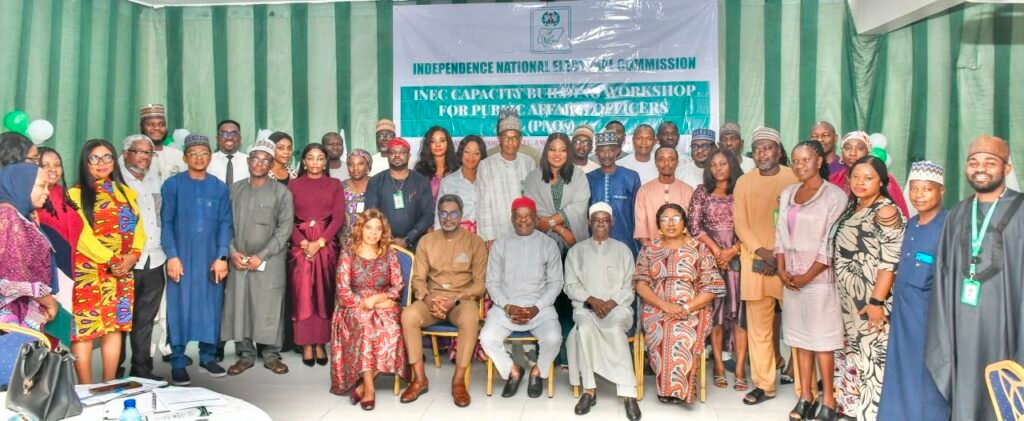
The commission made the call on Monday in Abuja during a capacity building Workshop for the PAOs, with the theme: “Strengthening PAOs’ Capacity for Credible, Verified and Responsible Election Communication Towards 2027.”
The News Agency of Nigeria (NAN) reports that the workshop was organised by the INEC Voter Education and Publicity Department.
Mohammed Haruna, National Commissioner and Chairman of the Information and Voter Education Committee (IVEC), while declaring the workshop, open said that skills in communication management and verification were key to the success of 2027 elections.
Haruna quoted the INEC Chairman, Prof. Josh Amupitan, as noting recently that election credibility today no longer depends only on ballot papers, Bimodal Voter Verification System (BVAS) machines and result sheets, on the information environment in which voters form their judgments.
“As the chairman has noted, generative AI has made it cheaper and considerably harder to detect manipulated audio, video and images.
“Its misuse extends beyond fabricated contents to highly targetted messaging that can feed conflicting narratives to different groups of voters. This is no longer a distant, theoretical risk to this commission.
“We are preparing for the 2027 general elections, a period during which the volume, speed and, at times, the inaccuracy of information about the commission and the electoral process will increase considerably.
“The skills you build here in verification, in escalation and in clear, consistent messaging will be tested in real time,’’ he said.
Haruna described PAOs as the frontline communicators of INEC in the states, stating that the workshop aimed to build the officers’ capacity, sharpen their skills and prepare them to meet the demands ahead with confidence.
“Public affairs work within an electoral management body carries particular demands,” he said.
These, according to him, include: the need for accuracy, the need for speed and the need for sound judgment under pressure, all within an environment increasingly shaped by social media and, more recently, by AI.
Haruna noted that the workshop covered core areas of their responsibilities, including managing the information ecosystem as well as how to identify, verify and respond to misinformation and disinformation.
“You will also be introduced to the responsible use of artificial intelligence in your work, an area that holds real promise for improving how we communicate, but one that must be approached with care, verification and appropriate safeguards,’’ he said.
In her remarks, INEC’s Director of Voter Education and Publicity, Mrs Victorial Eta-Messi, said that the workshop came at a defining moment for the PAOs, as INEC prepares for 2027 elections.
Eta-Messi noted that PAOs serve as the primary bridge between INEC, the media and the general public in their respective states.
“It is through you that Nigerians form much of their impression of who we are, what we stand for and how reliable our information is.
“That responsibility calls for skill, consistency and, above all, credibility,’’ she said.
Eta-Messi urged the participant to take advantage of the workshop, which she described as the beginning of sustained engagement to equip them for the responsibilities ahead.
“INEC operates under constant public scrutiny and is regularly confronted with attempts to misrepresent its work and undermine public confidence in it, and it is essential that our communication personnel are continually equipped to meet that reality,’’ she said.
The commission’s Deputy Director, Information and Publicity, Mr Wilfred Ifogah, while presenting the overview of the workshop, said that the workshop, among other things, aimed to build participants’ competence in preparing for and supporting effective media and public engagements.
Ifogah said it was also targetted at strengthening participants’ ability to write clearly and consistently for different audiences and platforms.
“It is also to develop participants’ capacity to manage the information ecosystem, including monitoring media and social media, identifying misinformation and disinformation, verifying information and applying agreed escalation and response procedures;
“It is also to introduce participants to the responsible use of artificial intelligence in communication work, including its practical applications, its limitations and the safeguards required around confidentiality and verification,’’ he said.(NAN)
Edited by ‘Wale Sadeeq
Comments