


By Priscilla Osaje
The Policy and Legal Advocacy Centre (PLAC) has urged Nigerians to make their votes count in the 2027 general elections by making informed choices, rejecting vote-buying and holding elected leaders accountable.
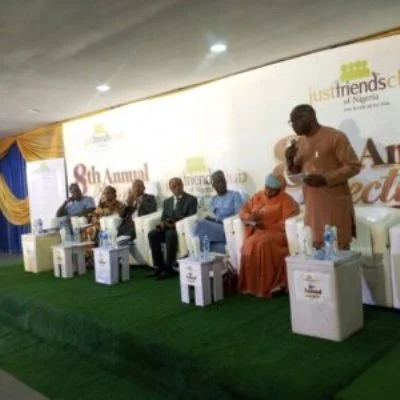
Mr Clement Nwankwo, Executive Director of PLAC and guest speaker, made the call at the eighth annual lecture of the Just Friends Club of Nigeria (JFCN) on Tuesday in Abuja.
The News Agency of Nigeria (NAN) reports that the event was organised by JFCN, a socio-cultural and philanthropic organisation established on the principles of friendship, unity, companionship and service to humanity.
Nwankwo, who is also the founder of the Civil Liberties Organisation (CLO), presented a paper titled, “From Concern to Action: Making Our Votes Count in the 2027 General Elections.”
He said Nigerians should transform their concerns about the economy, insecurity, unemployment, corruption and poor public services into informed and responsible democratic participation.
The PLAC executive director urged citizens not to allow dissatisfaction with the country’s challenges to discourage them from participating actively in the electoral process.
According to him, Nigerians must move beyond complaints and take practical steps towards shaping the country’s democratic future.
“As Nigeria approaches the 2027 general elections at an important moment, for many Nigerians, the dominant feeling is not necessarily optimism or pessimism, but concern about the country’s direction,” he said.
He identified the economy, insecurity, the cost of living, employment opportunities, corruption, public institutions, infrastructure and the quality of public services as major issues influencing citizens’ concerns.
Nwankwo said many Nigerians continued to experience economic pressure through high food and transportation costs, declining household purchasing power, unemployment and underemployment.
According to him, these challenges require citizens to carefully assess the policies, records and promises of political parties and candidates before deciding whom to support at the polls.
On security, he said Nigerians could not prosper without adequate protection of lives and property, citing terrorism, insurgency, banditry, kidnapping and communal conflicts among the country’s persistent challenges.
He also identified farmer-herder conflicts, attacks on communities and economic disruptions caused by insecurity as issues that should influence citizens’ assessment of political leadership.
According to him, the inability of citizens to go about their daily activities safely undermines economic growth, social stability and public confidence in government.
Nwankwo added that infrastructure remained a critical measure of government performance because citizens experienced governance through roads, electricity, water supply, public hospitals, schools and public transportation.
He said infrastructure should not be regarded merely as a development indicator but as a fundamental component of the social contract between the government and the people.
The PLAC boss noted that Nigeria continued to face significant infrastructure deficits, particularly in the electricity sector, alongside other challenges affecting the delivery of essential public services.
He argued that citizens had the right to demand explanations from public officials concerning government revenue, expenditure and the utilisation of public resources.
“A country that cannot provide quality infrastructure, education, healthcare, security and other public services without adequate public revenue must allow citizens to ask how public money is being spent,” he said.
Nwankwo described corruption as a major obstacle to national development, noting that funds lost through corrupt practices could otherwise support roads, schools, hospitals, security, electricity and employment-generating investments.
“Every naira lost through corruption is potentially a naira unavailable for roads, schools, hospitals, security, electricity, social protection and employment-generating investment,” he said.
He maintained that democratic governance should extend beyond periodic elections to include transparency, accountability and the continuous assessment of elected officials.
“Democracy cannot be reduced to elections, because elections choose governments and accountability determines how governments govern,” he said.
Nwankwo urged Nigerians to approach the 2027 elections differently by recognising that their responsibilities extended beyond voting to active citizenship and the protection of democratic values.
He called on citizens to protect the integrity of the electoral process by rejecting vote-buying, making informed choices and ensuring that their participation contributed to credible elections.
The PLAC executive director also warned against the tendency of citizens to withdraw from public affairs after casting their ballots, stressing that democratic participation must continue after election day.
“Perhaps one of the greatest weaknesses of democratic participation is that citizens often become active during elections and passive afterwards. We vote, then we disappear,” he said.
He urged Nigerians to monitor elected representatives, demand accountability and remain engaged in governance to ensure that campaign promises translated into tangible improvements in their lives.
“We have every right to be concerned about Nigeria, but concern alone will not change Nigeria, just as anger or complaints will not. Withdrawing from the democratic process will not change Nigeria,” Nwankwo said.
He added that the real challenge was to transform public concern into informed citizenship and sustained democratic action capable of influencing national development.
According to him, the 2027 elections should not merely be about choosing political parties or personalities but should provide an opportunity for citizens to determine the kind of country they want and the leadership required to achieve it.
“We should enter the 2027 elections neither with blind optimism nor with hopeless cynicism.
We should enter them with clear eyes, recognise the progress that has been made, acknowledge the pain that remains and scrutinise those seeking our votes,” he said.
Nwankwo reminded Nigerians that democracy placed responsibilities on both governments and citizens, stressing that the value of their votes should be reflected in their everyday commitment to accountability and national progress.
“Since our votes matter, our citizenship must matter every day by ultimately making our votes count,” he said.
Earlier, Mr Amaechi Aloke, President of JFCN, said the theme of the lecture, “From Concern to Action: Making Our Votes Count in the 2027 General Elections,” was deliberately selected to encourage reflection on issues affecting the country’s future.
Aloke observed that Nigerians had consistently expressed concerns about the nation’s direction through discussions in their homes, workplaces and communities, as well as through newspapers, television, social media and public advertisements.
He listed poor governance, insecurity, unemployment, infrastructure deficits, corruption, the rising cost of living and inadequate public services among the issues frequently raised by citizens.
“But there are important questions we must ask ourselves: what can we do with our concerns? Obviously, concern by itself does not change a country,” he said.
The JFCN president explained that the organisation also demonstrated its commitment to humanity through support for less privileged members of society, public lectures and career mentorship programmes for secondary school students in Abuja.
He expressed appreciation to the guest speaker, chairman, moderator and panellists, expressing confidence that the gathering would equip participants with knowledge to contribute more effectively to the electoral process.
Aloke said he expected participants to leave the event with a better understanding of their responsibilities as citizens during the 2027 general elections and beyond.
Also speaking, Mr Hussaini Abdu, Country Director of CARE Nigeria, said Nigeria’s middle class had lost some of its vibrancy because of excessive complaints, self-centred attitudes and the tendency of individuals to seek personal solutions to collective challenges.
Abdu observed that many members of the middle class appeared more interested in finding individual alternatives to national problems than in organising collective action to address the challenges confronting society.
“When you have such a middle class, what you get is what we are dealing with in this country today,” he said.
He described the middle class as a potentially transformative force, noting that it had historically played a significant role in driving social change and promoting reforms in different societies.
According to him, the challenge facing Nigeria was the weakening of collective action among members of the middle class, making it difficult for them to mobilise effectively around issues of public interest.
Abdu stressed that stronger civic engagement, collective responsibility and sustained public participation were necessary to promote accountability, improve governance and strengthen Nigeria’s democratic development.(NAN)
Edited by Deji Abdulwahab


Comments