







By Justina Auta
The United Nations Educational, Scientific and Cultural Organisation (UNESCO) has advocated an improved access to education and health services for the wellbeing of the girl-child and vulnerable groups.
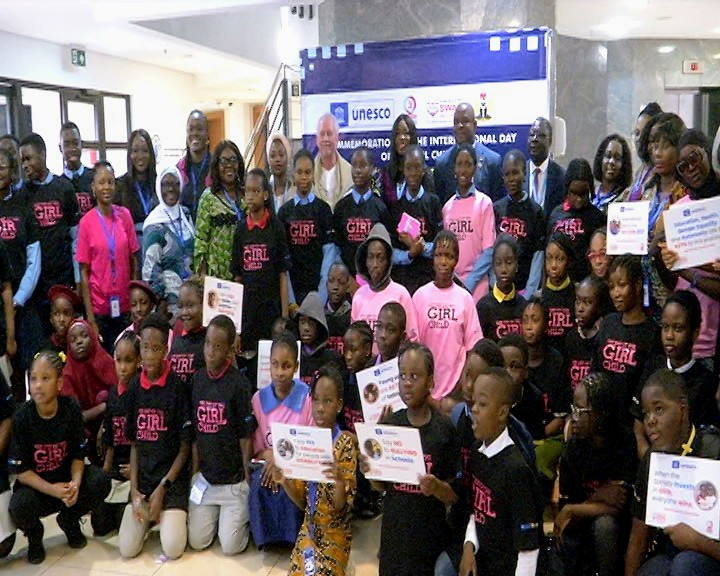
Mr Phillipe Delanghe, Officer in Charge in the Abuja Regional Head of Office UNESCO, made the call in Abuja during the 2023 International Day of the Girl-Child celebration.
The News Agency of Nigeria (NAN) reports that the theme of this year’s celebration is “Invest in girls’ rights: Our leadership, our well-being”.
Delanghe noted that the COVID-19 pandemic had reversed gains made in the education of girls, increased inequalities, deepened the national learning crisis and exposed them to exploitation and abuse.
He explained that girls in Nigeria had fewer educational opportunities, faced health risks due to early and frequent childbearing, HIV, early and unintended pregnancies, Gender-Based Violence (GBV) and harmful traditional practices.
He said despite the policies to improve access to health and education, a high estimate of 6 to 11-year-olds was out of school.
According to him, the estimate amounts to about 10.2 million children, with a larger proportion being girls.
“This situation does not just call for renewed commitment but a deepened level of engagement, with a critical mass of stakeholders, to the education, health and wellbeing of school-aged children.
This is “particularly to girls and other vulnerable children, through effective reproductive health education”.
He emphasised the role of men in empowering girls and achieving the Sustainable Development Goals (SDGs).
“It continues to be evident that, in improving the education, health and wellbeing of adolescent and young girls, the formative years to maturing into womanhood, strengthening the response to male involvement is key and imperative.
“Today, we are opening that conversation with role model men that continue to stand with and for girls while inspiring others to invest in girls’ agency, leadership and potential.”
He explained that UNESCO’s “Our Rights, Our Lives, Our Future (03 programme)”, provided support to ensure that policies developed and implemented had an impact on the wellbeing of children.
“It also deploys a user-centered approach, delivering cutting-edge impactful information and education to students, teachers, school management, religious leaders and other stakeholders with intent to ensure the agency of the adolescent and young person.
“The programmes also cater by ensuring safe spaces within and outside the schools, thereby reducing school-related GBV.”
Delanghe said that the 03 programme was currently in the second phase and covering 13 states in Nigeria with a plan to scale it up to an additional seven States by the end of 2027.
Dr Levin Damisah, father of four girls, reiterated his commitment to advocacies on providing opportunities and policies for the girl-child to harness her potentials and thrive.
“When you educate a girl child, you have solved a lot of societal problems.
Society is in crisis because, today, the girl-child is largely neglected; she is not supported and is at a disadvantage in education.
“So, we are here to change that narrative, to present an alternative narrative that the girl-child is unique,” Damisah said.
Also, Ene Okpe, a girl-child and student stressed the need to end all stereotypes and encourage girl-child to adopt Science, Technology, Engineering and Mathematics (STEM) related courses.
“There are lots of girls who don’t know their potential and what they can do in society.
“Girls are coming here to know about their rights, potentials and know that not all STEM courses are for boys.
“(Girls need to) understand that we should not limit our potential,” Okpe said.
The News Agency of Nigeria (NAN) reports that the event featured panel discussions by students and other critical stakeholders on the need to improve access to education for the girl-child to enable her to explore her potential. (NAN)
Edited by Idris Abdulrahman