










By Adenike Ayodele
The International Federation of Women Lawyers (FIDA) Nigeria has called for continuous review and strengthening of gender-responsive legislation to effectively prevent Gender-Based Violence (GBV) in the country.
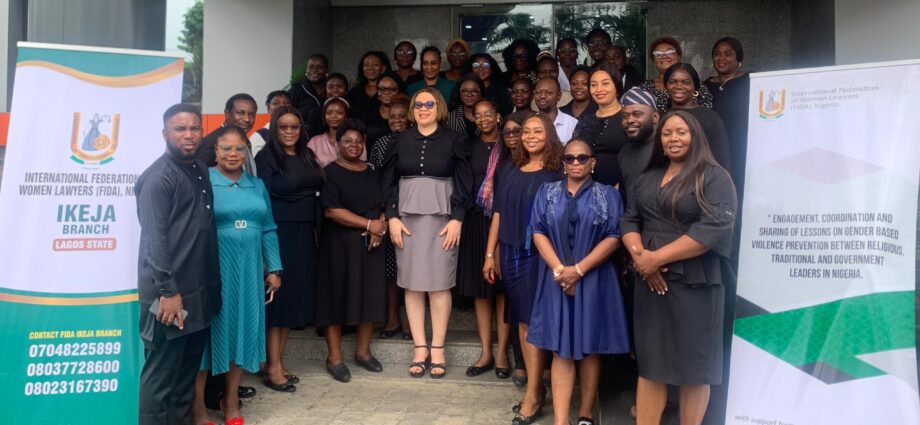
The Country Vice President of FIDA Nigeria, Mrs Eliana Martins, made the call on Monday at the second Annual Multi-Stakeholders Dialogue on the Review and Implementation of Gender-Responsive Legislations Preventing GBV.
Martins said the dialogue, organised with state actors from the Lagos State Ministry of Justice and its agencies, was aimed at exploring the ministry’s mandate on law reforms toward preventing gender-based violence in the state.
According to her, the dialogue is supported by the Ford Foundation and implemented by the FIDA Ikeja Branch.
She explained that the dialogue, themed “Promoting a Safer Environment for Women and Girls Using the Instrumentality of Gender-Responsive Legislation and Policies,” was deliberately targeted at legal reforms.
Martins said effective GBV prevention required not only enforcement of existing laws but also continuous review, harmonisation and strengthening of legal frameworks to reflect lived realities, survivor-centred approaches and prevention-oriented justice.
She recalled that in 2025, FIDA Nigeria convened its first annual multi-stakeholders dialogue in Lagos to assess the implementation status of gender-sensitive legislation and frameworks.
She explained that the forum examined the impact of social norms, cultural practices and religious beliefs on the enforcement of such laws at the state level.
“The dialogue provided a platform for state actors to interrogate implementation gaps, institutional constraints and contextual barriers affecting the effectiveness of GBV-related laws and policies,” she said.
Martins noted that while implementation of state legislation remained critical, the effectiveness of GBV prevention efforts was largely shaped by the quality, relevance and coherence of legal frameworks.
She observed that laws addressing GBV, sexual violence, harmful practices and women’s protection often contained gaps or ambiguities that weakened enforcement.
According to her, some of the laws do not sufficiently address prevention, survivor protection or institutional coordination, while others are not fully harmonised with national legislation or international human rights standards.
She said the dialogue was designed to examine ongoing state law review processes, integrate lessons from earlier implementation assessments and promote survivor-centred and gender-responsive legal reforms.
Martins expressed appreciation to the Ford Foundation for supporting the programme and wished participants fruitful deliberations.
One of the facilitators at the dialogue, Dr Ihuoma Ilobinso, identified gaps in legislation, weak enforcement and cultural biases as major challenges in tackling GBV in Nigeria.
Ilobinso, a lecturer in Commercial and Industrial Law at the University of Lagos, stressed the need to strengthen laws and institutions to better protect women and girls.
She said, “Although Nigeria has laws addressing gender-based violence, significant gaps still exist, and many of the laws are poorly enforced.
“It is not enough to have the law; we must also be able to enforce it effectively.”
Ilobinso stated that inadequate funding and lack of institutional support often made it difficult for relevant agencies to enforce the laws and address cases of violence.
She added that cultural norms and stereotypes placing women in subordinate positions continued to fuel GBV and hinder effective implementation of protective laws.
She called for stronger collaboration between government institutions and civil society organisations to tackle the problem.
Ilobinso added that sustained dialogue, institutional reforms and improved support systems would help create a safer environment for women and girls.
The legal scholar expressed optimism that continued discussions would shift focus from prosecuting offenders to prioritising prevention of gender-based violence.
A Senior Programme Manager at FIDA Nigeria, Mr Fikih Obaro, called for stronger policies and collaborative action to address GBV and protect citizens’ rights.
Obaro said there was a need to strengthen existing frameworks and introduce new measures to prevent GBV.
He observed that in spite of Lagos State’s progressive legislation and policies to protect citizens, social and cultural factors still fuel the persistence of GBV.
He said: “There is a need for policies and decisions that are gender-friendly, gender-responsive and gender-centric to effectively drive advocacy and prevent such violations.
“There is also a need for collective efforts involving communities, government institutions and other stakeholders to tackle the problem.
“Citizens’ education plays a critical role in addressing gender-based violations because people need to know their rights, understand reporting protocols and be aware of available remedies.”
Obaro expressed optimism that with continued dialogue, policy reforms and executive support, effective frameworks could be established to curb GBV and strengthen citizens’ protection.
The Vice-Chairperson of FIDA Ikeja, Mrs Clara Mbachu, called for a review of outdated laws to effectively address GBV and cyberbullying.
Mbachu said many existing laws were enacted decades ago and didn’t reflect current realities, stressing the need for reform to align with present developments.
She noted that although agencies responsible for enforcing laws on violence against women were active, cultural and societal pressures often discouraged victims from pursuing cases.
She explained that many complainants withdrew cases due to family or religious pressure, making prosecution difficult.
Mbachu added that improved technology and stronger enforcement were needed to track and punish cyberbullying perpetrators. (NAN)(www.nannews.ng)
Edited by Chinyere Omeire