


Gender-based violence: Finding succour from survivors in Kaduna communities
By Aisha Gambo, News Agency of Nigeria (NAN)
In 2018, when violence engulfed Kasuwan Magani, a community in Kajuru Local Government Area of Kaduna state, Marwanatu Abubakar, lost everything. Her home was burnt, husband was killed and belongings destroyed. She fled with her six children and resettled in a rented house in another part of the community, Unguwan Waziri, which was safer.
“I was so depressed and felt isolated. I stopped interacting with people because I lost everything except my children,” she said.
Her story changed when a Non Governmental Organisation, Empowering Women for Excellent Initiative (EWEI) invited widows and other survivors of the conflict to a meeting.
There, she discovered something unexpected; a structured training on Sexual and Gender-Based Violence (SGBV), mediation techniques, psychosocial support, and referral pathways.
“They showed us how to handle women who have been abused, they taught us how to respond to cases of rape and how to bring peace if there is violence,” she said.
Today, she is known by many residents of Kasuwan Magani as the community focal person for handling such cases.
A Local System close to people
Researchers consistently find that conflict increases gender-based violence due to breakdown of law enforcement, mass displacement and economic hardship.
Bandit attacks in rural communities have exposed women to further violence, including attacks on farms and forced displacement.
The Nigerian Demographic and Health Survey (NDHS) 2018 found that 9 per cent of women aged 15 to 49 had suffered sexual assault at least once in their lifetime and 31 per cent had experienced physical violence.
In many rural communities in northern Nigeria, survivors of domestic and sexual violence face barriers to justice due to lack of awareness, economic dependence, and stigma among others.
Though there are four Sexual Assault Referral Centers (SARC) in Kaduna state, the centers are usually located in cities making it hard for rural communities to access.
Through the ”Together We Can” project, the NGO provided counselling and mental health and psychosocial support (MHPSS) alongside economic empowerment initiatives for 30 survivors of violence in Kasuwan Magani.
Beyond economic empowerment, the project also trained them on how to identify, prevent and respond to Gender Based Violence after which offices were established in the community to serve as safe spaces for women and girls to report GBV cases.
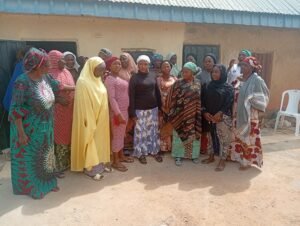
The women-led cooperative meets every Thursday to discuss issues in the community as well as attend to cases brought forward confidentially.
The group handles a range of cases which included physical assault, rape, denial of food and confiscation of women’s business capital by spouse.
The group’s strength lies partly in visibility, they conduct awareness sessions at naming ceremonies and weddings and educate community members about rights and consequences.
Their approach combines mediation with the threat of escalation. If a case is serious or unresolved, it is referred to the NGO office in Kaduna or to law enforcement authorities.
If domestic violence is reported, the perpetrator is summoned and warned of consequences.
Abubakar said that they were formally introduced to the Divisional Police Officer (DPO), the village head, and community members to establish legitimacy.
“They gathered people and told them what we were trained to do. Now if anyone has a problem, they come to us,” Abubakar explained
What happens to rape cases?
Before the training, few residents understood the importance of preserving evidence in rape cases. Survivors were often bathed immediately or handled in ways that could compromise medical or legal follow-up.
Now, members of the group say they follow a strict protocol and sensitise other women on such.
“If rape happens, we do not touch the survivor. We take her directly to health workers,” Abubakar said.
Uche Brown, Communications Manager, EWEI and Primary Focal Person Together We Can (TWC) project, said the project also trained 30 community health workers to act as first responders when cases of sexual and gender-based violence (SGBV) occur.
The training focused on referral pathways, ensuring survivors were connected to appropriate services such as healthcare, counselling and legal support.
Community leaders, religious leaders and health workers were included in the referral network to strengthen local responses to GBV.
In addition, judges, lawyers and clerks from customary courts in the communities received training on how to properly handle cases of violence against women and girls.
The Communications manager said this was necessary because customary courts are often the closest justice institutions available to residents in remote areas.
A health worker, Mr Emmanuel Amos, said that awareness activities under the project has improved the reporting and response to cases of sexual and gender-based violence (SGBV) in the area.
Amos said the community previously struggled with cases of rape, domestic violence and children being kept out of school but lacked knowledge on where to report such incidents.
He explained that through the project’s sensitisation and training, community members were educated on how to report cases and were provided with emergency contact numbers for confidential reporting.
According to him, the intervention has made it easier for residents to report incidents without fear of being identified.
“Before now, when rape or domestic violence occurs, many people hid the cases because they didn’t know where to report them or feared backlash,” he said.
Parents reporting SGBV cases to the group
Aisha Kailu, a resident of Kasuwan Magani, was doing some chores at home when a neighbor came in to notify her that her 10 year-old daughter was seen with an older man at the outskirts of town.
The man was not a stranger, he lives across Kailu’s street. Apparently, he had been buying gifts for her daughter, gaining trust from the girl before carrying out his evil intent.
Eyewitnesses told her that the man, who is married with children, was seen touching her daughter inappropriately. They further advised her to take action to prevent further harm to her daughter.
“The man is an old man with wives, children, and grandchildren. He initially tried to give her money, and people warned me not to let her be with him, he even bought clothes for her, but I told her not to wear them,” Kailu said.
Heeding to the advice of one of her neighbours, Kailu reported the matter to the women cooperative office. She was directed by the office to inform her village head of the development.
Together with Abubakar, the Focal person of the group, the disturbed mother visited the village head’s palace where the perpetrator was also summoned. He was warned by the village head not to communicate or involve with the girl again or face legal consequences.
“Since then, I have neither seen nor heard of him being around my daughter. My daughter was also cautioned and counselled not to allow men to entice her with money or touch her inappropriately,” Kaila said.
Gaps and sustainability
In spite of efforts made by the cooperative to solve SGBV cases with support from traditional institutions and the police, some cases have been left unresolved.
Abubakar noted that five cases were reported to the office since its establishment in March 2025, adding that only three were treated with the remaining two unresolved.
She gave an example of a rape case where a mother reported that a 20-year-old man had penetrated her three-year-old daughter. The daughter was examined and treated.
However, the perpetrator could not be arrested as he fled from the community .
“His parents paid the medical expenses of the girl and promised to hand him over to the police when found,” she said.
Due to the voluntary nature of the work, funding is another challenge faced by the group.
According to the Chairperson, members of the cooperative tax themselves N200 monthly to cover logistics and other expenses.
Data tracking on long-term reductions in violence remains informal and while community dialogue can resolve some disputes, serious criminal cases like rape require consistent follow-through from formal authorities.
The project is still ongoing and more women and girls are expected to be sensitised on issues around SGBV.
Abubakar said that plans were on the way to take sensitisation campaigns to Islamiya schools and hospitals for both married women and singles .(NAN)
**If used, credit the writer and the News Agency of Nigeria (NAN).
Comments