



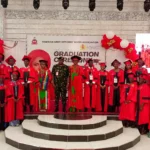







The discussions took place at the International Scientific and Practical Conference, “Youth Arctic: Science for the Future,” which brought together young researchers and experts from Russia and China, according to TV BRICS, a partner of the News Agency of Nigeria (NAN).
The conference, hosted for the third consecutive year in Russia’s Ugra region, was organised by the Russian-Asian Arctic Research Consortium with support from the Russia-BRICS Project Office for International Youth Cooperation
This year particular attention was paid to cooperation with BRICS countries. Young scientists and experts discussed joint initiatives in the fields of ecology, logistics, energy, tourism and the development of Arctic resources.
“Several universities and research organisations from China have already joined the work of the consortium, as well as representatives from India.
“We are moving forward and expanding in the Asian direction.
“This creates a very positive cumulative effect, as we do not approach the study of particular issues from a single perspective,” Roman Kuchin, Co-Chairman of the consortium and Rector of Ugra State University, said.
One of the key topics of the conference was the preservation of the culture of the Indigenous small-numbered peoples of the North.
Ugra is home to representatives of 139 ethnic groups, and the region is seeking new solutions to support young people living in remote areas.
One such solution is the “IT Nomadic Camp” project.
Thanks to access to broadband internet, residents of hard-to-reach settlements have gained new opportunities for education, communication and participation in social and cultural projects.
Aleksander Novyukhov said the number of young people who were ready to leave remote territories and nomadic camps had decreased significantly.
Novyukhov is a Senator and President of the Association of Indigenous Peoples of the North, Siberia and the Far East of the Russian Federation.
“Chats and unique social groups have emerged, which began communicating in their native languages. Most importantly, people gained the opportunity to participate remotely in socio-cultural projects,” Novyukhov said.
The International Youth Competition of Tourism Projects “DobroArktika” was also held as part of the conference.
Participants presented initiatives aimed at developing tourism in the Berezovsky District, which is part of Russia’s Arctic zone.
The winners were students from Ugra State University and Surgut State University, who developed projects in the fields of ecological, event and ethnographic tourism
Their projects also included improvement of natural sites and the creation of accessible infrastructure.
One of the projects was “CHUMbuilding”, which is already being implemented in the Beloyarsky District.
Its goal is to introduce tourists to the traditions of the Indigenous peoples of Ugra through practical experience.
According to the scholars, the experience is by building a chum (a traditional conical dwelling of the locals), staying in a traditional dwelling, and taking part in workshops, rituals and crafts.
Yang Nan, Assistant Professor at Qingdao University, who has been working in Russia for two years, noted that her perspective on the Arctic has changed.
The conference “Youth Arctic: Science for the Future” formed part of the All-Russian Forum for Civil Society Development “Dobrino”, which brought together more than 500 participants. (TV BRICS/NAN)
Edited by Sheji Halima