


By Bushrah Yusuf-Badmus, News Agency of Nigeria (NAN)
As the morning rush eased in Ilorin, the capital of Kwara State, Mrs Aishat Adeleye had already completed one important task; dropping her children off at school.
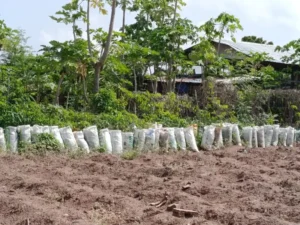
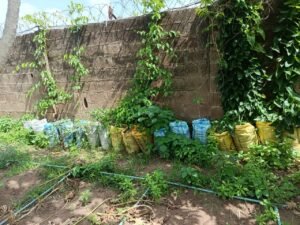
However, her next stop was a small carved-out space in her compound, where heaps of neatly arranged sacks brimmed with vegetables, crops and tubers.
Over time, what began as a modest sack farming venture has become a reliable source of food for her family, helping her cut down significantly on household food expenses amid rising prices.
Mrs Adeleye, a full-time housewife who runs a petty provision shop in front of her house, said sack farming had not only enabled her to grow food but also helped her build resilience in challenging economic times.
She adopted the practice in 2024 after getting pregnant and being unable to continue going to her farm in Oke-Oyi, a village in the Ilorin East Local Government Area of Kwara State, about 27 kilometres from Ilorin.
The decision was also influenced by the stress of travelling the distance and, most importantly, insecurity in the area.
Consequently, the new practice has helped put food on her table and reduce household food expenses.
“I used to have a farm in Oke-Oyi until I got pregnant and realised I didn’t have the strength to do both – farming and pregnancy.
“So after I put to bed and I do not have access to land within my vicinity, coupled with the insecurity in that area that got worse, I started sack farming at the back of my house because I have a large garden.
“I plant yam, garden egg plant, pepper and tomato, so I basically plant to eat because I couldn’t produce at market scale, due to the stress of filling up the sacks and maintaining them in large quantities,” she said.
Beyond Adeleye’s experience, women play vital roles at every stage of agrifood systems, yet they continue to face greater barriers in accessing land and other productive resources, which remain limited in many states.
Similarly, 42-year-old Hauwa Akodudu, a resident of Sango area in Ilorin, started sack farming as far back as 2012 due to lack of space to farm in her area, while insecurity prevented her from travelling far from home.
Akodudu said what started as a means of sustaining her family had gradually become a source of income, as she sells excess vegetables harvested from her sacks.
“I have started farming on the bare soil before, but there have always been issues with land ownership here and there, so in 2021, I just decided to start the sack farming in my backyard so as to feed my family with basic crops, tubers and vegetables.
“Now, I plant tomatoes and different kinds of vegetables, and it has been sustaining my family and I even get to sell the excess and make little money out of it.
“This kind of farming is easy to maintain and eco-friendly because we use local manure to boost the soil fertility,” she said.
Meanwhile, women farmers in Kwara continue to identify land access as a major constraint.
A study involving 1,801 women farmers across urban areas of Kwara State identified restricted access to land, lack of credit facilities and limited access to farm inputs as major barriers affecting productivity.
On her part, 36-year-old Bashirah Adisa, a resident of Offa Garage, started sack farming in 2025.
Although she had previously practised conventional farming, accessing fertile land within a residential environment became increasingly difficult, while growing insecurity in the area also influenced her decision to switch to sack farming.
Research on farming communities affected by insecurity found that insecurity significantly reduces crop production.
A one per cent increase in insecurity was associated with declines in agricultural output as many farmers avoid distant farms because of fear of attacks or conflict.
Additionally, flooding and conflict have contributed to food insecurity across Nigeria, with millions affected and extensive cropland losses recorded.
Mrs Adisa said getting fertile land wasn’t the only problem but securing herself and her farm produce became a herculean task.
“Sack farming gives me the opportunity to be able to farm within my reach, even on a concrete floor. I can always check on what I planted before going to work in the morning, as well as when I return in the evening.
“Once my crops and vegetables germinate, I won’t be buying any of them in the markets anymore.
The cases of Mrs Adeleye, Mrs Akodudu and Mrs Adisa are not isolated cases of the plight of farmers in Kwara state because apart from lack of access to lands as women, insecurity has escalated significantly in the state from the late 2025 till date.
Residents have been forced to seek refuge outside their homes, while farmers were forced to abandon their farmlands for their safety due to the fear of bandits.
A record near-35 million Nigerians are facing food insecurity, driven by conflict, climate shocks, displacement and the systemic collapse of local food systems.
Insurgency, especially in the Northeast Nigeria and central regions, has disrupted farming, caused mass displacement, and severely reduced agricultural output, contributing to record-high food prices.
Many states in Nigeria have been battling with insecurity which has reduced their food production, and Kwara, North Central Nigeria, is one of those states.
From Jan. 1 to Nov. 7, 2025 in Kwara, at least 207 people (including state and non-state actors) were killed and more than 177 abducted, mostly in the state’s northern areas.
However, amid conflict and uncertainty, these small-scale farmers have devised ways to adapt to changing circumstances, as many can barely afford to buy all their food staples from the market.
By filling used sacks with soil, they have been able to cultivate crops within the comfort of their homes.
For Bunmi Adebayo, easy access to vegetables and food staples has become one of the major benefits of sack farming, a practice he has embraced for the past four years.
Adebayo, who started sack farming to grow healthy vegetables without hindrance, said the practice has enabled him to produce enough food to support his household.
“As a way of recycling and not throwing away cement bags in the house, I thought about using them for backyard farming so as to be sure of what I am eating.
“This is because of the different inorganic materials people are using in planting these days. So, I started sack farming in my backyard,” he said.
Meanwhile, the experience is different for sexagenarian Alhaji Tajudeen Yunus, a retired civil servant in Egbejila, whose decision to adopt sack farming was influenced by changing climate conditions and rainfall patterns.
Research from Southwestern Nigeria found that about 67 per cent of farmers observed changes in climate patterns.
Farmers reported significant negative impacts on major crops including maize and yam.
Studies consistently show that Nigerian smallholder farmers depend heavily on rainfall and have limited adaptive capacity.
Meanwhile, climate variability affects crop yields, household income and food security particularly among poorer farmers with limited resources.
For someone that has always practised traditional farming, unpredictable weather conditions that destroyed yam when rain ceased in 2024 made Alhaji Yunus start sack farming solely to plant yams.
“When you plant them naturally on the ground and the rain ceases for a long time, like a month or more, it destroys most of the yam in the ground.
“But those ones in the sack don’t get destroyed because we wet them manually and so far, planting in the sack gives at least 80 percent assurance that the yam will come out well.
“So, this year now, I did not even plant yam on the ground at all,” he said.
Yunus added that the yams planted over the years have always served his household as yam and yam flour and also giving out excess as gifts.
He however noted that reviving the soil after each planting season was not always a problem for him due to the climate smart agriculture he practices.
Studies showed that when chicken manure is properly composted and applied to agricultural fields, it can enhance soil fertility and structure.
The organic matter present in chicken manure improves soil structure, promotes moisture retention, and increases microbial activity.
The organic matter also helps reduce erosion and compaction, making the soil more resilient and conducive to plant growth.
The retired permanent secretary uses manures from his poultry to fertilise the soil after harvesting, against the next planting season.
“After harvest, we pour the soil back on the ground and we pour poultry waste on it and leave it for three or four months to decay before transferring the soil into the sacks again.
However as sack farming seems as an answered prayer for small holders farmers, it comes with its daunting challenges.
To Alhaji Yunus, his major challenge was wetting the sacks which was cumbersome but overcame with the use of hose to run tap water into the sacks.
He also cited another challenge of securing sacks which has become scarce compared to when he started sack farming.
“I have now resorted to using poultry feeds sack which aren’t as strong as cement sacks which now sells for 1500 per dozen as compared to 1000 per dozen obtainable before. For the next planting season, I plan to get POP Cement bags which is stronger than the poultry feeds sack.
For Abdulbasit Folawemi, the sack preparation is more tedious than the normal land preparation before planting.
“You have to get the sack, fill it with sand, then lay it out before you start anything. Then after planting, the sack could get worn out due to the intensity of the sun and its exposure to heat, which could lead to exposure of the root if care is not taken.
However, climate adaptation, as it were, depends on access to information. Research among Nigerian farmers found that many farmers have contact with extension agents.
Yet only about 42.3 per cent reported receiving climate-change information.
The Managing Director of Enterprise Grooming Institute (EGI), Mr Tajudeen Ajisefini, said sack farming was an adaptive agricultural practice that also provided an opportunity to turn waste into wealth.
Ajisefini, whose institute trains people on effective sack farming techniques, said the practice was an economical way to promote backyard farming among urban residents with limited space.
He said although its productivity could not be compared with open-field farming, sack farming could generate income for households while supporting food production.
“Sack farming can be used for seedling production, which is a form of income.
“From a sack the length of a Dangote cement bag, if you divide it into two, you can get nothing less than 200 per cent of pepper seedlings from each sack. Selling pepper seedlings in Nigeria today is about N40 to N50 per strand.
“If you now have between 100 and 200 pieces at N50, you know how much that means. Within seven weeks, you should know how much that will bring,” he said.
He added that sack farming could create employment opportunities, especially for youths and women, while helping households sustain their livelihoods and maximise available spaces.
Since a study in Kwara also found women farmers often struggle to access extension services and training opportunities, the Agriculture expert called for care and precision when preparing the soil to be put in the sack.
This, he said was to ensure effective productivity, as lack of knowledge was always a major challenge.
‘’Majority of people are just talking about sack farming, they don’t know what it entails to do sacka farming.
‘’You need to first know the soil treatment and plant treatment. And if you want to do tuber farming, you need to know how to maximise the sack by cutting it into two to get results.
‘’These and some other things are essential to have a good harvest at the end of the day, but people just dabble into it without knowing the nitty gritty of sack farming,” he said.
Dr Tunde Arosanyin, National Coordinator of the Zero Hunger Nigeria Project, also highlighted the importance of proper techniques and precautions in achieving good results from sack farming.
Arosanyin said the sacks must be properly aerated to allow excess water to drain, while quality soil and adequate sunlight were also essential for successful production.
Describing sack farming as an innovation and a localised form of greenhouse farming, the international agriculture consultant said the practice had evolved from a hobby for some people into a means of feeding households and generating income.
He added that it had become useful for rural women in Kwara and beyond.
He said the practice was easier to manage because farmers could control weeds and maximise available spaces.
“You can regulate the nutrients of the soil, unlike when it is in vast land where the nutrients are being competed for. But since this one is in a regulated space, you can manage the nutrient for effective output.
“Also, when you look at the rate of insecurity in terms of cattle and other pests like goats’ invasion, sack farming is in a confined environment where even if you have domestic animals, they are restricted. The threat of cattle invasion at night is also eliminated. So, it is a win-win situation.
“And I have seen some women in Kwara, Ekiti and other Southwestern states harvesting over 500 or 600 tubers. Some sacks can produce two standard tubers of about 10 cm in length, which are good market-size or table-size tubers that can feed a family of five or six,” he said.
The agriculture expert, however, said land availability was not the only challenge facing farming in Nigeria, noting that the country still had a large portion of its arable land unused.
He said the land tenure system had placed women at a disadvantage, although some were able to negotiate access to farmland through their paternal families.
“But the major challenge is land development because if they give you land that has not been cleared, it will require close to about N500,000 to clear one hectare of land for either cassava or yam planting, which is a little bit expensive.
“You will need earth-moving equipment like a D7 bulldozer to remove those trees. So, yes, that is a major constraint to accessing land,” he said.
Arosanyin also expressed reservations about the capacity of sack farming to address the food needs of Nigeria’s growing population.
“On the commercial level, I still have my reservation whether this system can actually meet the food demand of a population that is over 250 million and is growing every year.
“Our food production is growing at arithmetic stages, while the population is growing geometrically.
“So, this system of farming cannot serve as the major food security base for us. It is suitable for women operating at a subsistence level or those trying to improve their income.
“But in the long run, it cannot meet the challenges of food sufficiency for the nation,” he said.
Meanwhile, Mr Omotola Ashaolu, Press Secretary, Kwara Ministry of Agriculture and Rural Development, said the state government had continued to encourage backyard farming, which could also include sack farming.
Ashaolu said the initiative provided residents with the opportunity to grow crops such as vegetables, pepper, tomatoes, maize, yam and cassava for household consumption.
“It is encouraged for people who do not have vast land space. Even if your house is cemented or rocky, you just get soil, put it in sacks, mix it with manure and plant.
“There is hardly any farming season that we do not emphasise the importance of backyard farming because it gives people the opportunity to eat fresh food and stay healthy,” he said. (NANFeatures)
(This report was produced with support from the Centre for Journalism Innovation and Development (CJID).


Comments