


By Hadiza Mohammed, News Agency of Nigeria (NAN)
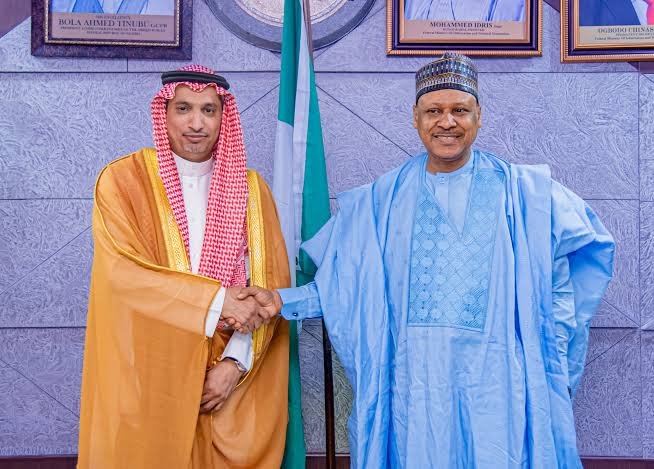
As Saudi Arabia marks its National Day on Sept. 23, attention turns to its longstanding relationship with Nigeria.
Anchored in faith and pilgrimage for decades, the relationship is now expanding into investment, education, health, energy and security.
The annual celebration commemorates the 1932 unification of the Kingdom of Saudi Arabia under King Abdulaziz Al Saud.
Religious leaders say Saudi Arabia’s National Day holds significance for Nigeria beyond the annual Hajj, given the Kingdom’s place in the lives of millions of Nigerian Muslims.
They also point to growing efforts by both countries to deepen economic and strategic ties, creating opportunities to expand a relationship long rooted in shared faith.
The scale of the two countries provides some context for the potential of that relationship.
Nigeria had an estimated population of 237.5 million in 2025, according to World Bank data, while Saudi Arabia’s population stood at about 37 million.
Nigeria’s economy was valued at about $290.8 billion in 2025, compared with Saudi Arabia’s economy at about $1.28 trillion.
For decades, however, the Hajj has remained the most visible expression of their relationship.
The National Hajj Commission of Nigeria (NAHCON) said about 39,000 Nigerian pilgrims under the government quota were airlifted to Saudi Arabia for the 2026 Hajj.
Nigeria had a total allocation of 50,000 pilgrims, including 9,750 slots allocated to licensed tour operators, officials and support personnel. NAHCON said 98 outbound flights were operated within 18 days.
Consequently, the annual movement of thousands of pilgrims has created enduring links between the two countries, making cooperation on travel, accommodation, welfare and consular support an important public concern.
From the plains of Arafat, where thousands of Nigerian pilgrims pray every year, to classrooms in Riyadh where Nigerian students pursue studies on Saudi scholarships, the relationship has long been driven by people-to-people connections.
Yet, while faith remains a powerful bond, the relationship is gradually taking on a wider economic and strategic dimension.
For years, bilateral relations between Nigeria and Saudi Arabia were largely defined by religious diplomacy, with Hajj and pilgrim welfare at the centre.
In the past year, however, there has been renewed emphasis on trade, investment, energy, education and security cooperation.
This was evident at the Nigeria-Saudi Diaspora Investment and Tourism Exhibition Summit in Abuja in August 2026, where discussions focused on investment, trade, innovation and sustainable economic development.
More importantly, the shift is also visible in the trade figures.
Data from Saudi Arabia’s official DataSaudi platform show that Saudi exports to Nigeria reached 2.3 billion Saudi riyals in 2025.
The main exports included plastics and related products worth 1.1 billion riyals, mineral fuels, oils and waxes worth 518.3 million riyals, and ships, boats and floating structures worth 459.4 million riyals.
By comparison, Saudi Arabia’s imports from Nigeria stood at 96.4 million riyals in 2025, although the figure represented a 69.8 per cent increase from the previous year.
Nigeria’s major exports to Saudi Arabia included aluminium and articles of aluminium worth 42.6 million riyals, wood and wood products worth 31.7 million riyals, and coffee, tea, spices and related products worth 4.6 million riyals.
The figures therefore reveal not only growing trade but also a substantial imbalance in its composition, with the value of Saudi exports to Nigeria far exceeding Nigerian exports to the Kingdom.
There is, consequently, considerable room for expanding Nigeria’s exports to the Saudi market while attracting more Saudi investment into the Nigerian economy.
The investment picture also provides an indication of the gap.
DataSaudi puts Saudi foreign direct investment stock in Nigeria at 212.3 million riyals at the end of 2024, marginally below the 212.9 million riyals recorded in 2023.
Against this backdrop, Nigeria has declared itself open to investment under the Renewed Hope Agenda, inviting Saudi investors to explore opportunities in the oil and gas value chain as well as renewable energy.
For Saudi Arabia, meanwhile, the search for investment opportunities abroad is taking place alongside a much wider domestic economic transformation.
Under Vision 2030, the Kingdom has been seeking to reduce its dependence on oil by expanding tourism, technology, logistics, manufacturing and other non-oil sectors.
The 2025 Vision 2030 report said real non-oil gross domestic product had risen to $892 billion, compared with a baseline of $598 billion, while private-sector contribution to GDP had reached 51 per cent, against a 44 per cent baseline.
That transformation creates areas where Nigeria and Saudi Arabia could potentially find complementary interests, particularly in energy, agriculture, logistics, technology, tourism and infrastructure.
At the same time, Nigeria is implementing a national Halal Economy Strategy aimed at expanding its participation in the global halal market.
The strategy covers sectors including agriculture, livestock, food processing, pharmaceuticals and Islamic finance.
Furthermore, with access to the African Continental Free Trade Area (AfCFTA), Nigeria offers investors a potential gateway to the wider African market.
Beyond trade and investment, education provides another important avenue for strengthening the relationship.
In April 2026, Saudi Arabia offered fully funded scholarships to 50 Nigerian students in petroleum and mineral studies as part of a bilateral education and capacity-building initiative.
Building on this, Speaker of the House of Representatives, Abbas Tajudeen, called for a structured parliament-to-parliament framework to expand such opportunities to medicine, engineering and digital technology.
Such proposals, he said could broaden educational cooperation beyond traditional areas of study to Science, Technology, Engineering and Mathematics (STEM), research and innovation.
The scale and demographic profiles of both countries also provide a basis for greater cooperation in human-capital development.
Nigeria’s large and youthful population creates substantial demand for education, skills, healthcare and employment opportunities, while Saudi Arabia is pursuing major economic and social transformation under its Vision 2030 programme.
Meanwhile, cultural and people-to-people ties continue to provide another bridge between the two countries.
Recent areas of engagement include news exchange between the News Agency of Nigeria (NAN) and Saudi Press Agency (SPA), broadcasting cooperation between the Nigerian Television Authority (NTA) and the Saudi Broadcasting Authority, as well as discussions on resuming direct flights between Jeddah and Abuja.
At the sub-national level, partnerships involving states such as Kano and Jigawa have also contributed to these ties, including humanitarian interventions by the King Salman Humanitarian Aid and Relief Centre (KSrelief) and agricultural support.
As these connections widen, attention is continually turning to what the partnership could deliver beyond existing areas of cooperation.
For Prof. Abdulrazak Ibrahim, a political analyst at Nile University, Abuja, he identified five areas that could shape future cooperation.
“I have followed this evolution closely, and what stands out in 2026 is the clear shift from goodwill to structured cooperation,” he said.
According to Ibrahim, cooperation across the energy value chain should be a priority, with the partnership extending beyond crude oil to joint investment in refineries, petrochemicals and renewable energy.
Equally important, he said, was investment in human capital.
Ibrahim advocated institutionalised partnerships involving universities, vocational centres and research laboratories.
He also suggested establishing educational institutions and healthcare facilities designed to meet the needs of women in communities where cultural considerations influence access to education and healthcare.
Another area he identified was the halal industry.
According to him, joint certification mechanisms and Islamic financing arrangements could support the growth of the sector.
Ibrahim also proposed exploring halal-compliant banking, mortgage systems, lending platforms and investment products in Nigeria in collaboration with Saudi institutions.
Such initiatives, he said, could expand access to financial services, create jobs and strengthen confidence in the financial system among interested Muslim communities.
He also identified connectivity and tourism as areas with potential for deeper cooperation.
Ibrahim advocated direct flights between the two countries, easier procedures for business visas and stronger cultural exchanges.
He further suggested collaboration with communities in northern Nigeria with longstanding cultural and linguistic links to the Arab world.
Security, meanwhile, presents another area of common interest.
Ibrahim cited terrorism and drug abuse, saying both countries could deepen cooperation in counter-terrorism, defence training and military education.
Health, too, offers an avenue for the two countries to learn from each other.
Similarly, Prof. Ibrahim Shuaibu (Rtd.) of Nasarawa State University Keffi, said Nigeria and Saudi Arabia had relatively young populations, with implications for healthcare demand and future disease burdens.
He said the two countries could collaborate on health financing, service delivery, workforce development, governance and health outcomes within a broader global health framework.
Shuaibu noted that Nigeria had significant human and natural resources, adding that the country could learn from nations that had developed systems for addressing similar challenges.
He cited malaria as one possible area for cooperation.
The contrast between the two countries is significant.
According to the World Health Organisation (WHO), there were an estimated 282 million malaria cases globally in 2024, with 95 per cent of cases and deaths occurring in the WHO African Region.
Nigeria alone accounted for 31.9 per cent of malaria deaths in the African Region in 2024, according to WHO estimates.
Saudi Arabia, meanwhile, reported zero indigenous malaria cases for the fourth consecutive year in 2024.
The difference provides a concrete area for possible technical and research cooperation, particularly in surveillance, vector control, data systems and public-health interventions.
For Shuaibu, Saudi Arabia’s experience could provide lessons for Nigeria in strengthening malaria control and surveillance.
He also identified HIV and AIDS as both a health and development issue, urging stronger international cooperation to develop practical responses and long-term strategies.
Beyond health, the relationship has also acquired a stronger security dimension.
In December 2025, Nigeria and Saudi Arabia signed a Memorandum of Understanding (MoU) on defence and military cooperation.
At the event, Bello Matawalle, Minister of State for Defence, said the agreement was a significant step towards strengthening Nigeria’s defence architecture.
“The signing of this MoU is a significant milestone.
“It has been on the drawing board for some time, and its conclusion will strengthen Nigeria’s defence architecture and enhance the capacity of our armed forces,” Matawalle said.
The agreement provides a framework for strengthening defence and military cooperation between both countries.
The Federal Government said the MoU was intended to enhance the capacity of Nigeria’s armed forces.
Viewed together, these developments suggest that the Nigeria-Saudi relationship is becoming broader in scope.
The ties between the two countries now encompass pilgrimage and faith, but also investment, education, health, energy, culture, tourism and security.
At the same time, the trade figures reveal a substantial imbalance in the value of goods exchanged, while also showing that Nigerian exports to Saudi Arabia grew by 69.8 per cent in 2025.
For both Nigeria and Saudi Arabia, the next phase will depend on turning existing commitments into sustained programmes and tangible benefits for citizens.
For decades, shared faith has been a strong foundation for relations between the two countries.
As cooperation expands into trade, education, health, energy and security, the question is whether shared faith can also translate into shared prosperity.
(NANFeatures)
Edited by Tosin Kolade

Comments