


By Rukayat Moisemhe
The Chief of Naval Staff, Vice Adm. Idi Abbas, and management professionals have stressed the need for human-centred organisational transformation.
They said the success of technological and strategic changes ultimately depended on the people driving and implementing transformation across organisations.
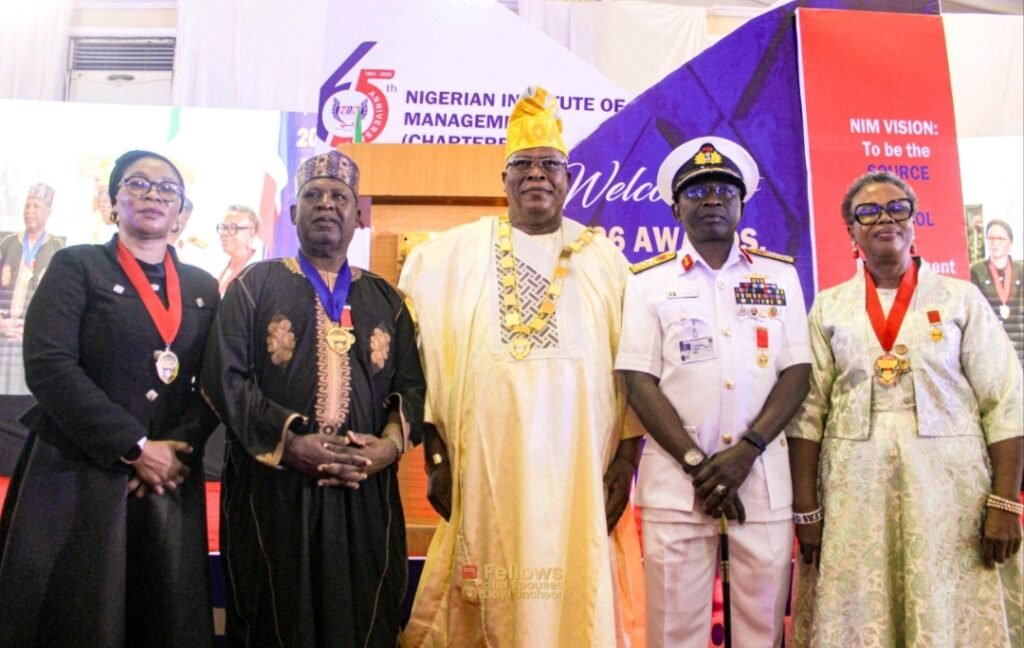
They gave the advice on Thursday in Lagos at the Nigerian Institute of Management Chartered (NIM) 2026 Awards, Fellows and Spouses’ Day Luncheon.
The event had the theme: “Leading Through Transformation: The Human Element in Modern Leadership.”
Abbas said transformation could only succeed when leaders created conditions that enabled people to take responsibility and serve effectively.
He said rapid economic realities and technological changes had made effective leadership increasingly important.
Abbas noted that while technology had attracted significant attention in modern transformation, people remained critical to determining whether such transformation succeeded or failed.
“Particularly in the armed forces, weapons remain only instruments until placed in the hands of personnel,” Abbas said.
Abbas, who was conferred with the fellowship of the institute, described the recognition as a renewed call to responsibility, accountability, integrity and excellent service.
He pledged to uphold the ethical values of the institute and contribute to national development.
Also speaking, the Group Head, Human Resources, BUA Group International, Mr Dotun Adako, said successful transformation went beyond adopting new technologies.
According to him, it required changes in organisational culture, operating models and the development of human potential.
He said leaders must balance strategic vision with empathy, particularly when managing uncertainty, resistance and disruption within organisations.
Adako added that effective leadership during periods of change required psychological safety, strategic trust and emotional intelligence.
He said these were necessary to enable employees to adapt, innovate and contribute meaningfully.
“Systems and technology alone do not drive transformation; human adoption dictates return on investment.
“Change triggers threat responses in employees, and empathetic leadership is required to mitigate operational fatigue,” he said.
Adako identified strategic goals, key performance indicators, stakeholders and teams, and project scope as four essential elements of effective change plans.
He also identified cultural alignment, continuous upskilling and transparent dialogue as key drivers of successful transformation.
Adako said the role of HR had evolved from traditional administrative functions to strategic business enablement.
He added that organisations must prioritise employee wellbeing alongside performance.
He said investing in people should be regarded as a strategic business imperative rather than solely an HR responsibility.
He cited research by McKinsey & Company which showed that transformations prioritising culture and workforce engagement were more likely to achieve strategic objectives.
The President, NIM, retired Commodore Abimbola Ayuba, said the elevation of members to the grade of fellow was a rigorous process.
He said the process was designed to ensure that only deserving members were honoured.
Ayuba congratulated the new fellows, urging them not to regard the fellowship as a destination or merely an addition to their names.
He called on them to commit their time, expertise, resources and ideas to the service of the institute, management profession and nation.
He said the institute had constituted its fellows into faculties of sectoral groups to identify challenges within various disciplines.
Ayuba said the faculties would develop studies and policy recommendations for the government through the institute’s advocacy programmes.
He urged the new fellows, particularly those selected or volunteering to lead the faculties, to expedite action on the initiative.
“This is an important aspect of the Institute’s objective of contributing to the management of the country in order to promote its development and the well-being of its citizens,” he said.
Ayuba also congratulated three elder statesmen who received the institute’s life membership award.
He noted that recipients must be at least 70 years old and have demonstrated active involvement in the institute’s activities over the years.
He urged all fellows to uphold the values of responsible leadership and use their professional competencies to contribute to the development of the country.(NAN)
Edited by Chinyere Joel-Nwokeoma



Comments