


By Sumaila Ogbaje
Dr Adedeji Ebo, Director and Deputy High Representative, United Nations Office for Disarmament Affairs (UNODA), says civil society organisations are critical to connecting arms-control policies with communities.
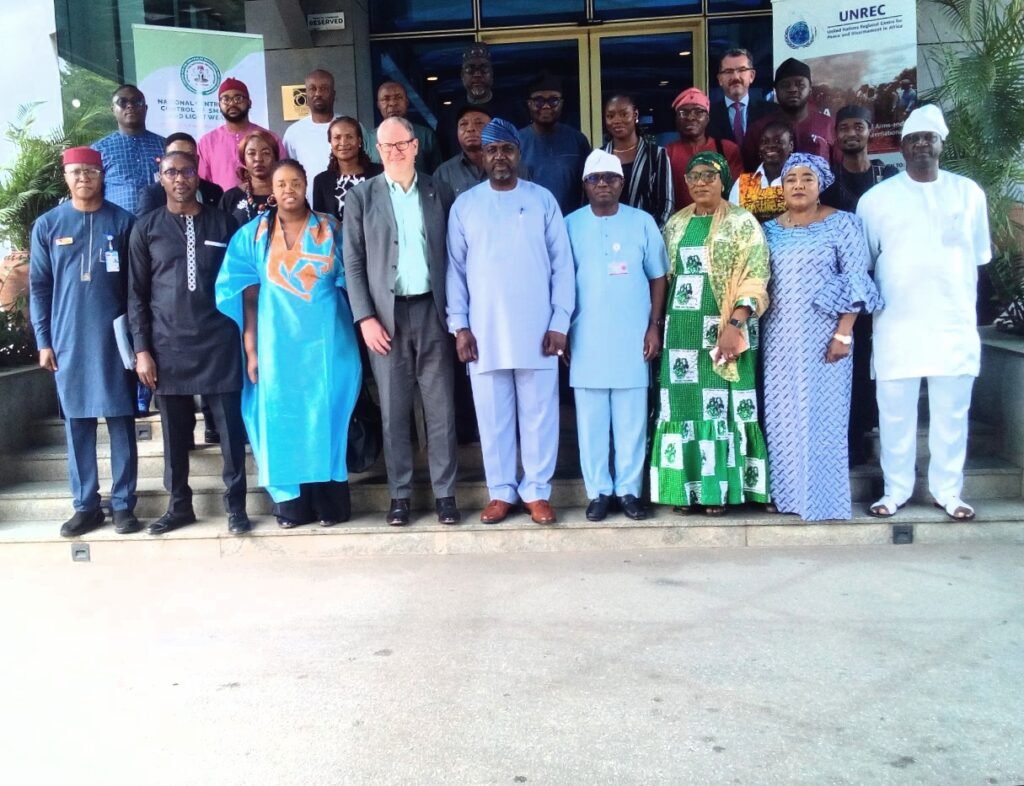
Ebo stated this at a high-level meeting with civil society organisations in Nigeria, organised in partnership with the National Centre for the Control of Small Arms and Light Weapons (NCCSALW), on Friday in Abuja.
He said civil society organisations serve as a bridge between government and communities, stressing that their involvement was essential to making national, regional and international arms-control instruments relevant at grassroots level.
According to him, civil society is the bridge between the state and society,” Ebo said, noting that communities needed to understand the relevance of instruments such as the ECOWAS Convention on Small Arms and Light Weapons, UN Programme of Action and Arms Trade Treaty.
He said the ongoing national baseline survey on illicit small arms and light weapons would only be useful if civil society organisations were taken seriously as partners and their community-level perspectives incorporated.
Ebo challenged civil society organisations to improve their coordination, professionalism and value proposition when engaging government and security institutions.
“You have to demonstrate what you bring to the table. Just because you say you are a civil society organisation or an NGO does not necessarily mean that doors will automatically open. You have to earn that access,” he said.
The UN official also questioned the absence of a unified umbrella platform through which civil society organisations could engage the NCCSALW, saying individual engagements with numerous organisations would be inefficient.
He urged the organisations to identify their major disarmament challenges, emerging trends and effective practices, including lessons from unsuccessful interventions.
He also sought their recommendations on strengthening partnerships with UNODA and national institutions, as well as areas requiring future technical and financial support.
The UN official further stressed the need for civil society organisations to provide credible community-level information to support evidence-based arms-control policies.
The Director-General of NCCSALW, retired AIG Johnson Kokumo, represented by the National Arms Registrar, retired Maj.-Gen. Bamidele Shafa, said civil society organisations remained central to Nigeria’s efforts to curb illicit small arms proliferation.
Kokumo said the organisations’ proximity to communities gave them unique insights into the human cost and drivers of illicit weapons proliferation.
He said civil society organisations would remain important partners in designing, validating and disseminating evidence from Nigeria’s forthcoming national baseline survey.
He also urged participants to be candid about funding constraints, access limitations and capacity gaps affecting their work, assuring them that the Centre was prepared to listen and facilitate practical cooperation.
In his remarks, the EU Ambassador to Nigeria and the ECOWAS, Gautier Mignot, said civil society organisations were indispensable in bridging national policies and community realities.
Mignot, represented by Ron Hendrix, EU Programme Officer in Charge of Migration, Organised Crime and Drugs, said their contributions included awareness creation, early warning, conflict prevention, policy advocacy, victim assistance, rehabilitation and reintegration.
He said lasting progress in arms control and disarmament required strong partnerships among government institutions, regional bodies, international partners and civil society.
Mariame Camara of the UN Regional Centre for Peace and Disarmament in Africa (UNREC), highlighted funding opportunities under the United Nations Trust Facility Supporting Cooperation on Arms Regulation (UNSCAR).
Camara said the annual call for proposals opened on July 15 and would close on Aug. 31, urging eligible organisations to submit proposals addressing practical arms-control challenges.
She said UNSCAR usually received about 100 applications annually but funded between 10 and 15 projects, with grants of up to 100,000 dollars per project.
According to her, projects specifically focused on Physical Security and Stockpile Management could receive up to 150,000 dollars.
Contributing, representatives of the CSOs called for stronger coordination among civil society organisations and proposed a joint technical training programme, a Civil Society Technical Advisory Group and a national small arms data hub to strengthen data collection, analysis and policy engagement.
They also called for the institutionalisation of a technical working committee and decentralisation of its activities to the grassroots.
The speakers also identified gender, policy and disability-related gaps, alongside porous borders, insecurity, mistrust, inadequate funding and limited technical capacity, as major challenges to arms control. (NAN) (www.nannews.ng)
Edited by Sadiya Hamza

Comments