








By Adesewa George
The Federal Government has begun nationwide consultations with states and other stakeholders to develop a National Water Compact to address Nigeria’s water security challenges.
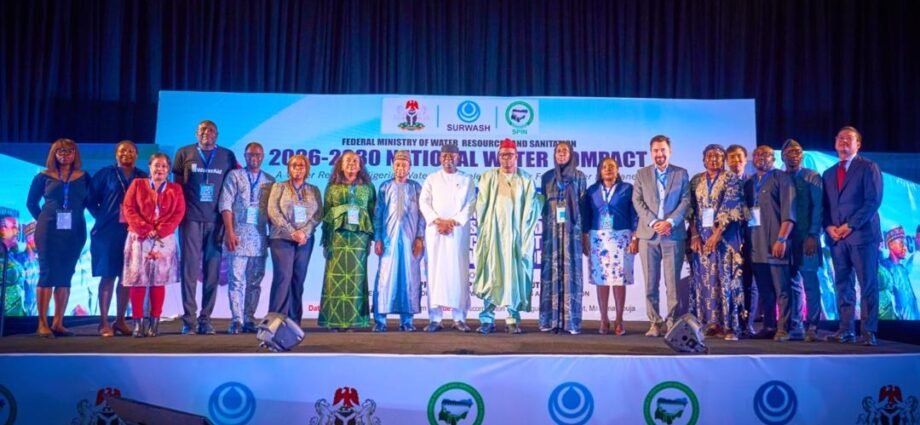
The Minister of Water Resources and Sanitation, Prof. Joseph Utsev, said this at a stakeholders’ consultation workshop involving state commissioners and other key actors in Abuja on Thursday.
Utsev said the compact would guide interventions in the water sector from 2026 to 2030, focusing on water security, safe water supply, sanitation, irrigation and sustainable water resource management.
He said Nigeria faced persistent water security challenges driven by rapid urbanisation, population growth, climate change, environmental degradation, inadequate infrastructure, fragmented institutions and financing constraints.
According to him, the challenges have affected the country’s ability to provide reliable water supply, sanitation services and productive water use.
The minister said the Federal Government remained committed to policies, reforms and strategic investments to guarantee water security and universal access to safe and sustainable water supply and sanitation services.
Utsev said the National Technical Working Group, comprising representatives of government, state governments, development partners, academia, professional bodies, civil society and the private sector, had produced the first draft of the compact.
He said the draft followed months of technical engagements, evidence-based analysis, inter-sectoral collaboration and consultations.
“However, the National Water Compact cannot succeed unless it reflects the aspirations, priorities and realities of the Nigerian people,” he said.
Utsev said the ministry had written to the Chairman of the Nigerian Governors’ Forum to secure the political commitment, ownership and buy-in of the 36 states and the Federal Capital Territory.
He said state participation was crucial because states had constitutional and operational responsibilities for water supply, sanitation and hygiene services.
The minister urged stakeholders to strengthen the draft by identifying state priorities, proposing strategic actions and ensuring clear implementation arrangements.
He said the compact was more than a policy document, as it would strengthen governance, improve financing and enhance access to water and sanitation services.
Utsev added that it would support irrigation development, food production, environmental sustainability and national water security.
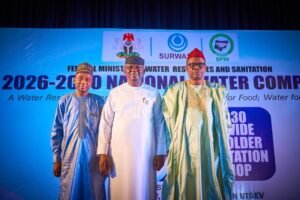
Also speaking, Mr Taimur Samad, Acting Country Director, World Bank, said the compact offered an opportunity to transform water delivery into jobs and support Nigeria’s development.
Samad said state governments should drive water-sector investments, reforms and prioritisation of critical actions because of their central role in water resource management.
He urged stakeholders to build on existing plans and strategies by bringing them together under a unified platform for coordinated action.
Samad stressed the need for stronger institutions and sustainable financing, saying public funding alone would not address the sector’s investment needs.
He said water should be treated as an economic asset, supported by sustainable revenue systems for capital investment, operations and maintenance.
Samad pledged the World Bank’s continued partnership with the Federal Government in advancing the country’s water agenda.
Representing the WASH Development Partner Group, Ms Emily Kilongi commended the ministry and the National Technical Working Committee for an inclusive consultation involving the 36 states.
Kilongi said the compact could strengthen coordination across WASH, irrigation, agriculture, climate, health and economic development.
She said state ownership would be critical to translating national ambitions into practical actions reflecting local priorities, capacities and realities.
Kilongi urged stakeholders to prioritise measurable results, mutual accountability, reliable data and evidence-based decision-making as the compact moved towards implementation.
Also speaking, the Minister of State for Health and Social Welfare, Dr Iziaq Salako, said water, sanitation and hygiene were fundamental to disease prevention and quality healthcare delivery.
Salako said health facilities could not function effectively without reliable water, sanitation and hygiene services for infection prevention, cleaning and safe healthcare delivery.
He said investment in water and sanitation should be viewed as investment in disease prevention, health promotion and healthier communities.
The minister urged stakeholders to ensure that the final compact addressed access to safe water in homes, communities, schools and public institutions.
He also called for climate-resilient health systems and equitable water governance to guarantee access for vulnerable and marginalised populations.
Salako said effective implementation would require sustainable financing, clear accountability, accurate data and strong collaboration among government institutions and other stakeholders.
He pledged the Federal Ministry of Health and Social Welfare’s continued support for the finalisation and implementation of the National Water Compact.
The workshop brought together representatives of federal and state governments, development partners, civil society organisations, academia, the private sector and other stakeholders in the water sector. (NAN)
Edited by Tosin Kolade