










By Taiye Agbaje
Former Vice President Yemi Osinbajo has called stricter regulation of the digital ecosystem to protect children from exploitation.
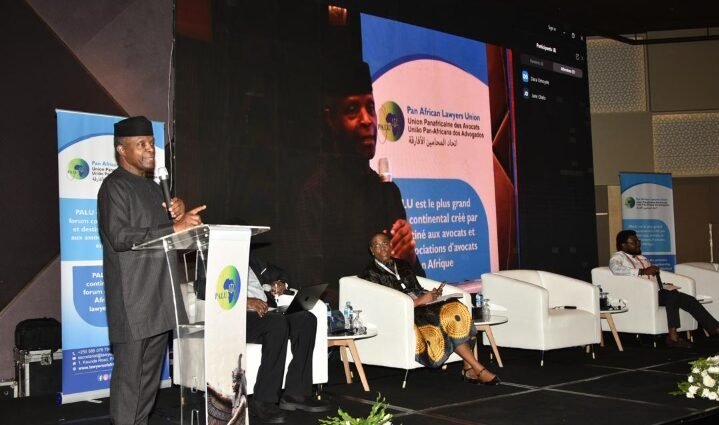
Osinbajo spoke in Cairo, Egypt at a session convened during the 16th Annual Conference of the Pan African Lawyers Union (PALU) to deliberate on the proposed Cairo Declaration on Child Rights and Design Accountability in the Digital Age.
The high-level session, titled: “Guardrails, Not Gates: Protecting Children in the Digital Age,” was organised by Justice Research Institute (JRI), in collaboration with the African Alliance for People-Centred Justice (AAPCJ) and with support from Luminate.
Osinbajo, who chaired the session, emphasised the need to move beyond approaches that place the primary responsibility for online safety on children and parents.
“We cannot build digital environments in which the risks are engineered into the product and then expect children and parents to carry the responsibility for managing those risks.”
The former VP, also a professor of Law, stressed that Africa’s response must be grounded in rights, accountability and innovation.
He observed that effective regulation should not seek to shut children out of the digital world but should ensure that the digital world is designed with their safety, dignity and development in mind.
“The objective is not to build gates that exclude children from technology.
“It is to establish guardrails that ensure technology works for children rather than exploiting their vulnerabilities,” he said.
Also speaking, Mrs Idumu-Shado, said the Cairo initiative reflected the need for African policymakers and legal practitioners to move from reacting to digital harms to shaping the rules and standards that govern digital design.
“Children in Africa are entering a digital environment largely designed elsewhere.
“We must ensure that African children are not merely protected from the consequences of technology but that their rights and interests are considered in how digital technologies are designed, deployed and regulated.
“A people-centred approach requires us to ask a simple question: does the digital environment serve the best interests of the child?
“If it does not, then the law must require those who design and profit from these systems to change the way they operate,” she said.
The director noted that the proposed declaration would provide an opportunity for African lawyers, regulators, civil society and technology stakeholders to establish a common continental position.
She said it would also allow individual countries to develop context-specific legislation and regulation.
NAN reports that lawyers, judges, regulators, policymakers and child-rights’ advocates across Africa were in attendance of the programme oranised to advance continental standard for children’s digital rights.
It was aimed at developing the draft Cairo Declaration on Child Rights and design accountability in the digital age.
The discussions focused on a fundamental question: “who should bear responsibility when digital products and artificial intelligence systems designed for children expose them to exploitation, manipulation, harmful content, excessive data collection and other digital risks?”(NAN)
Edited by Sadiya Hamza