


By Joan Odafe and Glory Akpan, News Agency of Nigeria (NAN)
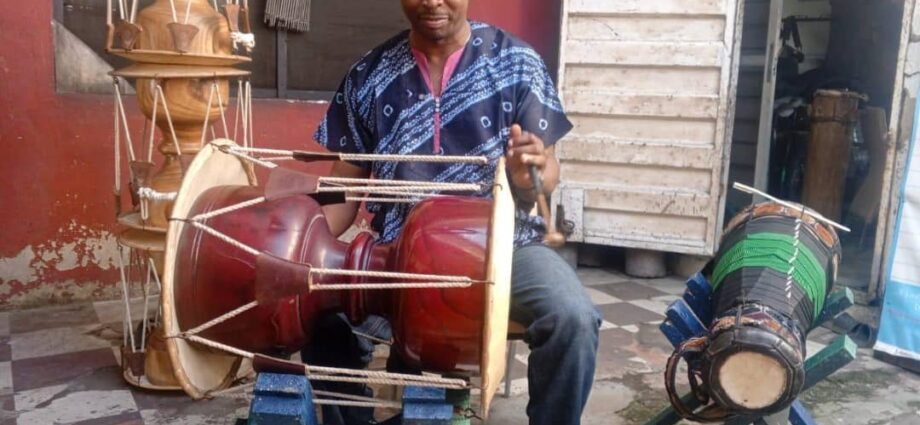
For Nigerian drummer Isioma Williams, the Korean Janggu is more than a foreign percussion instrument.
It has become a cultural mirror, showing what Nigeria could achieve by investing more deliberately in its indigenous drums and traditional music.
Janggu is a traditional Korean hourglass-shaped drum with two drumheads, played using distinct sticks that produce different sounds.
Williams encountered the Janggu after a fellow artiste returned from a residency in South Korea and told him about an opportunity for a Nigerian drummer.
The invitation took Williams to South Korea, where he was attached to the National Theatre of Korea and later Kyunghee University.
He also had to learn Korean because much of the music instruction was conducted in the language, eventually completing the university programme with a B grade.
For Williams, learning Janggu was challenging but its sound, technique and appearance immediately reminded him of Nigerian percussion traditions.
“ Janggu is a traditional drum, not really a modern drum ,though it looks unique, it looks modern.
“That’s how I got attached to it. So. it looks interesting. Very simple, though,” he said.
Williams, who is also known as ‘Papa Bata’ because of his familiarity with Yoruba Bata drumming, recognised similarities in its tones and playing techniques.
“So the tone, the tonation, too and the manner of the technique of playing it, I’m quite familiar with it.
“And it’s similar to our own drums here,” he said.
Yet Williams does not want Nigerians to replace their indigenous instruments with the Janggu.
His argument is that Nigeria should study Korea’s approach and apply useful lessons to its own Bata, Dùndún, Gangan, Sakara, Igba and other traditional drums.
“If the South Koreans can cherish their Janggu drums, and they are projecting it, that’s not the only traditional instrument they have, but they are pushing, projecting the Janggu drum as theirs, so, what stops us from doing more?” he asked.
His teaching, therefore, became an exercise in cultural translation, combining Korean Janggu techniques with Nigerian approaches to rhythm and performance.
While teaching, he found himself simplifying the technique by adding his experience in teaching the Janggu drum with the Nigerian style.
The workshops eventually trained more than 100 people, prompting Williams to ask what would happen after participants acquired the skill.
That question helped produce the recently held Janggu Festival Nigeria and Janggu Competition, creating a platform for participants to perform, compete and demonstrate their skills.
In the future, Williams also hopes participants can receive opportunities to continue their training in South Korea, while Korean experts who taught him could visit Nigeria.
“The festival can consequently become both a cultural celebration and a conversation about the future of traditional drumming in Nigeria”.
Williams believes Nigeria’s numerous indigenous drums are insufficiently documented, taught, developed and promoted, leaving valuable knowledge vulnerable to extinction.
He emphasised that traditional instruments could support performers, teachers, carvers, repairers and manufacturers.
“We have to build the little industry we have now. We have to expand it. We have to make a proper living out of it.
“Create a future out of it,” he said.
He also wants Nigerian drumming to receive stronger theoretical foundations through notation, documentation and formal learning.
His experience in Korea exposed him to textbooks and structured music theory, something he had not previously encountered as a traditional drummer.
“When I got there, they brought out a book, a text that we have to follow.
“So it was very strange,” he said.
The experience pushed Williams to introduce basic music theory, notation and scoring into his Nigerian workshops, hoping future drummers would not face similar difficulties.
He acknowledged the support of The Korean Cultural Centre Nigeria for the festival and broader cultural exchange.
The need to pass knowledge forward is already evident in the work of Oma Harrison, one of his students.
After attending Williams’ workshop, Harrison began teaching children, even though she lacked regular access to Janggu instruments.
“So we have to use buckets.
“At first, I started with buckets to learn this Janggu, to play this.
“I used the same buckets to teach the children with the knowledge I gained from Mr. Isioma Williams,” she said.
Classroom chairs also became practice instruments, while children aged three to 11 learnt gradually, sometimes mastering only two beats in a day.
Harrison appealed for support to make instruments available to learners.
At the festival’s grand finale, the National Association of Nigerian Theatre Arts Practitioners’, National President, Adeniran Makinde, described the Janggu as a vessel for cultural memory, stories, emotions and communal identity.
Makinde described the meeting between Korean and Nigerian percussion traditions as a conversation between cultures rather than a simple musical encounter.
He urged stakeholders to ensure traditional arts remained living practices rather than museum pieces.
“Let us use the drum to speak – not the language of division but the language of friendship,” he said.
The message echoed remarks by Korean Ambassador Yo-an Jeong at the 2026 Poongryu Festival, where he linked cultural identity with national dignity and international friendship.
“Freedom gives a nation its dignity; culture gives a nation its soul and when cultures meet in freedom and mutual respect, friendship between nations grows stronger,” he said.
Jeong also noted that Korean popular culture had deep historical roots, with K-Pop, dramas and films representing modern expressions of that cultural spirit.
“The K-Pop you listen to, the Korean dramas you watch, and the Korean films enjoyed around the world are modern expressions of a cultural spirit with deep roots in Korean history,” he said.
Williams believes that cultural journey offers Nigeria a lesson: indigenous traditions can remain relevant when they are valued, documented, taught and deliberately promoted.
His ambition is therefore not to make Nigeria Korean but to make Nigerians more conscious of what they already possess.
He is particularly interested in Janggu’s simplicity and portability, believing Nigerian drums could also be redesigned without losing their cultural identity.
“Most of our drums are very heavy, so it’s difficult for us to transport it to venues for our events.
“Why can’t I love my Igba? Why can’t I like my Duma? Why can’t I like my Bata and Sakara and Dundu?
“We should know how to maintain it,” he said.
For Harrison, the work has already begun with children learning rhythms using whatever is available.
For Williams, it is a longer journey requiring training, instruments, documentation, cultural institutions and sustainable opportunities.
“I’m just a starter. I need people to carry on the gospel,” he said.
The Janggu may have travelled from Korea to Nigeria, but Williams hopes its greatest legacy will be helping Nigerians rediscover, develop and pass on their own drums to generations yet unborn. (NANFeatures)www.nannews.ng
Edited by Vivian Ihechu
***If used, kindly credit the Writer and News Agency of Nigeria (NAN)***