


By Olasunkanmi Onifade
The Chemical Society of Nigeria (CSN) has called for increased investment in research, innovation and industry partnerships to translate scientific discoveries into industrial value.
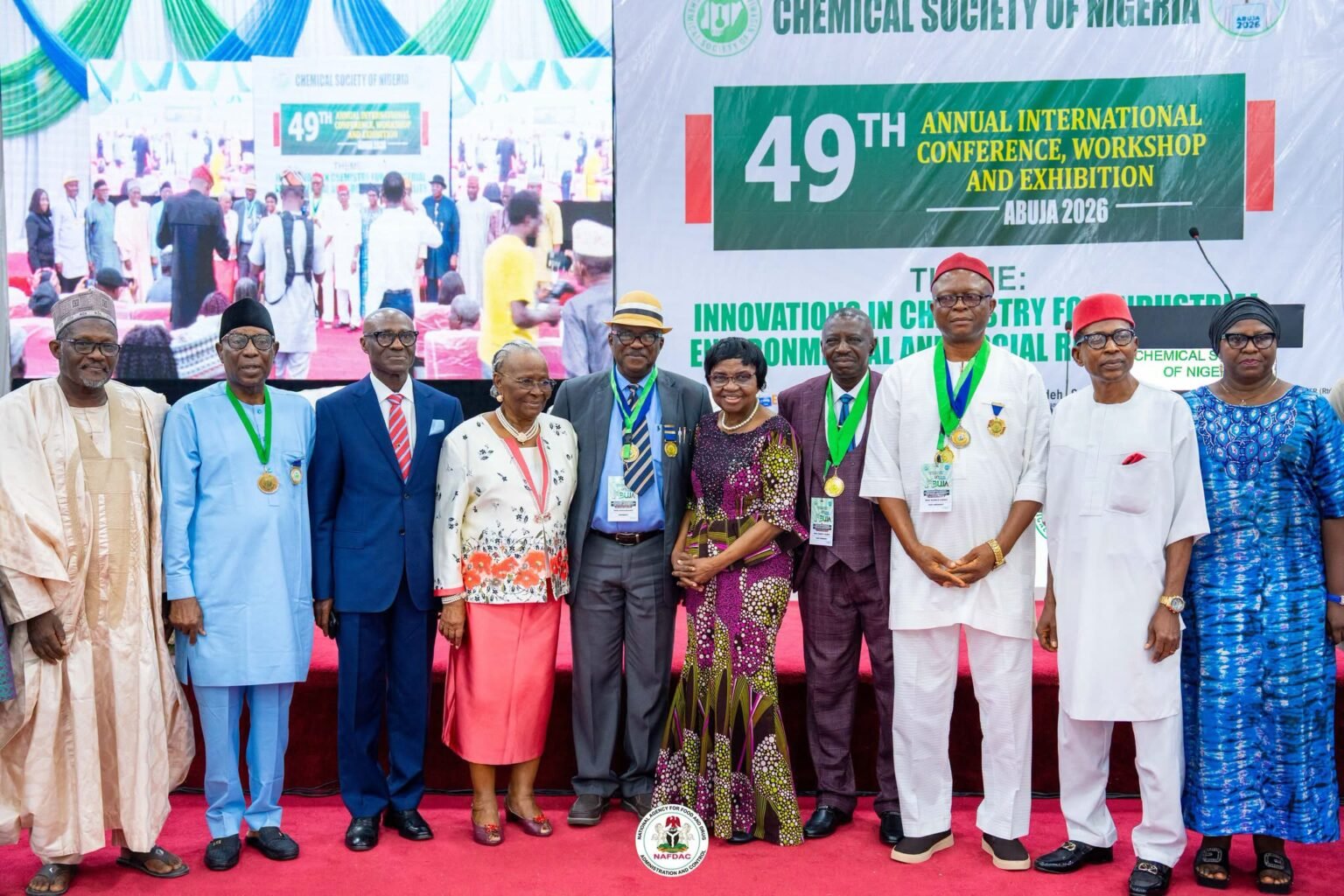
CSN President, Prof. Rufus Sha’atu, made the call at the ongoing society’s 49th Annual International Conference, Workshop and Exhibition in Abuja on Wednesday.
The conference, themed “Innovative Chemistry for Sustainable Development and Responsible Care,” is attracting more than 1,200 participants from Nigeria and other countries.
Sha’atu said scientific discoveries would have limited impact if researchers could not move them beyond the laboratory into commercial and industrial applications.
“When researchers gather at a conference such as this, they share ideas and showcase their discoveries, but this is mostly at the laboratory scale.
“Developing beyond that level is what the organised private sector should invest in, and this is what is lacking in our nation. It needs to be addressed as a matter of urgency,” he said.
He said chemistry was central to food production, medicine, energy, clothing, transportation and other aspects of modern life.
According to him, chemistry contributed to 11 of the 17 UN Sustainable Development Goals (SDGs).
Sha’atu said the society was promoting responsible chemistry, with emphasis on environmental sustainability, social safety and security.
He said CSN had introduced a Business Roundtable to expose young chemists to entrepreneurship and encourage the development of chemistry-based start-ups.
He also called for the resolution of challenges surrounding the Institute of Chartered Chemists of Nigeria (ICCON), describing it as an important regulatory institution for chemistry professionals.
Sha’atu urged governments and the organised private sector to partner with CSN to strengthen the application of chemistry in healthcare, agro-processing and environmental management.
The Director-General of the National Agency for Food and Drug Administration and Control (NAFDAC), Prof. Mojisola Adeyeye, said chemistry remained central to the agency’s functions, including product evaluation, quality assurance, safety monitoring and enforcement.
Adeyeye urged researchers to develop local solutions and strengthen domestic pharmaceutical manufacturing, particularly through medicinal and pharmaceutical chemistry.
She called for stronger collaboration among academia, industry, government and regulatory agencies to improve access to affordable medicines and bridge the gap between research and commercialisation.
Adeyeye said NAFDAC was strengthening regulatory science, digitalising regulatory processes, accelerating registration pathways for priority medicines and enhancing pharmaceutical traceability while maintaining standards of quality, safety and efficacy.
In his keynote address, Prof. Goodwill Ofunne, Chairman, FISAS Group, said innovation in chemistry should focus on producing useful products while consuming fewer resources and generating less waste.
“The future belongs to chemists who embrace green chemistry — those who do more with less and innovate processes that promote environmental sustainability and social responsibility,” he said.
Ofunne said digitalisation, artificial intelligence-driven analysis, advanced catalysts, biodegradable polymers and low-carbon products were transforming the chemical industry.
He identified the oil and gas sector as an area where chemistry-based innovation could generate greater value for Nigeria.
According to him, petroleum chemistry was important in oilfield chemicals, crude separation, refinery processes, pipeline corrosion control and enhanced oil recovery.
Ofunne called for greater attention to gas utilisation and reduction of gas flaring, saying advances in hydrocarbon chemistry could support efficient resource use and reduce environmental impacts.
The Minister of Defence, Gen. Christopher Musa, represented by Rear Adm. Olusanya Bankole, called for closer collaboration among scientists, defence institutions, government agencies, industry and universities to address emerging security challenges.
Musa said the inclusion of forensic and advanced chemistry for national security, safety and justice delivery in the conference programme reflected the growing role of science and technology in national security.
“This reflects the growing role of science and technology, as well as specialised expertise and training, in strengthening national security, ensuring public safety and enhancing confidence in our institutions,” he said.
He urged universities and security institutions to explore research grants and collaborative programmes to translate scientific knowledge into practical security applications.
The conference also featured the election of new CSN national executives, including Dr Ebitimi Berezi, President-elect; Chm. Buba Usman Shanu, Vice President-elect; Chem. Kehinde Oisemaye, Secretary-elect; and Prof. Joseph Akan, Membership Secretary-elect.
Others elected were Chm. Isijaan Nkanta, Publicity Secretary-elect; Dr Frank Oteiva, Assistant Secretary-elect; Prof. Theresa Onuegbu, Financial Secretary-elect; and Dr Stella Nweze-Akpa, Treasurer-elect.
Six other national deputy vice-presidents were also elected.
Highlights of the conference included the presentation of awards to winners of the national chemistry quiz competition from three states.
Special awards were also conferred on the Ministers of Environment; Defence; and Innovation, Science and Technology. (NAN)
Edited by Uche Anunne
Comments