


By Felicia Imohimi
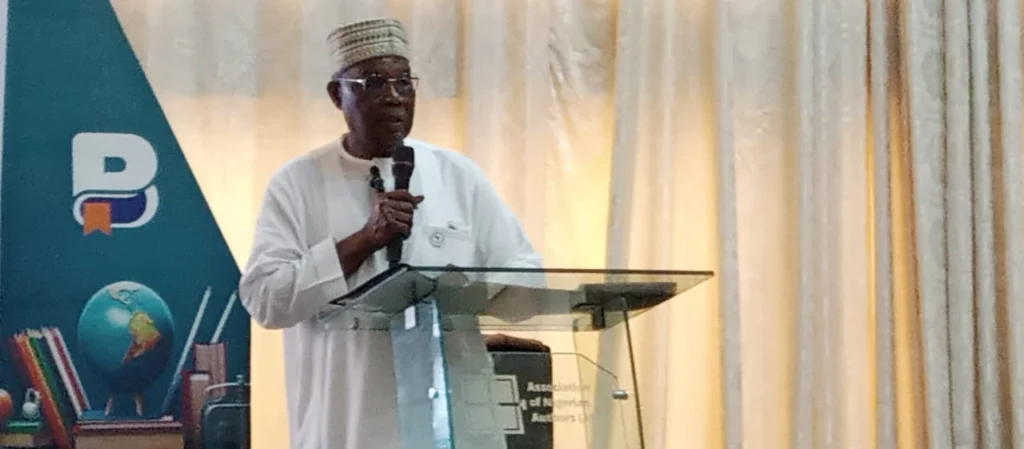
Dr Bukar Usman, former Permanent Secretary in the Presidency, has urged Nigerian writers to use literature as a tool for nation-building, peace and national security.
Usman, former President of the Nigerian Folklore Society (NFS) and President of the Dr Bukar Usman Foundation, gave the advice in his address at the 45th Annual International Convention of the Association of Nigerian Authors (ANA) in Abuja.
The News Agency of Nigeria (NAN) reports that the convention had the theme: “Literature, National Security and the Place of Nigeria in the World.”
Usman, who said national security remained dear to him, having been his preoccupation during his long years in public service, described effective national security as the bedrock of national development.
According to him, literature is very powerful and must be deployed with responsibility.
“The power of a pen can destroy anything. Today, you do not need sophisticated tanks and artillery to destroy a country.
“Propaganda and mass disinformation can destroy a country.
The saying that the pen is mightier than the sword remains true. Writers must use their influence with circumspection.
“We sing the national anthem about our motherland. You cannot address your father and mother in a disrespectful manner. But you can beg and submit to your mother and father with respect,” he said.
He said that while citizens might not be satisfied with some developments in the country , criticism must be laced with respect for the nation.
Usman said national security goes beyond protection of life and property to include provision of welfare and protection of government from subversion.
Usman said current internal security challenges confronting the country included communal conflicts, armed robbery, banditry, kidnapping, herders-farmers conflicts, electoral violence and border disputes.
According to him, commentators have blamed them on faulty security architecture, inadequate training and lack of modern equipment, adding that the identified gaps needed to be addressed.
Usman, who lauded the current move to decentralise policing however, recommended that the initiative should extend to the local government level.
Usman faulted some foreign studies ranking countries on violence, poverty, development index, maternal mortality and out-of-school children.
He said such studies did not present an edifying picture of Nigeria, though they are often laced with abuse of statistics.
“There is urgency in addressing those developmental gaps and writers have a role in bringing them to the attention of authorities,” he said.
On Nigeria’s literature and the Nigerian predicament, he said six broad areas attracted the attention of Nigerian writers since independence in 1960.
He said they as conflict of colonial and indigenous cultures, corruption, military dictatorship, civil war, ethno-religious violence, and human rights and gender issues.
Usman said Nigerian writers had done the country proud but warned against writing bitterly in a manner that could damage the nation’s image.
“As writers, we can help the country to solve some of these challenges by highlighting them constructively.
“While one may have cause for reservations and disappointments about some happenings, it is abominable to castigate or disown one’s parent.
“However bitter one might feel, it must be expressed in a restrained and constructive manner, the way a child will address a parent or an elder,” he said.
He emphasised that freedom of expression as guaranteed under the Constitution is not absolute, adding that writers must not breach laws against treason, subversion and libel.
“There is a lesson in our living memory of a notable foreign citizen who misapplied his literary endowments to dismember his country.
“Current mode of warfare may not necessarily require sophisticated tanks and artillery as propaganda and disinformation through literature could be devastating enough to do the job,” he warned.
He expressed satisfaction that Nigeria has maintained its territorial integrity since independence in spite of challenges. (NAN)
FUA/KUA
========
Edited by Uche Anunne

Comments