










By Nana Musa
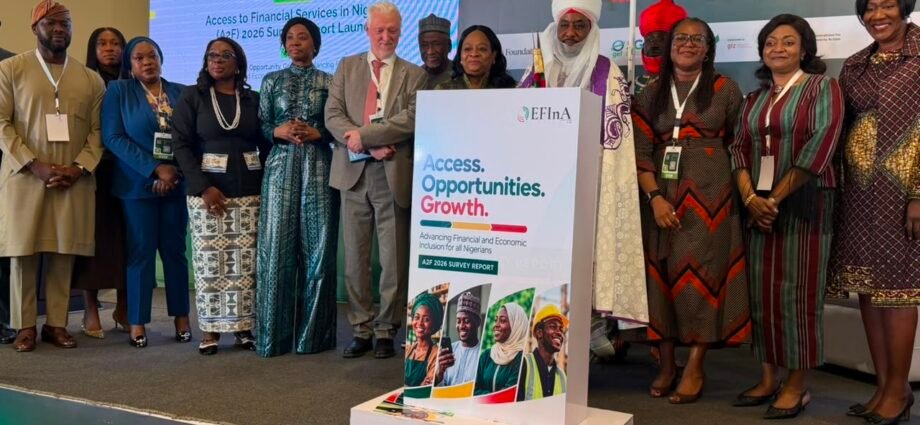
The Board Chair of Enhancing Financial Inclusion & Advancement (EFInA), Dr Agnes Martins, has urged stakeholders to ensure that financial access creates opportunities and economic empowerment.
Martins made the call at the inguration of the 2026 Access to Financial Services in Nigeria (A2F) survey report, in Abuja on Wednesday.
The programme was with the theme, “Access, Opportunity, Growth: Advancing Financial and Economic Inclusion for All Nigerians”.
Martins said that the survey reflected Nigeria’s next phase of financial inclusion, focused on access, opportunity and growth.
She said EFInA worked with government, regulators, financial institutions and development partners to address barriers and strengthen inclusive markets.
According to her, the A2F survey has provided nationally representative evidence since 2008, capturing Nigerians’ experiences with financial services.
Martins said that the EFInA’s 2024-2029 strategy focused on ensuring that Nigerians were financially included and economically empowered, with greater emphasis on usage, quality and impact.
“Access is only the beginning of the journey. It is not the destination,” she said.
She urged stakeholders to assess whether financial participation expanded opportunities and helped households and businesses manage their finances.
She said that the 2026 survey was timely, given changes in the country’s economy, digital channels and financial services landscape since 2023.
Martins said that Nigerians had diverse needs based on income, gender, location, age and economic activity, warning against policies designed for an “average” consumer”.
“The evidence must help us understand not only where the gaps are, but what is driving them,” she said.
Martins urged policymakers, regulators, financial service providers, governments and development partners to use the findings to guide policies, products and investments.
She said that the ultimate goal was for financial access to create opportunities and support economic advancement.
She commended the Central Bank of Nigeria (CBN), National Bureau of Statistics, development partners, financial institutions, the EFInA team and Nigerians who participated in the survey.
According to her, the next phase of financial inclusion should be measured, not only by access, but by the opportunities and growth it enables.
The Director-General of the National Pension Commission (PenCom), Ms Omolola Oloworaran, called for deeper pension inclusion through the A2F survey.
Oloworaran said that financial inclusion should focus on improving lives, resilience, security and well-being, rather than merely opening accounts.
She said that pension participation increased from 7.8 per cent of adults in 2023 to 9.1 per cent in 2026.
She, however, said that about nine in every 10 Nigerian adults remained outside formal pension arrangements.
Oloworaran identified traders, farmers, mechanics, drivers, tailors, hairdressers and digital workers among those needing greater pension coverage.
She said that PenCom was committed to expanding pension coverage through the Personal Pension Plan (PPP).
She urged stakeholders to develop a dedicated pension inclusion model showing what could encourage Nigerians to start and sustain pension savings.
The PenCom Director-General also called for a pension inclusion map capturing exclusion by geography, gender, age, occupation and income.
According to her, such data will help identify why pension gaps persist and guide effective policy interventions.
Oloworaran further urged stakeholders to test innovative approaches, including digital onboarding, accredited pension agents and transaction-based savings.
She said that the matching incentives and behavioural approaches should also be tested among Nigerians and independently evaluated.
“Opening a pension account is not by itself pension inclusion,” she said.
She said that an unfunded pension account could not provide adequate retirement security.
Oloworaran said the true measure of pension inclusion was consistent savings and sufficient accumulation for retirement.
She said the value of the A2F survey would ultimately depend on changes resulting from its findings.
The Director-General expressed the determination of ensuring that every working Nigerian could build a pension easily and affordably.
She said pension products should reflect the different ways Nigerians earn income.
She said that collaboration among government, PenCom, pension operators, technology providers and researchers could expand retirement security for millions. (NAN)
Edited by Kadiri Abdulrahman