


By Oluwafunke Ishola
The International Organisation for Migration (IOM) and Economic Community of West African States (ECOWAS) have called on the media to intensify public awareness of the ECOWAS National Biometric Identity Card (ENBIC).
They described accurate information as critical to the success of the regional initiative.
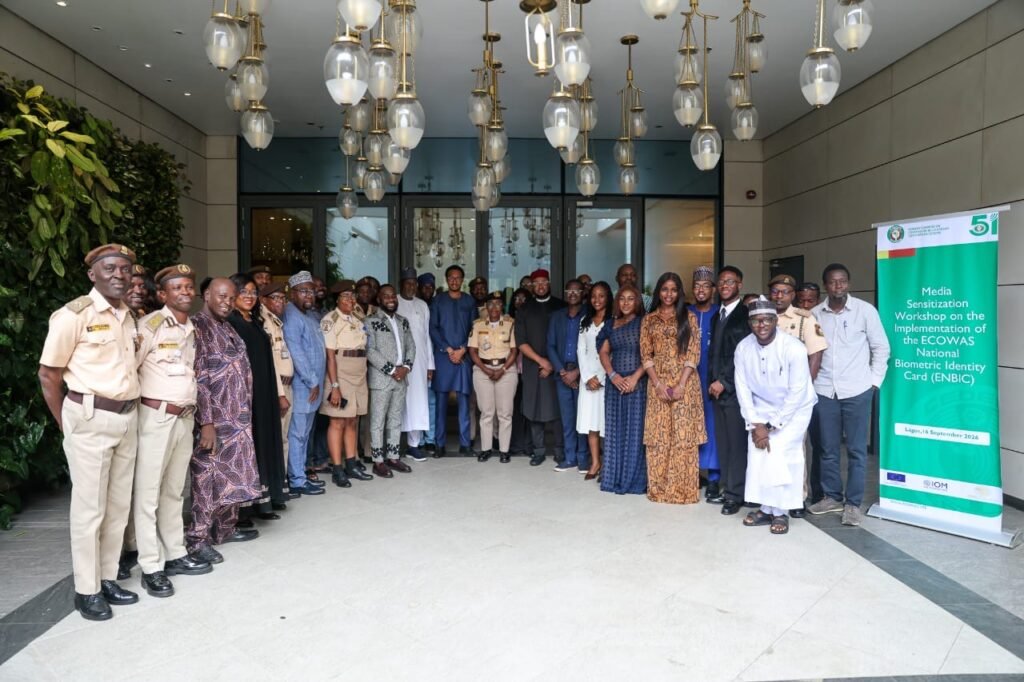
The call was made at a Media Sensitisation Workshop on ENBIC on Wednesday in Lagos.
ENBIC is a secure digital travel credential that replaces the old paper-based ECOWAS travel certificate.
The biometric identity system was designed to facilitate safer, more secure and predictable movement of people across West Africa while strengthening regional integration.
The workshop brought together officials of the Nigeria Immigration Service (NIS), ECOWAS institutions, development partners and media professionals to deepen understanding of the card.
It was also to highlight its implementation process, institutional responsibilities and its implications for citizens exercising their right to free movement within the region.
Ali Ibrahim, IOM Head of Suboffice, Lagos, commended Nigeria on the successful inauguration of the ENBIC in 2025, describing the development as an important milestone in the country’s implementation of regional integration instruments.
According to him, the initiative is consistent with the ECOWAS Protocol on Free Movement of Persons, Residence and Establishment and contributes to wider efforts to promote safe, orderly and regular migration.
He added that ENBIC also supports the objectives of the Global Compact for Safe, Orderly and Regular Migration, particularly in the areas of strengthening identity management systems, improving regular migration pathways, enhancing border governance and promoting cooperation among countries.
Ibrahim commended the ECOWAS Commission for its coordination role in supporting Member States in implementing the regional initiative.
According to him, IOM will continue supporting ECOWAS and Member States through the Free Movement of Persons and Migration in West Africa Phase II (FMM II) Project.
“As the lead implementing partner of the project, our support would include technical assistance, capacity development, operational guidance, knowledge sharing and implementation support.”
The objective, he said, was to contribute to border-management systems capable of facilitating legitimate movement while strengthening security, protection and public confidence.
Ibrahim emphasised that ENBIC could contribute to that balance by strengthening identity assurance and helping border authorities facilitate the movement of legitimate travellers more efficiently.
He underscored the role of the media in communicating the objectives and practical implications of the biometric identity card to the public.
Ibrahim described journalists as an important link between regional institutions, national authorities and citizens, particularly at a time when misinformation can spread rapidly through traditional and digital platforms.
He urged journalists to provide balanced and informed coverage that explains both the opportunities associated with free movement and the measures being undertaken to strengthen border governance, security and protection.
He also encouraged the media to focus on the experiences of communities and groups directly affected by regional mobility, including border communities, traders and young people.
Such reporting, he said, could help citizens better understand their rights and responsibilities under the ECOWAS Free Movement Protocol while also providing policymakers with greater insight into the practical realities of mobility across the region.
“The success of ENBIC will ultimately be measured not only by the number of cards issued, but by the extent to which it contributes to safer mobility, stronger regional integration, increased economic opportunities, and a better experience for citizens moving across ECOWAS borders.”
Similarly, Obinna Ajugwo from the Border Management ECOWAS Commission said the workshop comes at a critical moment in the collective journey toward a more connected, secure, and prosperous ECOWAS sub-region.
Ajugwo said the initiative was conceived and endorsed by the region’s Heads of State and Government against the background of increasing mobility and the corresponding need for stronger identity and border-management systems.
According to him, Nigeria is the seventh ECOWAS country to operationalise ENBIC, after Benin, Ghana, Guinea-Bissau, Gambia, Senegal, and Sierra Leone.
He described ENBIC as more than a card, saying it represents a mechanism for inclusion and an instrument for facilitating safe, secure and efficient movement within the ECOWAS region.
“However, the success of this initiative does not depend solely on technology or policy frameworks. It depends on people. It depends on trust. And it depends on information.”
According to him, the media play an indispensable role in disseminating and sensitising the public, describing the workshop as a partnership-building platform.
Also, Bennett Chiagoro, Deputy Comptroller of Immigration, ECOWAS and other travel documents NIS HQ Abuja, said implementing ENBIC is a statutory duty which the Service would execute with the utmost rigour and commitment.
“However, an identity and mobility project of this magnitude cannot succeed in a vacuum. The media remains our most critical bridge to the public.
“Accurate information dissemination is absolutely essential to educate our citizens on what the ENBIC is, its eligibility criteria, and how it simplifies cross-border travel.
“Misinformation at points of entry benefits no one, and that is why your role as journalists and media influencers is indispensable to the acceptability and success of this project.”
He disclosed that the official fees for acquiring the ENBIC are N35,500, including bank charges. (NAN)
Edited by Vivian Ihechu



Comments