










By Rukayat Moisemhe
Stakeholders in Nigeria’s automotive sector have called for affordable vehicle financing tailored to Nigerians’ cash-flow patterns to support domestic production, ease mobility costs and make vehicles more accessible as productive assets.
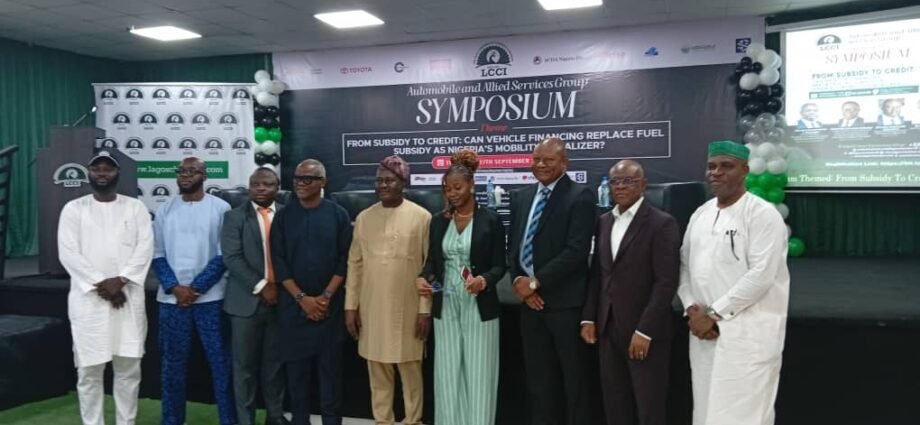
They made the call at the Lagos Chamber of Commerce and Industry (LCCI) Automobile and Allied Services Group Symposium on Thursday in Lagos.
The symposium had the theme: “From Subsidy to Credit: Can Vehicle Financing Replace Fuel Subsidy As Nigeria’s Mobility Equaliser?”
Dr Femi Eguaikhide, Chairman, Auto and Allied Sectorial Group, LCCI, said for millions of Nigerians, a vehicle was not simply a means of transportation but a workplace and an income-generating asset.
He noted that fuel subsidy initially helped to lower mobility costs for decades but its removal in May 2023 had created an urgent need for an alternative framework.
According to him, the issue was no longer whether subsidy should return but what sustainable mechanism could replace its mobility function.
Eguaikhide said vehicle financing could provide that mechanism if loans were affordable and structured around how Nigerians actually earn their income.
He noted that less than five per cent of vehicles in Nigeria were financed, describing the low level of financing as both a challenge and an opportunity.
“If subsidy equalised consumption, credit can equalise ownership,” he said.
Eguaikhide called for single-digit interest rates, longer repayment periods and lease-to-own arrangements, particularly for commercial transport operators and other informal-sector users.
He said that financing products should reflect the cash-flow patterns of Nigerians, including daily repayment options for transport operators and other businesses with daily income.
He also advocated the use of alternative data, including telematics, GPS tracking, Point-of-Sale transactions, cash-flow records and transport union records, to assess borrowers who lacked conventional credit histories.
“A 25 per cent bank loan for a N15 million bus is not financing. It’s a trap.
“Banks don’t lend to danfo drivers because they have no credit score. But that driver has two years of daily cash-in from his route,” he said.
He said using such data would enable financial institutions to finance the productivity of vehicle users rather than rely solely on conventional collateral.
Beyond helping Nigerians acquire vehicles, Eguaikhide added that financing should be deliberately directed toward vehicles and technologies that could reduce transportation costs and deepen local production.
Mr Leye Kupoluyi, President, LCCI, represented by Mr Opeyemi Aminu, Vice President, said the removal of fuel subsidy had fundamentally changed the economics of mobility and increased transportation costs for households and businesses.
Kupoluyi said the development provided an opportunity to rethink mobility support by moving from consumption subsidy to productive asset financing.
He, however, cautioned that vehicle financing would not automatically solve the problem if interest rates remained high, loan tenors short, vehicle prices excessive, insurance unaffordable and energy costs elevated.
“Our objective should be affordable and sustainable mobility finance, not simply more vehicle loans,” he said.
He proposed a National Vehicle Financing and Mobility Credit Framework with clear targets for access, affordability and responsible lending.
Kupoluyi also called for a Vehicle Finance Guarantee or Risk-Sharing Facility to reduce lender risk and enable longer repayment periods.
He advocated specialised financing windows for commercial and income-generating vehicles, particularly for transport operators, logistics companies, MSMEs and agricultural value chains.
Chief Anselm Ilekuba, Chairman, Association of Local Content Manufacturers Association of Nigeria (ALCMAN), said vehicle financing could also become a tool for industrialisation if it prioritised Nigerian-made and locally assembled vehicles.
He was represented by Mmesoma Ilekuba, Head of Strategy, Cedric Masters Group.
Ilekuba said the major challenge facing the automotive industry was not lack of demand but affordability.
According to him, high financing costs, short repayment periods and pressure on household incomes were making vehicle ownership difficult, even where Nigerian assemblers had the capacity to produce competitive vehicles.
“We therefore need a financing architecture designed around the realities of the Nigerian automotive industry.
“This is why I believe the proposed National Automotive Bank being championed by the National Automotive Design and Development Council deserves serious national consideration and support,” he said.
Ilekuba stressed that the bank should not simply become another government financial institution.
According to him, it should be designed as a specialised automotive financing platform capable of supporting the entire value chain—from purchasing a locally assembled vehicle, to the assembler expanding production, to the component manufacturer investing in machinery and tooling.
He also called for greater localisation of automotive components, including tyres, batteries, glass, seats, wiring harnesses, plastics, filters, brake and suspension components.
“Increased local production of components would reduce foreign exchange requirements while creating jobs across manufacturing, logistics, technology, maintenance and other related sectors,” he said.
Mr Joseph Osanipin, Director-General, National Automotive Design and Development Council (NADDC), said vehicle financing could provide a more sustainable approach to mobility by enabling individuals, businesses and transport operators to acquire vehicles and pay for them over time.
He was represented by Mr Timothy Tanko, Principal Information Officer.
Osanipin, however, stressed that credit alone was not enough but that financing must be affordable, accessible and sustainable, with repayment terms reflecting the realities of Nigerian consumers and businesses.
“Most importantly, financing should support Nigerian-made and locally assembled vehicles.
“This will not only expand access to mobility but also stimulate local manufacturing, create jobs, strengthen the automotive value chain and reduce dependence on vehicle imports,” he said.
Osanipin stressed that government, financial institutions, manufacturers and other stakeholders must collaborate on innovative financing models, including affordable loans, leasing, fleet financing and credit guarantees.
He stated that with the right policies and partnerships, vehicle financing can become a powerful instrument for mobility, economic inclusion and automotive industrial development.(NAN)
Edited by Oluwole Sogunle