


By Sumaila Ogbaje
A former Minister of Power, Prof. Bathlomew Nnaji, has commended the Nigerian military for demonstrating that Nigeria can achieve self-reliance in science, technology and defence production.
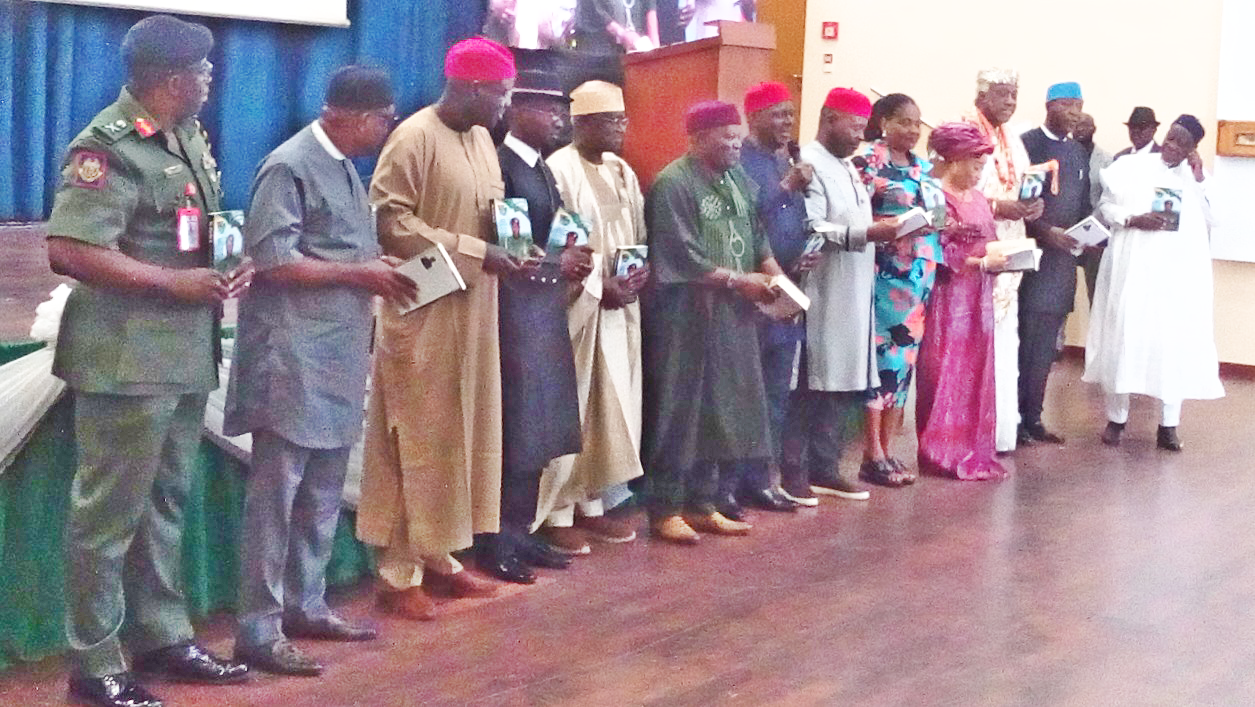
Nnaji gave the commendation at the public presentation of a book titled “We Can Do It – Towards Nigeria’s Self-Reliance in Science and Technology,” written by retired Maj.-Gen. Nnaemeka Maduegbunam,
Maduegbunam was a former Director-General of the Defence Industries Corporation of Nigeria (DICON).
Nnaji said that DICON remained critical to Nigeria’s technological and defence advancement, adding that Maduegbunam had demonstrated the ingenuity and brilliance within the military by helping to revive DICON during his tenure as Director-General.
“What Maj.-Gen. Nnaemeka Maduegbunam has done is to show the brilliance that actually exists within the military.
“Before his arrival at DICON, the organisation was basically moribund, but he used his ingenuity and brilliance in engineering to restart that very important institution,” he said.
The former minister said the development of indigenous defence capabilities was essential to reducing Nigeria’s dependence on imported military hardware and addressing economic challenges.
According to him, local production of defence equipment will help reduce costs, conserve foreign exchange and strengthen Nigeria’s technological capacity.
Nnaji, who spent part of his career in the United States, said the U.S. military had demonstrated the importance of collaboration between the armed forces, research institutions and private industries in developing military technologies.
He said Nigeria could adopt a similar model by enabling DICON to work closely with research institutions and indigenous private companies to develop and mass-produce defence equipment.
“I had the privilege of seeing how the American military worked to produce all those weapons that you see.
“The weapons are not simply produced by industries without the participation of the military. The military plays a critical role in research, design and prototyping before industries take over for mass production,” he said.
Nnaji also commended emerging Nigerian companies involved in the production of drones, saying partnerships between such firms and DICON would accelerate indigenous defence manufacturing.
He said DICON should be empowered to identify the military’s technological needs, develop prototypes and collaborate with civilian industries for mass production.
“That is the sort of thing that should be done. The military, using DICON, should be able to think about what it wants to produce, show how it can be done and allow civilian industries to participate through partnerships,” he said.
Nnaji expressed optimism that Nigeria could attain greater self-reliance in science, technology and defence production if the country sustained such collaborations.
He congratulated Maduegbunam for documenting his experience and ideas in the book, describing the publication as a contribution to Nigeria’s quest for technological self-reliance.
“I am a firm believer that we can do it. I left the United States to come back to my own country to be part of ‘We Can Do It’,” he said.
Nnaji thereafter welcomed dignitaries to the occasion and urged participants to pay attention to the ideas contained in the book.
While reviewing the 383-page book, Dr Emeka Nwosu, a veteran journalist, described it as a priceless literary work that celebrates resilience, patriotism and Nigeria’s technological possibilities.
Nwosu said the book was divided into three parts and 11 chapters, chronicling the author’s early life to his peacekeeping exploits in Liberia and Sudan, and his transformative stewardship as Director-General of DICON.
The reviewer noted that Madubunam’s courageous response “We can do it sir” to then President Olusegin Obasanjo, earned him presidential backing of N1 billion to revive the complex.
According to Nwosu, Madubunam delivered a three-million-round ammunition contract in four months after five years of failure, revived all factory lines and produced the wholly Nigerian-made AK-47 rifle codenamed OBJ-006.
Nwosu described the book as rich, well-researched and reader-friendly, offering lessons in fortitude and selfless service, and recommended it for students of history, the military, policymakers, the scientific community and the general public. (NAN)
Edited by Isaac Aregbesola

Comments