

By Felicia Imohimi
The Small-Scale Women Farmers Organisation in Nigeria (SWOFON) has called for stronger public investment, budget accountability and inclusive policies to support smallholder women farmers in the country.
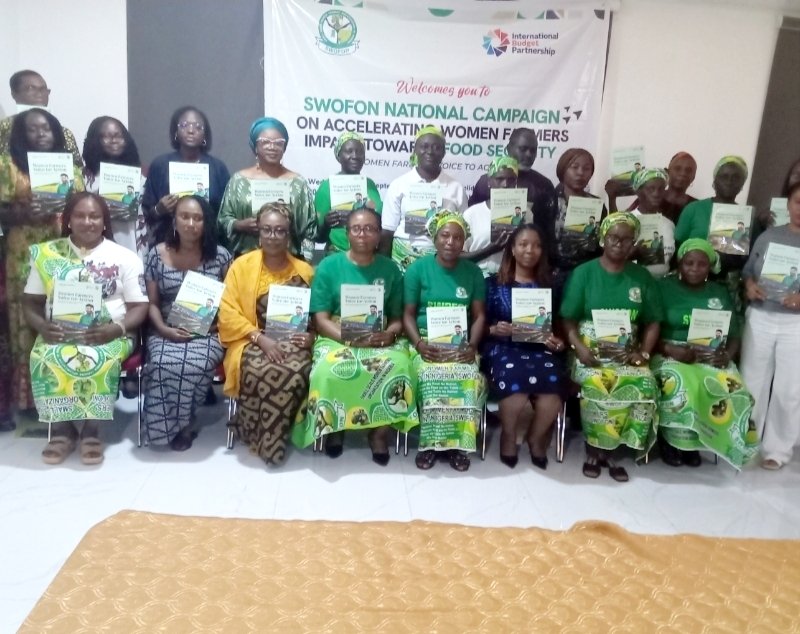
The organisation made the call on Wednesday in Abuja at the “SWOFON National Campaign on Accelerating Women Farmers’ Impact towards Food Security”, tagged “Women Farmers’ Voice to Action”.
It also unveiled the “SWOFON-International Budget Partnership (IBP) SPARK Programme Policy Brief”.
Mrs Florence Ojo, SWOFON Acting National President, said the campaign would help accelerate the economic impact of women farmers and contribute to food security.
“Our voice to action is to promote better agricultural policies and adequate budgetary provision, which we have advocated for.
“When we invest in women farmers, we invest in strong families and communities and a better future for our nation.
“Accelerating women farmers’ impact is essential to strengthening Nigeria’s food systems and improving rural livelihoods,” Ojo said.
She urged policymakers, particularly government officials, to involve women farmers in the preparation and implementation of agricultural budgets, as well as in decision-making processes.
Mrs Chinasa Asonye, National Secretary of SWOFON, said increased participation of women in policy and budget processes must be matched by identifiable budget commitments, timely implementation and equitable delivery of agricultural services.
Asonye said the campaign sought to move beyond recognising women farmers’ voices to ensuring that their priorities were reflected in government decisions, agricultural plans, public budgets and service delivery.
She said smallholder women farmers remained central to Nigeria’s food production, rural livelihoods and household welfare, but continued to face barriers relating to land, finance, agricultural inputs, mechanisation, extension services, insecurity, markets and participation in decisions affecting their livelihoods.
“Through the ‘Women Farmers’ Voice to Action’ campaign, we are calling for stronger links between the realities experienced by smallholder women farmers, evidence-based advocacy, government commitments and measurable action.
“Evidence shows progress in participation, but gaps remain in budget responsiveness.
“Findings from SWOFON’s assessment of its 2019 to 2025 partnership with the International Budget Partnership (IBP) under the SPARK project show that organised women farmers gained stronger recognition and participation in state budget processes across the five focal states.
“The states are Nasarawa, Niger, Anambra, Oyo and Jigawa.
“All five SWOFON state chapters submitted Charters of Demands to relevant government institutions during the assessment period, and the submissions were acknowledged.
“However, the assessment found that participation had advanced faster than fiscal responsiveness.
“The available evidence does not consistently demonstrate that women farmers’ demands were translated into identifiable state budget lines, timely releases, expenditure and verifiable delivery,” Asonye said.
She added that Federal Government budgetary provisions for agriculture had increased significantly in nominal terms in recent years.
According to her, the allocation increased from N228.4 billion in 2023, representing about 1.05 per cent of the federal budget, to N362.94 billion in 2024, representing 1.32 per cent, and N826.5 billion in 2025, representing 1.7 per cent.
She, however, said that in sspite of the upward trend, agriculture’s share of the national budget remained substantially below the 10 per cent Maputo/Malabo commitment used as an advocacy benchmark.
Asonye noted that based on the 2025 budget figure of about N49.7 trillion, 10 per cent would amount to about N4.97 trillion, compared with the reported N826.5 billion allocated to agriculture.
She said this represented an indicative gap of about N4.14 trillion.
“The increase in nominal allocations is therefore important but should be considered alongside the scale of Nigeria’s agricultural financing needs and the extent to which approved resources are actually released, spent and converted into services and productive assets.
“The Federal Government’s own Budget Office maintains annual appropriation and budget implementation records, providing a basis for continued monitoring of agricultural allocations, releases and expenditure.
“Our key advocacy priority is consequently not only to increase the quantum of public resources devoted to agriculture, but also to ensure that a meaningful share of those resources responds to the needs of smallholder women farmers.
“The needs include access to land, affordable finance, improved inputs, mechanisation, extension services, irrigation, storage, markets and climate-resilient agricultural technologies.
“These findings reinforce the need to move beyond budget approval to tracking the full public finance cycle, from allocation and release to expenditure, implementation and actual delivery to farmers,” she said.
Asonye said the Charter of Demands remained one of SWOFON’s key advocacy instruments for translating the experiences and priorities of women farmers into concrete policy and budget proposals.
She said the assessment found that while the charter process had improved women farmers’ access to government platforms, there was limited evidence of a consistent pathway from their priorities to budget commitments, expenditure, implementation and delivery.
Mrs Petuniya Kefas, National Treasurer of SWOFON, said the organisation’s Charter of Demands should become a practical tool for securing identifiable and costed government commitments.
Kefas said priority demands should be converted into budget lines with clearly identified beneficiaries, locations, responsible agencies, timelines and measurable delivery indicators.
“We urge governments to involve women farmers in agricultural planning and budget processes at the local government level.
“Local governments are closest to communities and play important roles in issues affecting farmers’ everyday lives.
“Creating formal opportunities for women farmers to contribute to local agricultural priority-setting will strengthen the connection between community needs, public budgets and service delivery.
“We call on the Federal and State Governments, local government councils, the National and State Houses of Assembly, development partners, civil society organisations, among others, to work with women farmers to build a more inclusive and accountable agricultural system.
“Smallholder women farmers are not only beneficiaries of agricultural development. They are producers, economic actors and critical stakeholders in Nigeria’s food security.
“Their voices must be reflected in the policies, plans and budgets that shape the agricultural sector,” she said.
The News Agency of Nigeria (NAN) reports that the campaign featured smallholder women farmers, government representatives, civil society organisations, development partners, media professionals and other stakeholders.
It focused on the challenges confronting women farmers and efforts to strengthen action around their priorities in agricultural policy, budgeting and implementation. (NAN) www.nannews.ng
FUA/TAK
Edited by Tosin Kolade

Comments