


By Joan Nwagwu
The International Trade Union Confederation-Africa (ITUC-Africa) has raised concern over declining protection of women workers against gender-based violence and harassment.
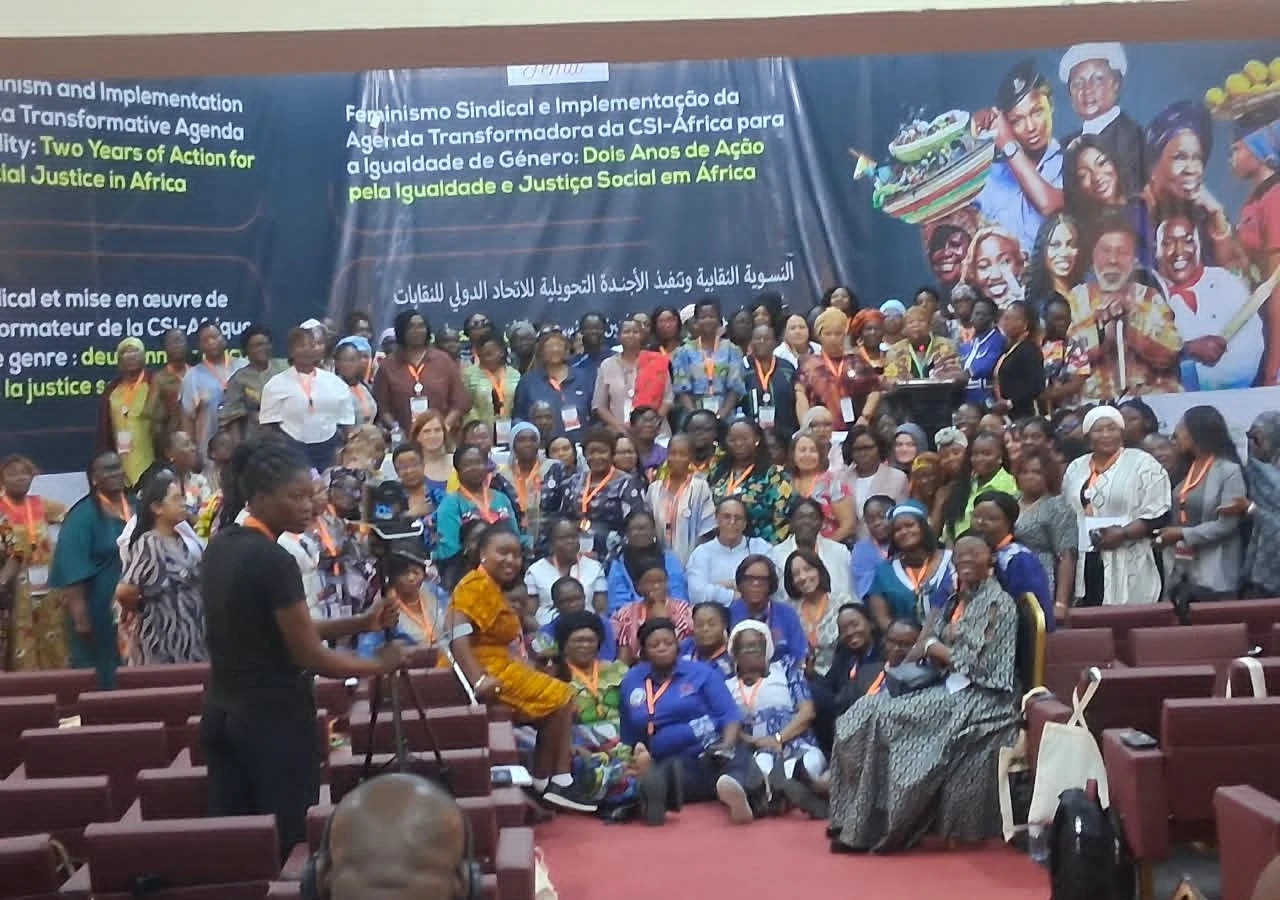
Mr Joel Odigie, General Secretary of ITUC-Africa, raised the concern on Wednesday at the organisation’s Women’s Conference in Lomé, Togo.
The News Agency of Nigeria (NAN) reports the conference is themed,
“Trade Union Feminism and the Implementation of ITUC-Africa’s Transformative Gender Agenda: Two Years of Action for Equity and Social Justice in Africa.”
Odigie said an assessment of trade unions revealed significant gaps in protecting women workers, despite progress in their participation and leadership.
He expressed concern over declining momentum in ratifying the International Labour Organisation’s Convention 190 on Violence and Harassment.
“Today, it is very low. We appeal for more work in that regard because we have not yet achieved our objectives,” he said.
Odigie said ITUC-Africa had developed a sexual harassment policy and urged affiliated unions to adopt it to strengthen workplace protection and create safe spaces.
He said the assessment, conducted by the African Labour Research and Education Institute (ALREI), received 57 responses from 51 unions across 27 African countries.
According to him, the findings identified inadequate funding, weak protection against gender-based violence, poor reporting and limited structural changes as major challenges.
“We cannot build a transformative movement on commitments that we refuse to resource,” Odigie said, urging unions to provide women adequate funding and institutional support.
He said 49 respondents reported increased efforts to organise women since August 2024, while 28 reported documented growth in women’s membership.
Odigie said women’s concerns were increasingly incorporated into collective bargaining demands at workplace, community and national levels.
He attributed increased women’s participation in union leadership to affirmative action, gender quotas and growing awareness among union leaders.
He urged unions to prioritise women in the informal economy, many of whom face economic inequality, precarious employment and limited access to social protection.
Mrs Gladys Branche, Chairperson of the ITUC-Africa Women’s Committee, said the conference would assess progress since adoption of the gender transformation agenda in Cotonou.
Branche said the committee adopted a 14-point resolution two years ago, including campaigns for ratification of ILO Conventions 190 and 189.
She said the agenda also focused on recognising care work, addressing women’s economic challenges and demanding 50 per cent representation in decision-making bodies.
Branche said women workers continued to face sexual harassment, bribery and other risks at border crossings, while gender gaps, reduced social spending and patriarchy remained concerns.
In a keynote address, Prof. Akua Britwum, Associate Professor at the University of Cape Coast, Ghana, called for trade unions to recognise social reproduction as wealth generation.
Britwum urged unions to place care at the centre of negotiations, advocate public provision and examine patriarchal control of social reproduction and its effects on society.
She also urged unions to critically examine patriarchal masculinity and its effects on men, women and society as part of efforts to advance gender equality.(NAN)
Edited by Rotimi Ijikanmi

Comments