


By Mark Longyen
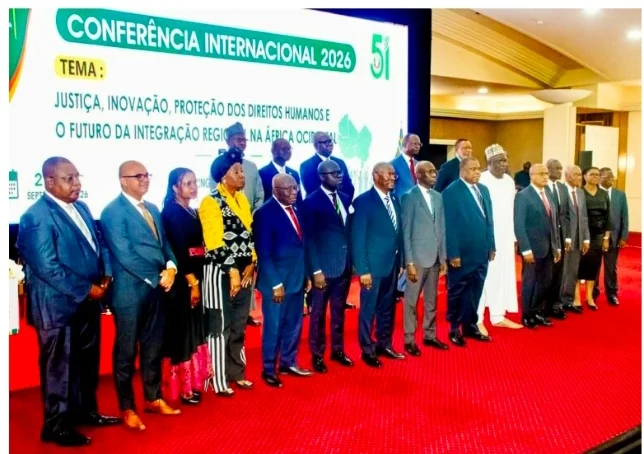
The ECOWAS Court of Justice has emerged from its 2026 annual international conference in Dakar, Senegal, with an ambitious reform agenda.
However, its biggest test, which begins after the event, is to turn recommendations into enforceable institutional change.
The five-day conference, held from Sept. 21 to Sept. 25, marked the Court’s 25th anniversary with the theme of justice, innovation, human rights and regional integration.
Its deliberations confronted the central tensions facing regional justice, which include weak enforcement, institutional independence, national sovereignty, technological change and the future credibility of ECOWAS integration.
Court President Justice Ricardo Gonçalves described the Court as being at a critical crossroads, calling for practical solutions to strengthen its contribution to regional integration.
He urged participants to produce “clear, innovative and feasible proposals” capable of strengthening the Court’s institutional framework, access to justice and judicial effectiveness.
The challenge became particularly stark when participants examined the gap between judgments delivered by the Court and their implementation by member states.
President of the ECOWAS Commission, Gen. Birame Diop, represented by ECOWAS Director, Legal Affairs, Gaye Sowe, said the gap was a major challenge to the regional legal order.
“The Court speaks the law,” Sowe said, stressing that member states, Community institutions, lawyers, human-rights bodies, civil society and media must make that law effective.
Perhaps, the most important message from Dakar is that the Court cannot solve the enforcement problem alone because judgments ultimately require cooperation within national legal systems.
According to the conference communiqué, only about 18 to 22 per cent of the Court’s enforceable judgments are being implemented, with some member states yet to comply with judgments against them.
Such a compliance deficit raises questions about whether regional judicial authority can fulfil its promise when successful litigants may still struggle to obtain effective remedies.
The problem is not merely administrative. It directly affects the credibility of the regional legal system and citizens’ confidence that ECOWAS institutions can protect rights.
Prof. Ernest Abotsi, keynote speaker and Dean of University of Professional Studies (UPSA) Accra, Ghana, linked the Court’s credibility directly to enforcement and judicial independence.
He warned that member states must reconcile national interests and political considerations with their obligations to a supranational judicial institution.
Abotsi also argued for clearer and more predictable jurisdictional boundaries, saying this could reduce sovereignty concerns and strengthen confidence among governments, citizens and lawyers.
His intervention points toward another post-Dakar priority, which is to strengthen the Court without creating unnecessary uncertainty about the limits of its authority.
Such requires continuing dialogue among the regional Court, national supreme courts, justice ministries, legislatures, lawyers and human-rights institutions.
Former Chief Registrar of the Court, Dr Tony Anene-Maidoh, identified diplomatic engagement with member states as key to ensuring compliance and enforcement of the court’s judgments.
“Diplomacy is very, very important. We are looking at ECOWAS institutions that ought to play a vital role in diplomatic engagement to resolve this problem of non-compliance.
“Diplomatic channel or diplomatic engagement is a very important vehicle for compliance or enforcement of judgments of regional courts.
“When you are talking about international courts, the importance of diplomacy cannot be overemphasised,” he stressed.
Senegal’s Justice Minister Moussa Sarr similarly argued that regional integration must extend beyond economic movement to include strong institutions and accessible justice.
“Regional integration cannot be limited to the free movement of people, goods, and capital,” Sarr said, linking integration to institutions, law and trusted justice.
Sarr’s argument places the Court at the centre of a broader question: whether West African integration can deepen without stronger legal mechanisms binding the Community together.
Senegal’s Supreme Court President Justice Mouhamadou Mbaye reinforced that perspective, saying law should serve regional integration rather than obstruct it.
“The emergence of genuine community citizenship is framed by law,” Mbaye said, underscoring the connection between legal protection and regional identity.
Closer cooperation between national and regional courts could therefore become one of the Court’s most practical post-Dakar reforms.
Such cooperation could promote consistent interpretation of Community law while helping national judges understand procedures for implementing ECOWAS judgments.
The Court’s proposed regional monitoring mechanism could provide another important instrument by systematically tracking judgments, deadlines, responsible authorities and implementation progress.
The conference recommended supervisory involvement by the ECOWAS Authority of Heads of State and Government and the Council of Ministers.
It also proposed a dedicated compliance-monitoring unit within the ECOWAS Commission and annual reporting on member states’ implementation records.
Those mechanisms would shift enforcement from an essentially fragmented process toward one in which compliance becomes a continuing regional institutional responsibility.
The proposal for clearer sanctions, including possible monetary penalties, also deserves careful consideration, particularly where persistent non-compliance follows repeated diplomatic engagement.
However, sanctions would require precise legal rules, predictable procedures and safeguards against politicisation, ensuring that enforcement strengthens rather than destabilises regional cooperation.
The proposed compensation fund for victims could similarly provide a practical remedy where judgments recognise violations but implementation remains delayed.
Its financing, eligibility requirements and relationship with state responsibility would need detailed legal and financial arrangements before implementation.
Dakar also advanced the proposal for an Appeal Division, potentially changing the Court’s present structure, in which judgments are final and ordinarily not appealable.
Participants proposed treaty amendments defining appellate jurisdiction, grounds, timelines, judicial qualifications and the effect of appeals on enforcement.
An appellate mechanism could address judicial errors and strengthen jurisprudential consistency, but its design must avoid unnecessarily prolonging litigation.
The conference, therefore, considered whether the proposed Appeal Division should sit periodically rather than permanently, partly because of the financial implications.
This illustrates the broader challenge facing the Court, that is, institutional expansion must be matched by sustainable financing and measurable improvements in justice delivery.
Technology emerged as another major dimension of the Court’s future, particularly artificial intelligence, data protection, digital rights and electronic case management.
Sarr stressed that artificial intelligence could assist judicial work without replacing the judge, while calling for stronger dialogue between national and Community jurisdictions.
The Court therefore faces the task of embracing digital innovation while protecting judicial independence, personal data, due process and human rights.
Environmental justice, refugee protection and forced displacement also demand greater regional judicial attention as West Africa confronts increasingly cross-border social and environmental pressures.
The Court’s response to these emerging issues will determine whether its jurisprudence remains aligned with the changing realities confronting citizens across the region.
Ultimately, Dakar has provided the ECOWAS Court with a reform blueprint, but implementation will determine whether the institution actually crosses the crossroads it identified.
The next phase should, therefore, focus on deadlines, responsible institutions, measurable compliance targets and transparent reporting, transforming conference resolutions into an accountable programme of action.
If member states, ECOWAS institutions and the Court sustain that commitment, Dakar could become more than an anniversary conference, marking a turning point in West African regional justice(NANFeatures)
Edited by Isaac Aregbesola


Comments