


By Folasade Akpan
Civil Society Organisations (CSOs), the media and other stakeholders have called for health-centred manifestoes and tracking of political commitments ahead of the 2027 elections.
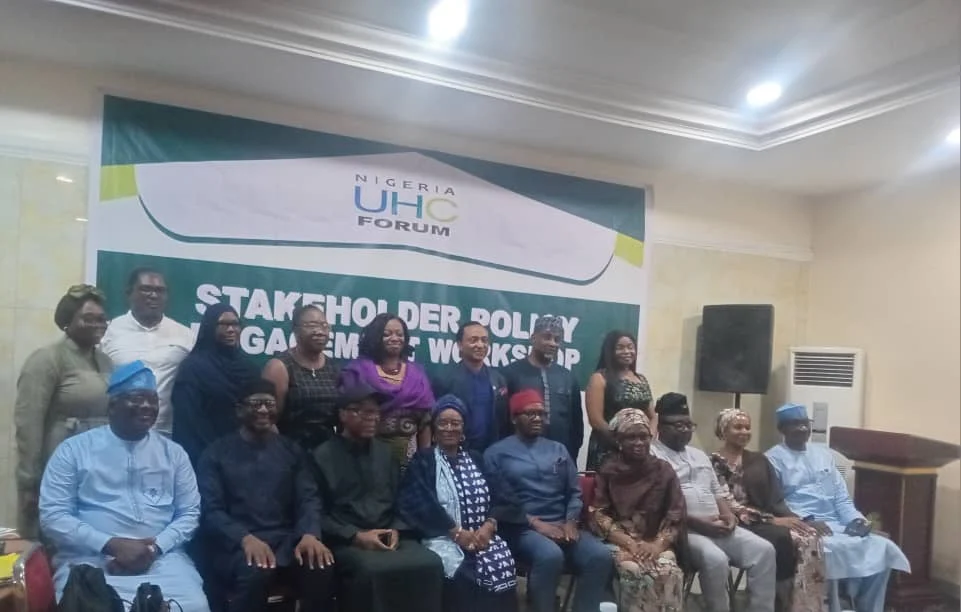
They made the call on Wednesday in Abuja, at the Nigeria Universal Health Coverage (UHC) Forum with the theme, “Leveraging 2027 Election to Advance Nigeria’s UHC Quest.”
The Chair, Nigeria UHC Forum, Chief Moji Makanjuola, said the forum’s experience ahead of the 2023 elections showed that sustained engagement with political actors could influence health priorities, noting that the Citizens-Led Health Agenda had influenced the manifesto of the ruling party.
She said the forum would build on that experience by developing a clear health agenda for political actors and engaging them before and after the 2027 elections.
“We should demand from the politicians when they speak to health, how much of understanding do they have about how health operates? That’s what Nigeria UHC is trying to put together,” Makanjuola said.
She said political candidates should be challenged to look beyond infrastructure, emphasising that health facilities could not deliver quality care without adequate human resources, effective primary healthcare and systems tailored to Nigeria’s health needs.
Makanjuola also urged stakeholders to demand health equity and reduce out-of-pocket spending, while calling on the media to interrogate health budgets and track how allocated funds were used.
“Let’s follow the money. We must be evidence-based reporters going forward because that’s what health needs,” she said.
Dr Gafar Alawode, Chief Executive Officer, DGI Consult and Co-convener, Nigeria UHC Forum, said lessons from states that had performed well in health financing and insurance should inform the agenda being developed for political actors.
He cited Delta as an example of a state that had expanded health insurance coverage to about 50 per cent of its population while paying attention to poor and vulnerable residents.
Alawode said effective budget execution was also critical, noting that some states had achieved 80 per cent to 90 per cent execution of their health budgets.
“It’s not only about additional money, it’s about being intentional about what we’re spending the money on and especially paying attention to human resources for health,” he said.
He also called for innovative financing, including health taxes, emphasising that additional revenue should be deliberately earmarked for health and efficiently utilised.
Prof. Aliko Ahmed, the Senior Advisor and Special Regional Representative of the Director-General of Africa Centres for Disease Control and Prevention (Africa CDC), West Africa, said political leadership remained central to achieving UHC.
He said evidence from about 40 countries studied through the political economy of UHC showed that major advances in universal coverage were often driven by political responses to crises and shocks.
Ahmed said Nigeria’s current fiscal and health-system challenges could provide an opportunity for political leaders to make stronger commitments to UHC.
“The political environment can serve us a good driver for that. We also found out that democracy is also good for health,” he said.
Dr Fatima Zanna of GIZ, who represented Development Partners, said elections provided an opportunity for political parties to define the priorities and future they wanted for citizens, with health being one of the most important priorities.
She said UHC should go beyond expanding services to building resilient health systems capable of protecting Nigerians against emerging threats, including outbreaks, climate change, non-communicable diseases and future public health emergencies.
“These challenges are a reminder that UHC cannot simply mean expanding services.
“It must also mean building health systems that are resilient enough to protect Nigerians when the next challenge comes,” Zanna said.
She said achieving UHC required a Nigeria-owned and Nigeria-led process involving government, civil society, private sector, academia, traditional and faith-based structures and development partners.
Chairperson, Health Sector Reform Coalition, Dr Muhammed Lecky, urged political parties and candidates to treat health as a key election issue and implement existing health-sector commitments rather than creating new ones.
Lecky said existing compacts signed at national and sub-national levels provided sufficient commitments to guide political actors, particularly on health financing, pharmaceutical care and expansion of health insurance coverage.
“We don’t need to reinvent new commitments. These commitments have been signed over a year ago. We just need to take them to scale and implement them,” he said.
He also called for enforcement of provisions of the National Health Insurance Authority Act, saying the legal framework for universal coverage was comprehensive but required effective enforcement mechanisms.
Lecky said the Health Sector Reform Coalition would continue working with stakeholders to ensure that the 2027 elections became a catalyst for accelerated progress towards UHC.
President, Association of Nigeria Health Journalists (ANHEJ), Mr Joseph Kadiri, pledged the media’s continued support for efforts to achieve UHC through sustained reporting and accountability.
Kadiri recalled the role health journalists played in advocacy around the National Health Act, saying the media would continue to provide information needed to keep health issues in the public domain.
He said health journalists would use available information to scrutinise health-sector commitments and ensured that developments around UHC received adequate public attention.
The News Agency of Nigeria (NAN) reports that Nigeria UHC Forum is a coalition of development partners, private-sector actors, civil society organisations and the media working to raise the political prioritisation of UHC in Nigeria.(NAN)
Edited by Abiemwense Moru

Comments