


By Lucy Ogalue
Nigerian statisticians have advocated advanced spatial data analysis techniques to improve data accuracy and strengthen evidence-based policy planning across various sectors.
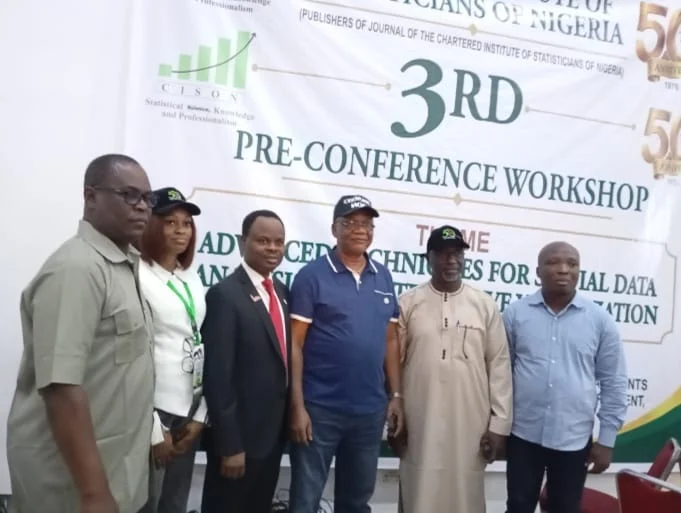
The statisticians made the call at a pre-conference workshop organised by the Charterd Institute of Statisticians of Nigeria (CISON) on Tuesday in Abuja.
The event was with the theme, “Advanced Techniques for Spatial Data Analysis and Interactive Visualisation”.
Dr Atoil Victor, Managing Editor of the institute’s journal, said the two-day workshop aimed to familiarise statisticians, lecturers and professionals with emerging geographical data analysis techniques.
Victor said reliable data and appropriate analytical methods were essential for effective planning and policy formulation.
“Without having accurate information, accurate data and analysing data using the appropriate methodology, you will not be able to get reliable data for planning,” he said.
He said the training would equip participants with skills to apply the techniques in their workplaces and improve organisational planning and decision-making.
Dr Yahya Usman, Rector of Federal Polytechnic Idah, described the workshop as educative, noting that spatial data analysis applied to statistics, financial analysis and health analysis.
He said the training provided experienced professionals, including administrators, opportunities to refresh their knowledge and learn emerging analytical methods.
Prof. Polycarp Chigbu, a statistics professor at the University of Nigeria. Nsuka, said spatial data analysis helped researchers determine where events occurred, complementing information about what happened and when.
Chigbu said modern tools, including “R and Python”, could integrate geographical information with other datasets to improve analytical outcomes.
He said that combining location-based information with established statistical methods could enhance research quality and support informed decisions.
A participant, Mr Amechi Igweze, said the workshop provided an opportunity to examine Nigeria’s challenges at the grassroots rather than relying solely on national-level analysis.
Igweze said spatial statistics could help identify areas experiencing security challenges and economic difficulties, enabling authorities to develop targeted interventions.
He said the annual conference brought together academics, industry professionals and private practitioners to exchange knowledge and explore solutions to national challenges.
Another participant, Miss Richie Lawrence, described the training as impactful, particularly for young professionals seeking practical experience beyond university education.
Lawrence said the workshop introduced her to spatial data analysis, which combined statistical methods with geographical information.
She said the knowledge gained would help her apply the techniques in her professional work and personal data analysis.
The participants expressed optimism that adopting the techniques would strengthen statistical practice, support evidence-based decision-making and improve planning across various sectors.(NAN)
Edited by Kadiri Abdulrahman


Comments