


By Sumaila Ogbaje
President Bola Tinubu has endorsed the leadership philosophy of the Chief of Army Staff (COAS), Lt.-Gen. Waidi Shaibu, describing it as the foundation of a more adaptable, professional and combat-ready Nigerian Army.
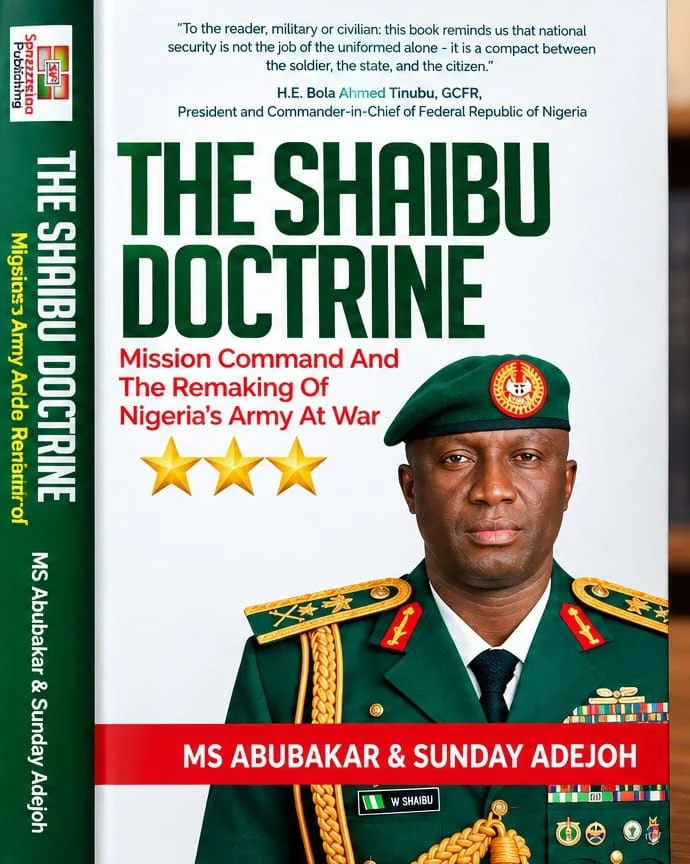
Tinubu stated this in the foreword to The Shaibu Doctrine: Mission Command and the Remaking of Nigeria’s Army at War, co-authored by Dr Muhammed Abubakar and Associate Prof. Sunday Adejoh of the Nigerian Defence Academy (NDA).
The president said the doctrine reflected the Armed Forces’ responsibility to secure Nigeria and create an environment where democracy and development could thrive.
“As Commander-in-Chief, I have charged our Armed Forces with one mission: to secure Nigeria so that democracy and development can thrive,” he said.
Tinubu said the four pillars of professionalism, adaptability, combat readiness and resilience underpinned Shaibu’s command philosophy and guided the Army’s approach to training, equipment, operations and leadership.
He described the doctrine as a departure from military conservatism, saying the Army was moving from static defence towards more mobile offensive operations.
The president said the reforms also emphasised technology adoption, indigenous military equipment production, personnel welfare and stronger adherence to military ethics.
“These were not abstract reforms. They were choices made in the heat of battle, with lives on the line and the nation watching,” he said.
Speaking in an interview with newsmen on the motivation for the publication, Abubakar said the book examines Shaibu’s leadership philosophy, particularly Mission Command, troop welfare and decentralised decision-making as instruments for improving operational effectiveness.
He said his professional interactions with Shaibu began when the latter served as Brigade Commander in Bama and continued during his tenure as Theatre Commander, Operation Hadin Kai.
According to him, the experiences provided insights into Shaibu’s management of personnel and military resources, as well as his efforts to sustain troop morale in demanding operational environments.
Abubakar said he and Adejoh decided to document the philosophy systematically following Shaibu’s appointment as COAS, believing it offered lessons for the Army’s evolving operational challenges.
He explained that the philosophy was built around five pillars captured by the acronym PROSE: Professional Excellence, Robust Administration, Operational Readiness, Strategic Cooperation and Exemplary Leadership.
At its centre, he said, was a Soldier-First culture that prioritised personnel welfare, morale, training, dignity and empowerment as foundations of combat effectiveness.
Abubakar described Mission Command as a leadership approach based on trust, initiative and empowering subordinate commanders to make decisions within their areas of responsibility.
He said senior commanders set operational objectives, while subordinate commanders determined how best to achieve them based on prevailing battlefield conditions.
According to him, the approach could reduce decision-making delays, strengthen accountability among junior commanders and improve the tempo of clearing and holding operations.
“The core of Mission Command is trust,” Abubakar said, stressing that commanders on the ground needed authority to respond promptly to threats without waiting for multiple layers of approval.
He, however, said decentralised decision-making required adequate equipment, logistics, training and personnel welfare to sustain operational effectiveness.
Abubakar, nonetheless, identified intelligence gaps, inadequate persistent air support and the need for enhanced aerial surveillance as challenges requiring further attention in Nigeria’s counter-insurgency campaign.
He advocated increased investment in human intelligence and stronger collaboration with credible community actors and private security outfits with local knowledge of conflict-prone areas.
He also called for more persistent air support for ground troops and closer coordination between the Nigerian Army and the Nigerian Air Force.
The military scholar said strengthening Army Aviation and prioritising long-endurance drones could improve battlefield surveillance, situational awareness and commanders’ responses to emerging threats.
He noted that Nigeria’s complex security environment, extensive borders and the asymmetric tactics employed by armed groups required continuous adaptation of military strategies and capabilities.
Drawing on his experiences in the North-East and North-West, Abubakar said counter-insurgency could not be won through military action alone.
He called for a whole-of-government and whole-of-society approach involving security agencies, government institutions and local communities in addressing insecurity.
Abubakar stressed that the book was not a biography of Shaibu but an analysis of a military strategy and the institutional changes required to sustain operational effectiveness.
He said the publication sought to stimulate discussion on aligning leadership, organisational structure and military culture with the challenges of insurgency, terrorism and banditry.
He identified military expansion, fiscal discipline, personnel welfare and institutional adaptation as important considerations in strengthening the Army’s long-term capacity.
Abubakar said the book was intended to provide practical lessons for policymakers, military officers, cadets and Nigerians seeking to understand the principles guiding the Army’s leadership.
He said its central message was that effective leadership required commanders to trust subordinates, invest in personnel, align administration with operations, promote inter-agency cooperation and lead by example.
The book is scheduled for presentation on Nov. 24, 2026, at the Nigerian Army Resource Centre, Abuja. (NAN)
Edited by Sadiya Hamza



Comments