


By Racheal Abujah, News Agency of Nigeria (NAN)
The latest confirmed Ebola case has sparked a frightening sense of familiarity for many Nigerians.
The familiar pattern involves a traveler arriving from an infected region, falling ill, seeking treatment, and ultimately testing positive for the virus.
The development has revived memories of July 2014, when the late Dr Ameyo Adadevoh played a decisive role in preventing an infected Liberian-American diplomat, Patrick Sawyer, from leaving a Lagos hospital, helping to avert wider transmission in Africa’s most populous country.
Nigeria successfully contained that outbreak in 93 days, earning international recognition for its response.
Following a confirmed imported Ebola case in Abuja involving a female passenger from Uganda, officials are monitoring 44 close contacts. Meanwhile, medical experts emphasise that the 2026 outbreak demands a completely different response strategy.
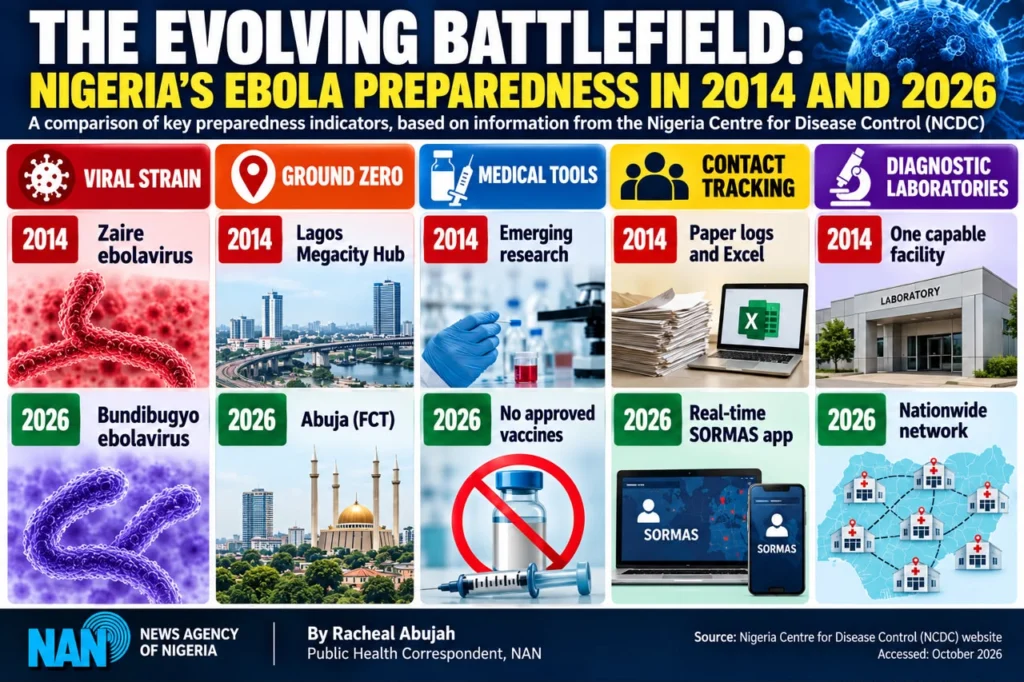
The virus involved is Bundibugyo ebolavirus, a distinct species from the Zaire ebolavirus responsible for the 2014 outbreak in Nigeria.
The distinction has important implications for treatment and prevention.
Although vaccines and specific treatments have been developed for the Zaire species, no vaccines or specific antiviral treatments are approved for Bundibugyo virus disease.
Consequently, early detection, prompt isolation, effective contact tracing and supportive clinical care remain critical to containing the outbreak.
Nigeria’s growing burden of chronic conditions, including diabetes and hypertension, also raises concerns about how underlying illnesses could complicate the management of patients who develop severe Ebola disease.
The 2014 outbreak in West Africa prompted intensive international research, leading to vaccines and treatments that have improved the options available for managing Zaire ebolavirus infections.
However, those advances cannot automatically be applied to Bundibugyo ebolavirus.
According to the Africa Centre for Disease Control, for patients infected with Bundibugyo virus, treatment relies heavily on supportive care, including prompt replacement of fluids and electrolytes, monitoring of vital signs and management of complications.
The absence of an approved vaccine or specific antiviral treatment makes early clinical assessment particularly important.
As anxiety mounted over the confirmed case in Abuja, the Coordinating Minister of Health and Social Welfare, Prof. Muhammad Ali Pate, reassured Nigerians that the country’s multi-agency surveillance system was prepared to respond.
Pate said the authorities were working to contain the case through contact tracing and other public health measures.
“We are doing everything possible to contain this case by tracing all the contacts the individual may have had,” he said.
However, experts warn that managing Ebola becomes more challenging when patients have underlying conditions that can complicate fluid loss, circulation and organ function.
Dr Chukwuma Anyaike, a consultant epidemiologist and public health physician, said severe Ebola disease could involve persistent vomiting and diarrhoea, resulting in significant fluid loss and potentially life-threatening complications.
Anyaike explained that dehydration could place additional strain on the kidneys and cardiovascular system, particularly in patients already living with diabetes or hypertension.
For people with diabetes, he said substantial fluid loss could worsen blood glucose control and increase the risk of acute kidney injury.
“In patients with hypertension, severe dehydration and falling blood pressure can also compromise blood flow to vital organs.
“These complications make timely diagnosis, careful fluid management and close clinical monitoring essential.”
He also warned that Ebola’s early symptoms, including fever, severe headache and muscle weakness, could resemble those of common illnesses such as malaria.
He said that the similarity could complicate early recognition, particularly in settings where malaria and other febrile illnesses are common.
“A person who assumes that a fever is malaria or typhoid could delay seeking medical assessment, increasing the risk of further exposure if the illness is Ebola,” he said.
Public health specialist Dr Isaac Egboja has also called for vigilance among healthcare workers and the public.
Speaking during a national broadcast on the Nigerian Television Authority (NTA), Egboja acknowledged that the Bundibugyo virus was generally associated with a lower case fatality rate than the Zaire species responsible for the 2014 West African epidemic.
However, he cautioned against interpreting this difference as a reason to relax preventive measures.
“It remains a serious public health concern requiring strict precautionary measures,” he said.
He urged healthcare workers nationwide to maintain a high index of suspicion when assessing patients with compatible symptoms and relevant travel or exposure histories.
While the clinical challenges have changed, Nigeria’s public health infrastructure has also evolved since 2014.
One significant development is the increased use of digital tools for disease surveillance and contact tracing.
During the 2014 response, contact tracing relied on intensive fieldwork, paper records, telephone calls, and spreadsheets.
Health workers had to identify people who had interacted with confirmed cases, locate them and monitor them for symptoms throughout the prescribed observation period.
Today, the Nigeria Centre for Disease Control and Prevention (NCDC) uses the Surveillance Outbreak Response Management and Analysis System (SORMAS), a digital platform designed to support case-based surveillance, contact tracing and outbreak management.
The agency said that the system could help public health teams organise information, follow contacts and identify potential transmission links more efficiently.
Experts say its effectiveness depends on timely data entry, reliable connectivity, trained personnel and sustained coordination between federal, state and local health authorities.
The monitoring of 44 close contacts associated with the imported case in Abuja provides an opportunity to assess how effectively these systems function under real-world conditions.
Nigeria’s laboratory capacity has also developed since 2014, when access to specialised Ebola testing was limited and diagnostic services faced considerable pressure.
In the current response, the NCDC’s National Reference Laboratory in Abuja has been identified as a key facility in investigating and confirming the imported case.
A wider network of public health and reference laboratories can strengthen the country’s ability to investigate suspected cases and respond to emerging infectious disease threats.
However, laboratory infrastructure alone does not guarantee effective preparedness.
Facilities need trained personnel, appropriate equipment, quality assurance, reliable specimen transport and adequate supplies.
Prof. Oyewale Tomori, a prominent virologist, emphasised the importance of transparency and independent scrutiny in assessing Nigeria’s preparedness.
Tomori said that the prompt identification and monitoring of contacts are important components of an effective response.
He said Nigerians also needed clear information about the country’s readiness to detect and contain further cases.
“The authorities must communicate what is known, what remains uncertain and what measures are being taken to address identified gaps,” he said.
Nigeria’s response also involves measures intended to reduce the risk of further importation and transmission.
NCDC Director-General Dr Jide Idris, who was involved in the country’s frontline Ebola response in 2014, is leading the agency’s current efforts.
At international airports, Port Health Services personnel play a role in screening travellers, assessing possible health risks and referring people who require further evaluation.
Depending on established protocols, measures may include health declarations, temperature screening, travel-history assessment and referral for clinical evaluation.
However, public health experts said temperature screening alone cannot detect every infected person, particularly those who have not yet developed symptoms.
They said effective preparedness therefore requires several layers of protection, including timely information-sharing, surveillance, clear referral procedures and coordination with international and regional health agencies.
Dr Yahya Disu, Executive Director, Afrihealth for Social Development and Impact, said that the country’s land borders present additional challenges because of the volume of movement across formal and informal crossing points.
“At busy border communities, including areas around the Seme corridor, preparedness requires cooperation between health authorities, border agencies, neighbouring countries and local communities,” he said.
Disu said that community engagement can improve awareness of symptoms and reporting procedures, while cross-border coordination can support the timely exchange of information about suspected cases and potential exposures.
Perhaps one of the most significant differences between the two responses is the financial framework supporting emergency operations.
All in all, the 2014 outbreak taught us that technology, funding, and emergency declarations are not enough to contain a crisis.
True containment relies on trust, transparency, seamless coordination, and a healthcare system that can quickly turn plans into action.
While Nigeria possesses more advanced tools in 2026, the true measure of success will be whether this technology can effectively save lives, halt transmission, and preserve public trust.(NANFeatures)
Edited by Chijioke Okoronkwo
***If used, please credit the writer and the News Agency of Nigeria.



Comments