


By Fortune Abang
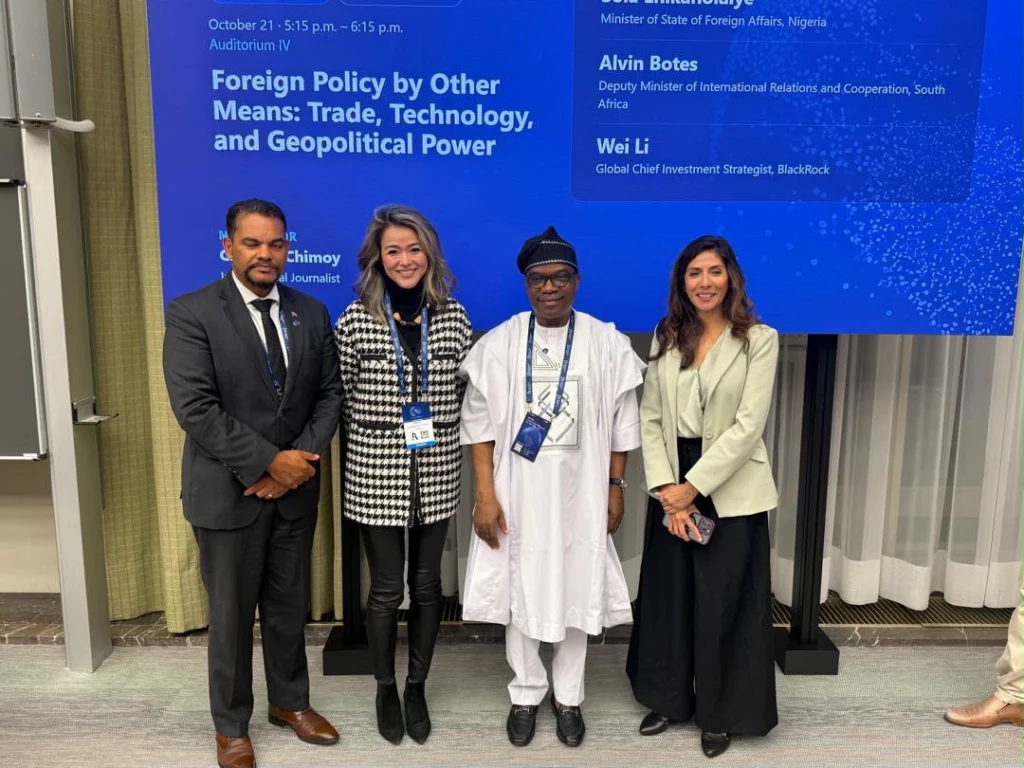
Enikanolaiye spoke at the Berlin Global Dialogue 2026, on the sidelines of a high-level panel on “Foreign policy by other means: trade, technology, and geopolitical power”, at the Policy Lab on infrastructure and investment.
Mr Raphael Oni, Special Assistant on Digital Media and Public Diplomacy to the minister, said this in a statement on Friday in Abuja.
Enikanolaiye said Africa’s new engagement model was grounded on sovereignty, commitment to African priorities, mutual respect and shared prosperity.
He said Nigeria’s vision for reformed engagement with Africa was anchored on sovereignty, strategic autonomy, domestic resource mobilisation and bankable infrastructure.
“Africa has come to this conversation with great assets, substantial opportunities and determination to shape its own development based on partnership with the rest of the world,” he said.
He said diplomacy was shifting from rigid political alliances to pragmatic, fluid, transaction-focused strategies, citing a recent policy lab organised in Abuja by a foreign embassy.
He said government’s role was to clear the path for private enterprise, citing Nigeria’s stabilising role through ECOMOG in Liberia and Sierra Leone, which enabled Nigerian banks to thrive regionally.
He affirmed Nigeria’s doctrine of strategic autonomy, which he said allowed room to act to advance national interest, regardless of the ideology or political complexion of various blocs.
He said government policy required investors to establish local processing industries, with strict oversight functions on environmental and community protection.
“We learned from our experience in the Niger Delta. We are now doing things differently to give rights to local communities where minerals are found,” he said.
He identified reliable electricity, efficient intermodal transport, and appropriate digital connectivity as infrastructure areas needing attention to expand production and create opportunities for Africa’s young population.
He added that revenue generation using metering systems was another major opportunity for foreign investment in Africa’s power sector.
He said African governments had overhauled legacy laws to attract investment, driven by macroeconomic stabilisation and deregulation.
He stressed that de-risking required well-prepared projects, predictable regulation, transparent procurement and credible risk-sharing.
He cited Africa’s average growth of 4.3 per cent, against an ambition of seven per cent, and progress on the ECO currency.
He said Nigeria’s single window system and PAPSS, launched in January 2026, were critical to raising intra-African trade.
He said such trade stood at 16 per cent under AfCFTA, adding: “We need to trade more among ourselves to develop competitive advantages.”
He called for reform of the international credit rating system, welcomed the African Credit Rating Agency and tied Africa’s AI future to stable power supply.
Meanwhile, Enikanolaiye and Nigeria’s Ambassador to Germany, Sen. Ita Enang, met the Foreign Minister of Lesotho, Limpho Tau, to discuss deeper cooperation and a possible Lesotho diplomatic presence in Abuja.
Tau commended Nigeria’s historic role in African liberation and invited Nigerian industrial leaders, including the Dangote Group, to invest in Lesotho. He said the meeting would advance cooperation through AUDA-NEPAD. (NAN)
(Edited by Emmanuel Yashim)

Comments