



By Felicia Imohimi
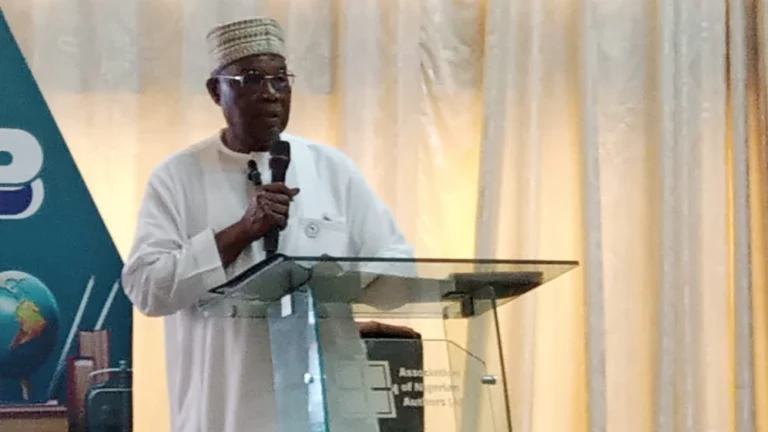
Prof. Mahfouz Adedimeji, Vice-Chancellor of the African School of Economics, (the Pan-African University of Excellence), says literature must be deliberately integrated into national security and peacebuilding policies.
Adedimeji made the recommendation while delivering the keynote address at the 45th Annual International Convention of the Association of Nigerian Authors (ANA) in Abuja.
The convention is themed: “Literature, National Security and the Place of Nigeria in the World”.
He said the creative industry and the arts, which translate into movies and productions, should be channelled towards building a peaceful and safe country, not just winning awards and making profit.
According to him, collaborations should be forged in such a way that understanding of insecurity incorporates the narratives, grievances, cultural identities and social experiences of affected communities.
He noted that peacebuilding begins where the assumption that security is simply the absence of fighting ends, adding that a society may experience no active warfare and still contain deep structures of hostility.
“Peace requires institutions, justice and economic opportunity, but it also requires communication,” he said.
Adedimeji said government must recognise that good governance is itself a security strategy.
“No amount of literary intervention can compensate for persistent injustice, corruption, unemployment, poverty and institutional failure.
“Leaders at all levels must demonstrate through their actions that every Nigerian has dignity, value and a stake in the national project,” he said.
He further recommended that literature and the humanities in general must receive appropriate attention in the country’s educational system.
He said reading, writing, critical thinking, ethical reasoning, civic consciousness and intercultural understanding should be central to the development of responsible citizens.
“The world is in turmoil today because guided weapons are controlled by misguided people and we emphasise the quantitative aspects of science and technology at the expense of the human heart and social condition,” he said.
Adedimeji called for strengthening of the publishing and reading ecosystem, adding that more awards and encouragement are needed for writers.
“Public and school libraries should be adequately funded. Nigerian authors should enjoy stronger institutional support, while the protection of intellectual property should be strengthened.
“As a matter of fact, books should be treated with respect in a country that aspires to thrive in a global knowledge economy,” he said.
He said the country must deploy literature in peace education and national integration.
“Our educational institutions should encourage students to read works from different Nigerian communities and African societies.
“Literary festivals, inter-school debates, drama competitions and cultural exchanges should be promoted as instruments of social cohesion,” he said.
He added that literary competitions could encourage young people to engage with peace, citizenship and coexistence without dictating conclusions, while theatre can support community dialogue.
“Nigerian literature should be promoted more extensively through embassies, universities and international cultural programmes but the cardinal principle must remain freedom,” he said.
He also urged investment in the globalisation of Nigerian cultural products.
“International literary exchanges, publishing partnerships, digital distribution and cultural diplomacy should become deliberate elements of our foreign policy,” he said.
He urged universities to lead interdisciplinary research by creating platforms where literature, security studies, international relations, political science, communication, psychology and development studies intersect.
“The days of living in academic silos are gone.
“Scholars need to research how narratives influence radicalisation, how language shapes conflict, how literature promotes reconciliation and how cultural diplomacy strengthens international influence,” he said.
“I call on Nigerians to re-embrace reading culture, saying reading makes a full man, conference a ready man and writing an exact man.
“A reading country is a leading country and groups, associations and societies should revive reading clubs to broaden horizons and deepen insights beyond the chatter of social media,” he said.
He said national security ultimately involved protecting more than territory, but protecting the conditions within which people can live meaningful lives together.
According to him, Nigeria’s security crisis cannot be addressed by weapons alone because much of it originates in the realm of human relationships.
“There are crises of trust, citizenship, belonging, justice, memory and identity alongside terrorism, kidnapping, banditry and violent crime, all of which point to the centrality of human security as an approach to guaranteeing national security.
“Literature operates within this human terrain. It records what official memory forgets.
“It asks questions that political convenience may suppress and it allows societies to confront painful histories.
“It creates opportunities to encounter strangers imaginatively as human beings and exposes injustice before injustice becomes normal,” he said.
He said the relationship between literature and national security is structural, adding that a country is secured at more than one level.
“Its borders must be secured; its people must be secured; its institutions must be secured and its information environment must be protected.
“But its imagination must also be secured against hatred, intolerance, manipulation and the dangerous conviction that some Nigerians are more Nigerian than other Nigerians,” he said.(NAN)
FUA/EMAF
=========
Edited by Emmanuel Afonne


Comments