


By Sumaila Ogbaje
The Defence Industries Corporation of Nigeria-D7G (DICON-D7G) says it has signed an agreement involving 2,000 military vehicles for export to an African country.
The development is part of efforts to boost Nigeria’s defence manufacturing and exports.
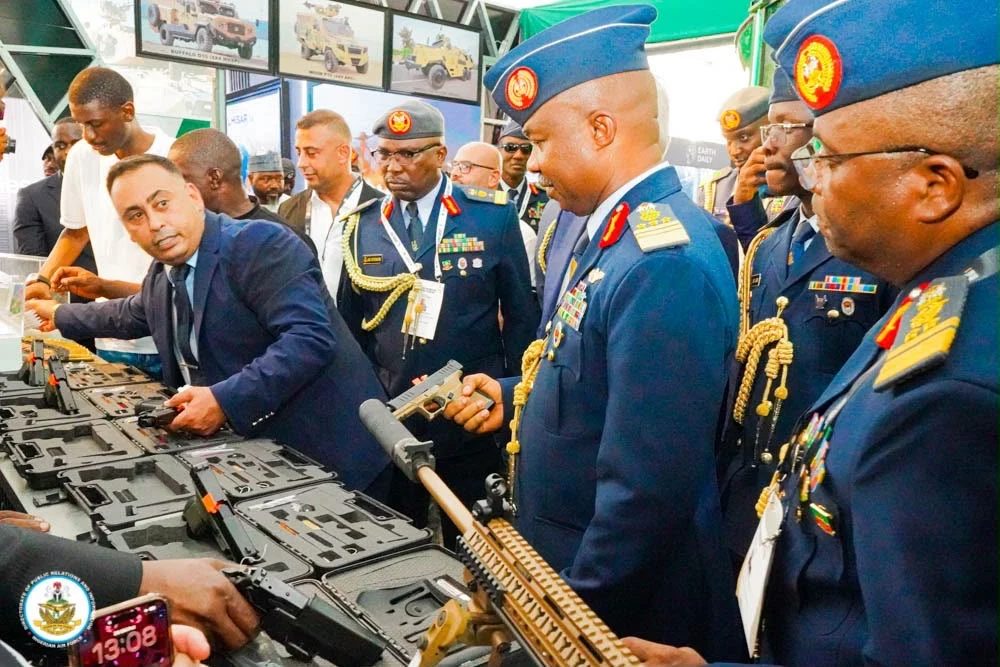
The Chief Executive Officer of DICON-D7G, Mr Osman Chennar, disclosed this in an interview with the News Agency of Nigeria (NAN) on the sidelines of the ongoing Africa International Defence Exhibition (AFRIDEX) 2026 in Lagos.
Chennar said the agreement covered mine-resistant ambush-protected (MRAP) vehicles, Buffalo vehicles, EPCs and tanks.
He said the vehicles would be delivered over two to three years, subject to agreed arrangements.
The CEO said the company was already exporting to Ghana, Gabon and Côte d’Ivoire, while pursuing further opportunities across the African market.
He said the company’s expansion plans went beyond arms and ammunition to include armoured vehicles, drones and other defence equipment.
According to him, DICON-D7G has commenced the first phase of assembling and producing DG-103 rifles as part of its efforts to strengthen local defence manufacturing.
“We are not planning to produce only arms and ammunition. We are also planning to manufacture MRAP vehicles, drones and other defence equipment,” he said.
Chennar also said that the company planned to inaugurate a military logistics facility in Lagos before the end of November 2026 to support production, assembly, storage and regional distribution.
He added that the facility would serve Nigeria and other African countries through imports, exports and other logistics operations.
The CEO further said that the company was planning to establish six service and maintenance centres across Nigeria’s geopolitical zones.
He explained that the centres would maintain, repair and upgrade military vehicles and other equipment, with retired military personnel expected to participate.
Chennar said the company’s pricing strategy was designed to make its products competitive in the international defence market.
He put the price of EPC vehicles at between 290,000 dollars and 340,000 dollars, while MRAP vehicles would cost between 420,000 dollars and 570,000 dollars, depending on specifications.
He said the tanks would cost between 1.4 million dollars and 1.9 million dollars, depending on their configurations.
Chennar attributed the proposed competitive pricing to technology transfer and local production in Nigeria.
He revealed that the company intended to engage Nigerian and other African firms through subcontracting arrangements to expand production capacity and support local industries.
According to him, DICON-D7G will provide financing, technical assistance and production models to participating companies to enable them to contribute to the manufacturing process.
He expressed appreciation to the Nigerian military, other security agencies and the Federal Government for supporting the company’s operations.
Also speaking, the Director of Land Systems, DICON-D7G, retired Maj.-Gen. Mainasara Masanawa, said the company was working to ensure that the military and other security agencies could access their equipment requirements locally.
Masanawa said the company’s objective was to provide equipment ranging from small-arms ammunition to armoured personnel carriers, MRAP vehicles and tanks.
He said local manufacturing, maintenance and upgrades would help improve equipment availability and operational readiness among the armed forces and other security agencies.
According to him, DICON-D7G invites end users to test its weapons and equipment before delivery to ensure that they meet operational requirements.
He disclosed that the Nigerian Army had recently procured DG-103 rifles from the company and participated in test-firing exercises to assess their performance.
Masanawa said the tests included firing at designated targets and concrete to evaluate the ammunition’s performance.
He added that the company also repaired and upgraded some AK-47 rifles belonging to the Nigeria Customs Service at no cost to the agency.
According to him, the upgrades enable the rifles to accommodate accessories such as telescopic sights and under-barrel grenade launchers where required.
Masanawa said the company’s broader objective was to strengthen Nigeria’s defence industrial base by combining local production with equipment maintenance and upgrades.
He said the planned service centres would help security agencies maintain their vehicles and equipment in operational condition to respond to evolving security challenges. (NAN)
Edited by Deborah Coker
Comments