


By Rose Okudaye
A former President of the African Export-Import Bank (Afreximbank), Prof. Benedict Oramah, has called for stronger economic and institutional integration between Africa and the Caribbean.
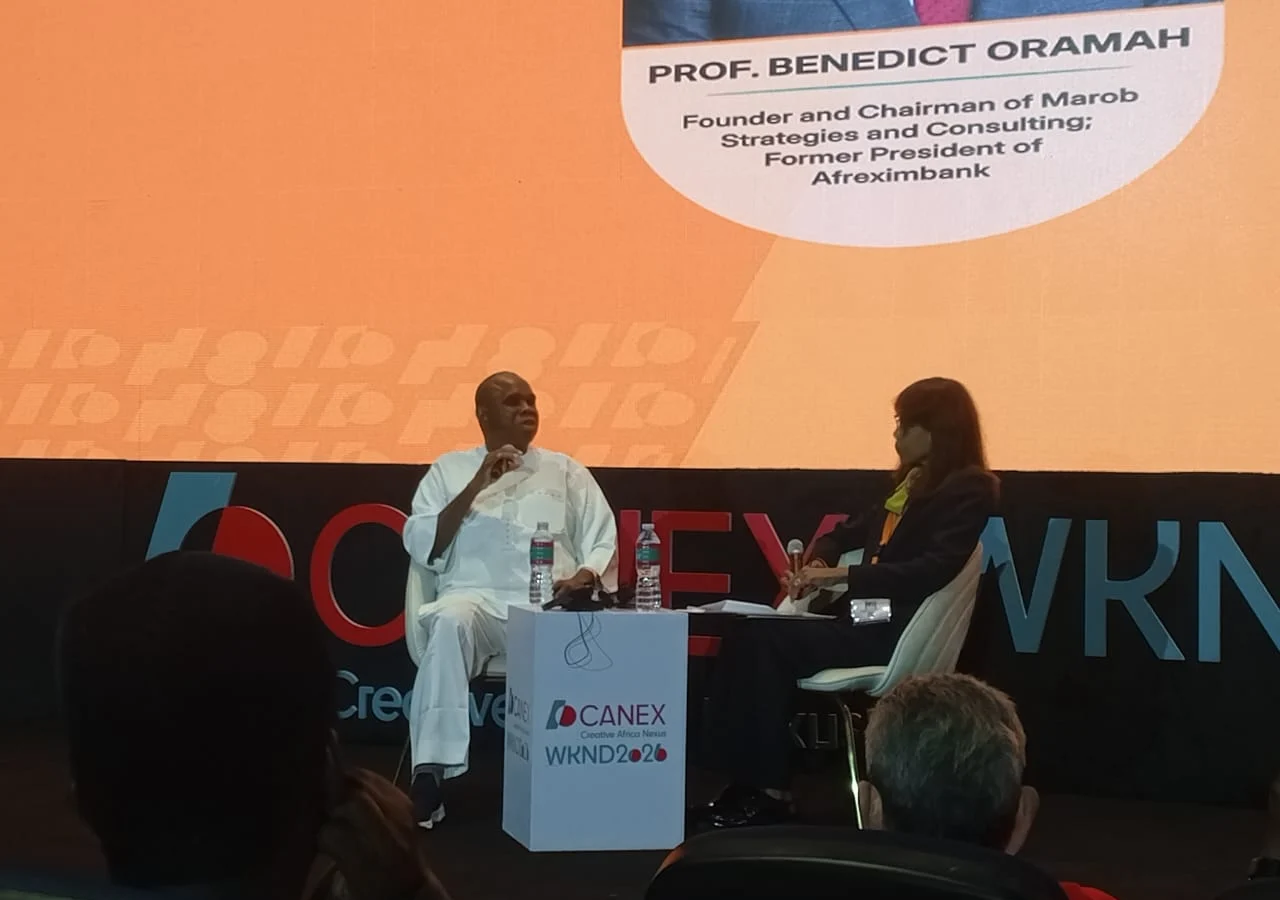
He made the call at the Creative Nexus Africa (CANEX) WKND event in Lagos on Friday, during a conversation following the screening of a documentary chronicling his years at the bank.
The News Agency of Nigeria (NAN) reports that the CANEX is a flagship initiative established by the Afreximbank to support, scale and finance Africa’s creative and cultural industry.
Oramah reflected on the institution’s role in strengthening Africa-Caribbean relations and advancing economic collaboration.
He stressed that the two regions must embrace a common destiny to restore the dignity of people of African descent.
He noted that Africa’s development and global recognition could not be achieved independently of the Caribbean and the wider African diaspora, highlighting the need for collective action, economic cooperation and self-reliance.
Describing the documentary as a source of nostalgia and fulfilment, Oramah said its message represented the collective efforts of colleagues and stakeholders who shared the vision of restoring the dignity of African people.
He said that the achievements portrayed in the documentary were not the accomplishment of one individual but the product of collective commitment and collaboration.
According to him, the historical divisions created by slavery and colonialism had continued to undermine relationships between Africans on the continent and their descendants in the Caribbean, despite their shared heritage.
He recalled that his first visit to Barbados prompted him to question why African countries maintained stronger connections with distant parts of the world than with Caribbean nations, which were relatively closer geographically.
Oramah noted that his approximately six-hour flight from Dakar to Barbados made him reconsider the artificial barriers that had historically separated the two regions.
He argued that Africans could not genuinely achieve collective dignity while people of African descent elsewhere continued to experience discrimination and marginalisation.
”If an African-American is looked down upon, there is no way somebody in Africa can come and say, ‘Oh, I’m too wealthy.’ When an African in the Caribbean is looked down upon, we cannot be a collective body. We must find a collective solution,” he said.
The former bank president explained that the need to translate the vision into practical economic activities informed the establishment of institutional frameworks to facilitate trade, investment and financial cooperation between Africa and the Caribbean.
He said financial institutions had a crucial role to play in driving the integration process, noting that political declarations alone would not produce meaningful results without tangible economic opportunities.
”If people do not see money, they will not get money,” he said, explaining that the bank sought to demonstrate the commercial viability of closer economic relations through institutional support and investment.
Oramah cited the bank’s intervention in facilitating financing for Suriname’s participation in oil-related opportunities as an example of how financial institutions could help overcome barriers to economic cooperation.
He also expressed satisfaction with the reception the African-Caribbean partnership received across the region, recalling the emotional response that greeted an African delegation on its arrival in the Caribbean.
According to him, the reception demonstrated the deep historical and emotional connection between the people of both regions and the desire for renewed engagement.
He said developments in recent years had further reinforced the importance of collective self-reliance, particularly as countries increasingly recognised the limitations of depending on external powers to advance their interests.
”We now must know that there can be nobody who would love us more than ourselves,” he said, urging African countries and their diaspora communities to work together in addressing shared economic and developmental challenges.
On the establishment of the African Medical Centre of Excellence (AMCE), Oramah disclosed that the initiative originated from Afreximbank’s strategic plan, which included health and medical tourism as priority areas for intervention.
He explained that the plan had envisaged the establishment of specialised medical centres of excellence, with defined timelines and technical parameters.
However, he said his personal experience with a severe health condition while in Cairo brought a deeper significance to the initiative.
Recounting his medical emergency, Oramah described the difficulties he encountered while seeking treatment abroad, including critically low blood levels and the challenges associated with arranging emergency medical evacuation.
He said the experience reinforced the importance of developing world-class medical facilities on the continent so that Africans would not have to leave their countries to access specialised healthcare. (NAN)www.nannews.ng
Edited by Vivian Ihechu

Comments