


By Angela Atabo
The Nigerian Committee on Large Dams (NICOLD) has called for increased private-sector investment and sustained training of young engineers to strengthen dam safety and management in Nigeria.
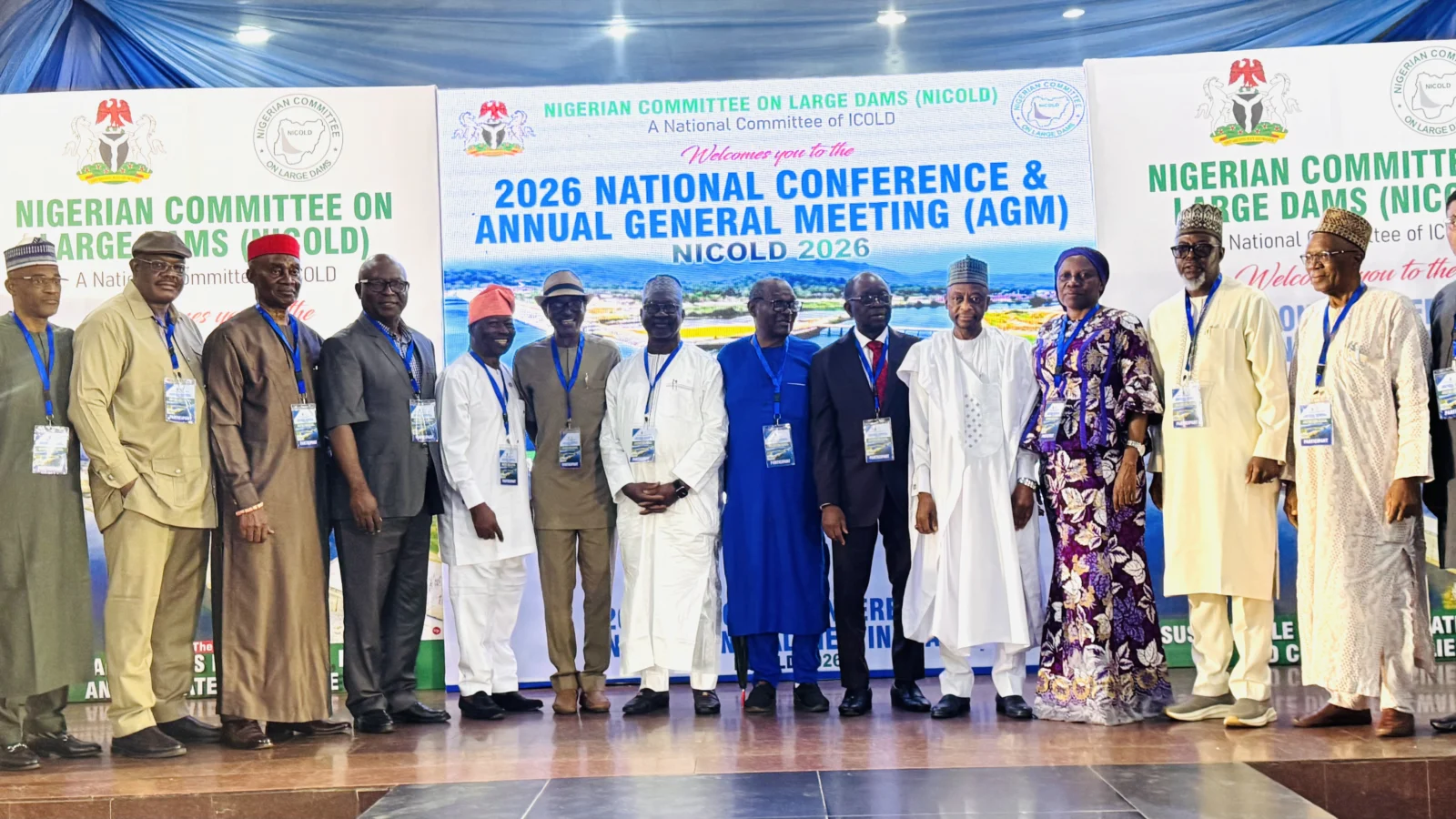
The committee’s President, Dr Johnson Adewumi, made the call at its 2026 National Conference and Annual General Meeting (AGM) in Abuja on Tuesday.
The conference was themed “Sustainable Dams for Water, Energy and Climate Resilience”.
Adewumi said the conference provided a platform for engineers, policymakers, researchers and other stakeholders to exchange knowledge and develop solutions to challenges in dam engineering.
He said while the public sector was responsible for policy development, private organisations had a critical role in translating policies into practical programmes and projects.
He urged more companies to partner with NICOLD, noting that the committee brought together professionals involved in dam engineering and technology.
Adewumi said NICOLD had organised seven training sessions on dam operations and maintenance with sponsorship from partners, including Mainstream Energy Solutions and DeCrown West Africa Company, whose contributions he acknowledged.
The president stressed the need to equip younger engineers with skills in dam design, construction, operation and management to sustain professional expertise and prevent infrastructure failures.
He said NICOLD was promoting knowledge transfer from experienced professionals to younger engineers, adding that continuous training was necessary to prepare them for future responsibilities.
Adewumi, who said he was 75, noted that experienced professionals had a duty to mentor younger engineers and ensure the transfer of technical knowledge.
He said dams remained vital to water security, food production, hydropower generation and flood control, adding that reservoirs also supported irrigation, livestock production, industrial activities and public water supply.
He called for the adoption of modern technologies, research and innovation to improve dam monitoring, structural assessments and maintenance.
Earlier, the Minister of Water Resources and Sanitation, Prof. Joseph Utsev, called for stronger collaboration and investment to improve dam safety, hydropower generation and water resources management.
Utsev, represented by the Acting Permanent Secretary of the ministry, Ali Dallah, said sustainable dam development was essential to water security, agricultural production, energy generation and flood management.
He identified the Sustainable Power and Irrigation for Nigeria (SPIN) Project, implemented with Federal Ministry of Power and World Bank support, as a key initiative to strengthen dam safety, modernise irrigation and promote hydropower.
The minister said effective dam management required regular inspections, structural assessments, preventive maintenance and timely rehabilitation to identify risks and protect infrastructure.
He also warned that changing hydrological conditions and extreme weather events posed challenges to dam design and operations, making climate resilience necessary throughout the development and management of dams.
Utsev said the ministry, through the Nigeria Hydrological Services Agency, was strengthening hydrological data collection, flood forecasting and early warning systems.
He said the Annual Flood Outlook provided information to support flood preparedness, reservoir management and decisions by relevant stakeholders.
Also speaking, dam safety expert, Mr Matthew Offie, called for the reassessment of existing dams using current climate data to ensure their safety and functionality.
Offie said many dams were designed using historical hydrological data that might no longer reflect prevailing climate conditions.
He cited changing rainfall patterns, erratic flooding and prolonged droughts in parts of the country as reasons for updating hydrological assessments.
He recommended retaining the original engineering principles of existing dams while incorporating current climate data into their operation and management.
Offie said satellite information and emerging technologies could make such assessments more affordable and accessible.
He said his conference paper examined cost-effective approaches to hydrological assessment, drawing on lessons from more than 40 years of professional experience to recommend solutions and avoid repeating past project failures.
The News Agency of Nigeria (NAN) reports that dams support water supply, irrigation, electricity generation and flood control, making their safety critical to communities and economic activities.
The National Emergency Management Agency reported that floods affected 315,762 people, displaced 113,367 and killed 231 across 25 states and 86 local government areas as of September 2025.
The floods also damaged 46,304 farmlands.
The Nigerian Electricity Regulatory Commission reported that hydropower plants generated 3,081.88 gigawatt-hours of electricity in the first quarter of 2025, compared with 3,029.07 gigawatt-hours in the preceding quarter.
Changing rainfall patterns and extreme weather events also highlight the need to incorporate current climate data into dam planning, operation and maintenance to reduce risks and sustain water and energy supplies. (NAN)
Edited by Tosin Kolade



Comments