


By Ismail Abdulaziz, News Agency of Nigeria (NAN)
On May 1, 2026, China did something no major economy had ever done for Africa.
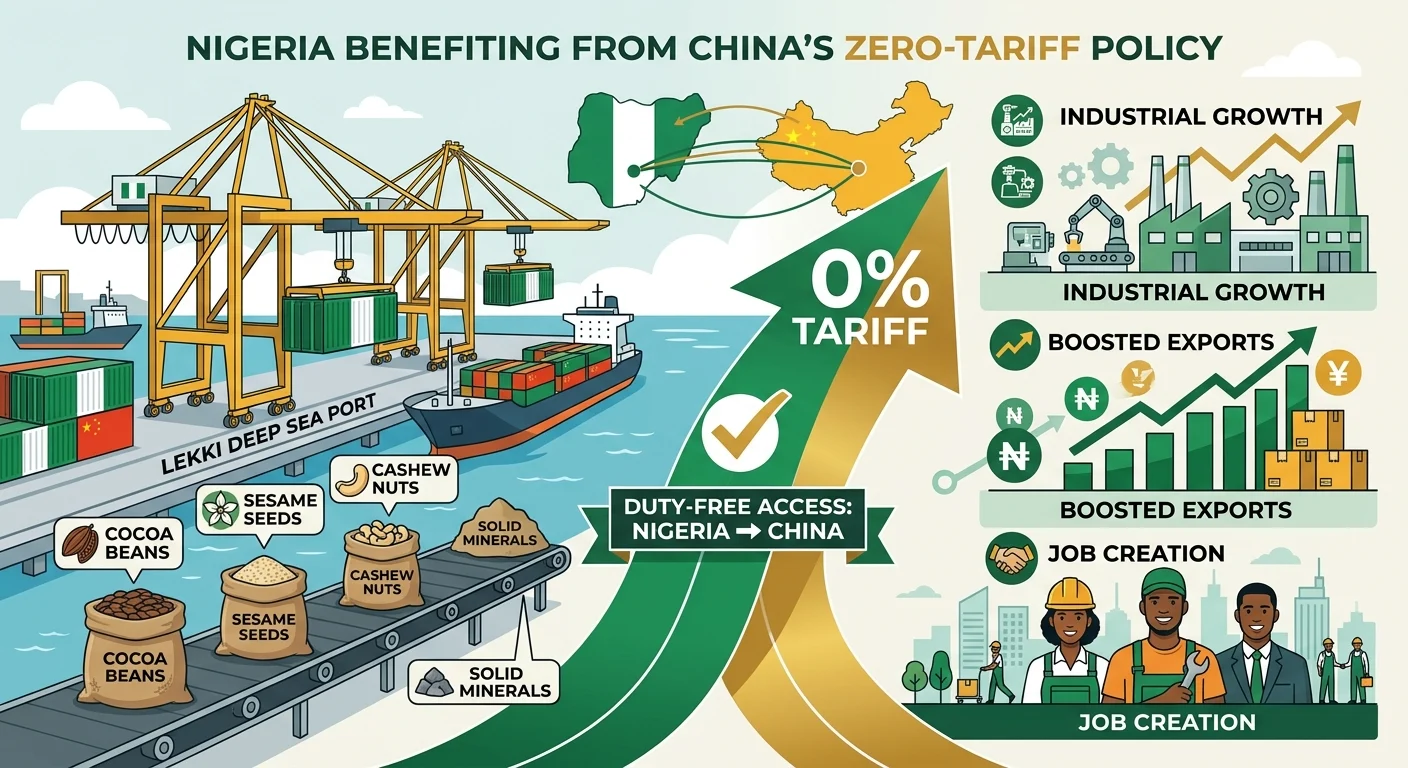
It opened its vast market of 1.4 billion people to goods from 53 African countries at zero tariff.
For Nigeria, Africa’s largest economy, it was a historic opportunity.
Sesame from Jigawa, cashew from Ogbomoso, ginger from Kaduna, hibiscus from Kano, and solid minerals from Nasarawa can now enter China duty-free.
However, six months into the policy, a critical question is emerging in Abuja, Lagos and Kano.
Is Nigeria ready to benefit before the door closes?
The zero-tariff treatment for Nigeria is not permanent.
Rather, it is a two-year preferential window, from May 1, 2026, to April 30, 2028, within which China expects to negotiate a long-term deal called the China-Africa Economic Partnership for Shared Development (CADEPA).
According to the World Trade Organisation, CADEPA is a comprehensive, cross-regional free trade and economic cooperation framework proposed by China for its trade relations with African nations.
Consequently, if Nigeria does not use the window, experts warn that the opportunity could slip away.
The policy was announced under the Changsha Declaration in June 2025, within the Forum on China-Africa Cooperation (FOCAC) framework.
Unlike a free trade agreement, where both sides cut tariffs, this is a unilateral concession by China.
It means China charges zero per cent on Nigerian goods entering its market, while Nigeria is not required to give Chinese goods zero per cent in return.
Previously, only 33 African Least Developed Countries (LDCs) enjoyed zero-tariff access.
However, the 2026 expansion brought in 20 non-LDCs, including Nigeria, South Africa, Kenya, Egypt and Ghana.
“It is the most comprehensive unilateral trade concession offered to Africa by any major global economy.
“For decades, Nigeria’s processed goods faced tariffs as high as 25 per cent in China. Today, that barrier is gone. The question is no longer about tariffs, it is about capacity, ” Dr Hussaini Tukur said.
In practical terms, China has about 8,000 tariff lines, which are product categories in its customs code, and the policy covers 100 per cent of them.
For normal products like sesame, cashew and ginger, duty has fallen from 8 per cent to 30 per cent.
However, for 47 special products under Tariff-Rate Quotas (TRQs), such as wheat, rice, sugar and cotton, the zero per cent only applies within a quota.
Once the quota is filled, the high out-of-quota rate still applies.
“The zero per cent does not mean unlimited access. For quota products, you must be early, you must be competitive, and you must meet the quota rules,” Tukur said.
This is where many Nigerian exporters get it wrong.
Although the duty is zero, the exporter must still pass three requirements, namely rules of origin, inspection and quarantine, and customs procedures.
First, the product must be genuinely Nigerian.
“You cannot import goods from another country, repackage them in Lagos, and re-export them as Nigerian to get zero per cent. China will check,” Mr Segun Giwa, an exporter, said.
To demonstrate compliance, exporters need a Certificate of Origin proving that the product was grown, mined or substantially transformed in Nigeria.
Beyond establishing the product’s origin, inspection, quarantine and food safety requirements also apply, especially to agricultural exports.
In this regard, Nigeria must meet China’s strict Sanitary and Phytosanitary (SPS) standards, including pesticide residue limits, packaging, labelling in Chinese and registration with China’s General Administration of Customs (GACC).
Furthermore, for many products, China requires a bilateral protocol, which is a government-to-government agreement confirming that Nigeria’s inspection system is acceptable.
Without such a protocol, even with zero per cent tariff, the product cannot enter.
“We have the products, but we don’t have protocols for many of them. That is the bottleneck,” Alhaji Ibrahim Dutse, a sesame seed farmer, said.
“We grow some of the best sesame in the world, but if our phytosanitary certificate is not recognised, or if we don’t have a signed protocol, our sesame will sit at the port.”
It is also important to note that zero tariff removes import duty, but China still charges import VAT, usually nine or 13 per cent depending on the product, and consumption tax where applicable.
These charges are not waived.
“The exporter who thinks zero tariff means zero cost will be shocked at the Chinese border,” Mr Bolaji Disu, a Lagos freight forwarder, said.
“You must budget for VAT, logistics, testing, and compliance. The tariff is gone, but the cost of quality remains.”
Meanwhile, China-Africa trade is still dominated by crude oil and unprocessed minerals. Bilateral trade between Nigeria and China reached about 18 billion dollars in the first half of 2026.
Nevertheless, the new policy could change the composition of that trade if Nigeria moves from raw exports to value-added exports.
“The biggest winners should be agro-processing and solid minerals processing. Raw cashew at zero per cent is good, but processed cashew kernels at zero per cent is transformational,” Dr Anunne Eze, an international relations analyst, said.
“If we rush to export raw lithium, raw tin, raw sesame without processing, we will defeat the Federal Government’s policy of stopping raw mineral exports. Zero tariff should reward processing, not raw extraction.”
Similarly, a miner in Nasarawa State, Mr Bako Awayi, expressed concern over the potential impact on local value addition.
“Chinese buyers come and want raw lithium. They pay cash. It is tempting. But if we process here, we create jobs here. Government must ensure the zero-tariff does not become a pipeline for raw materials.”
On the positive side, the Nigeria Export Promotion Council (NEPC), the Standards Organisation of Nigeria (SON) and the Nigeria Agricultural Quarantine Service (NAQS) have stepped up training for exporters on Chinese requirements.
“We are training exporters on packaging, labelling, and GACC registration. We are also working with China to sign protocols for more products like soybean, groundnuts, and dried hibiscus,” an NEPC official told NAN.
In spite of these efforts, infrastructure remains a major hurdle, with poor rural roads, inadequate cold storage, high testing costs and delays at Nigerian ports.
For instance, Mrs Ngozi Eze, a ginger cooperative farmer in Kaduna, said a farmer in Taraba could grow excellent ginger, but the cost of transporting it to Lagos could eat into the profit.
“We need aggregation centres, standard warehouses, and affordable laboratories for residue testing. Without them, smallholders cannot meet Chinese standards,” she said.
Adding to these concerns, Mr Lukman Hakeem, a member of the Abuja Chambers of Commerce, Industries, Mines and Agriculture, said China was not a charity market but one of the most demanding markets in the world.
“Quality is non-negotiable. One bad shipment can blacklist a whole country,” he said.
Against this backdrop, experts agree on five urgent steps Nigeria must take before April 2028.
First, they say Nigeria must fast-track protocols by signing market-access agreements with China for priority products such as sesame, cashew, soybean, hibiscus, groundnuts and processed minerals.
Second, Nigeria needs to build compliance infrastructure, including more accredited laboratories, pack houses and traceability systems to prove product origin and safety.
Third, experts identify the need to support small and medium-scale enterprises (SMEs) and cooperatives, as smallholders produce most of Nigeria’s export crops.
According to them, these farmers and businesses need grants, training and aggregation facilities to meet volume and quality requirements.
Fourth, Nigeria must negotiate CADEPA wisely to ensure that the long-term partnership protects its industrial policy, especially on value addition, rather than locking the country into raw material supply.
Finally, Nigeria must address its logistics challenges because the cost of moving goods from farms to ports is among the highest in the world.
Without addressing these challenges, the zero tariff at the Chinese border could be cancelled out by high costs at home.
“The window is short. Two years is nothing in trade. If we sleep, April 2028 will come and we will have nothing to show,” Tukur said.
“China has opened the door. It is now up to Nigeria to walk through it; not with raw materials alone, but with quality, processed, competitive products that create jobs at home.”
Ultimately, for the sesame farmer in Jigawa, the cashew processor in Ogbomoso and the ginger cooperative in Kaduna, the message is clear. The tariff is zero, but the work is 100 per cent. (NANFeatures)
Edited by Kayode Adebiyi/Tosin Kolade
***If used, please credit the writer and the News Agency of Nigeria (NAN).

Comments