


By Muhammad Sani
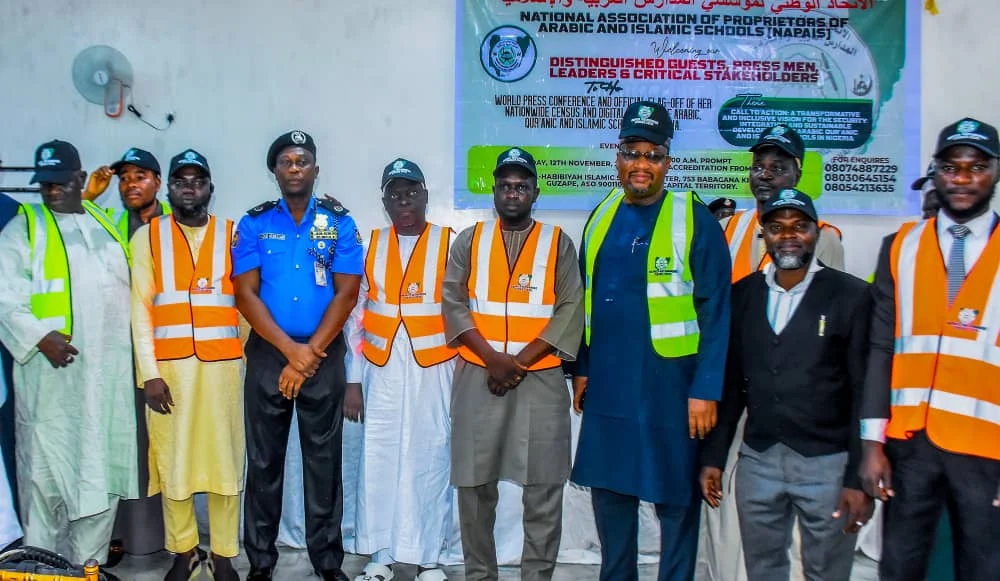
The National Association of Proprietors of Arabic and Islamic Schools (NAPAIS) has appealed to President Bola Tinubu to support its efforts to reform the Al-majiri education system in Nigeria.
The National President of NAPAIS, Malam Muhammad Jamiu, made the appeal at a news conference in Abuja on Thursday.
The conference was organised under the theme: “Call to Action: A Transformative and Inclusive Vision for the Security, Integration and Sustainable Development of Arabic, Qur’anic and Islamic Schools in Nigeria.”
Jamiu said the association had commenced efforts to restore the original Al-majiri education system and was seeking the cooperation of governments, security agencies and other stakeholders.
He appealed to Tinubu and other political leaders to support the initiative, recalling the President’s previous engagement with Al-majiri schools before assuming office.
“All the leaders, most especially President Bola Tinubu, we beg you, we call on you. You are concerned because you visited most of Al-majiri before you became president in 2023,” he said.
He recalled that Tinubu had promised transformative interventions for the system, urging him to fulfil the commitment by supporting the association’s reform agenda.
According to him, the association is determined to address the challenges confronting Al-majiri education through collaboration with federal and state governments, lawmakers and other constituted authorities.
Jamiu stressed that NAPAIS was not advocating the abolition of Al-majiri education but rather its restoration to its original form.
“NAPAIS says we will not cancel Al-majiri. It’s a clear message. We will not outlaw the system. We will never outlaw Al-majiri, and we will never stop Al-majiri,” he said.
He explained that the current challenges associated with the system were consequences of its distortion and neglect rather than inherent weaknesses in the traditional model.
The NAPAIS president called on the Federal Government to implement and adequately fund the National Policy on Enhancing Al-majiri Education to achieve meaningful reforms.
“We will reform Al-majiri. It’s like you helped us in the journey to reform it through what you have already laid down as a policy to enhance Al-majiri education. Please implement it. Please fund it. Please let it come alive,” he appealed.
He observed that the absence of effective implementation had undermined the policy, adding that many states had yet to domesticate it.
Jamiu argued that abolishing Al-majiri schools without providing adequate alternatives could worsen the country’s existing out-of-school children challenge.
He noted that public schools in several states were already struggling with inadequate classrooms and facilities, making it difficult to accommodate additional pupils.
“If you cancel Al-majiri system, our children will go to the school that they don’t have enough already. Where we have about 100 in some classes, are they going to still have this Al-majiri system to it?” he queried.
He said the association was prepared to work with relevant authorities to address the problems through transparency, accountability and sustainable interventions.
Jamiu disclosed that more than 50 per cent of Nigeria’s out-of-school children were enrolled in Qur’anic, Arabic and Islamic learning schools and centres.
He therefore urged the government and international partners to recognise such institutions as important stakeholders in the country’s education sector rather than categorising their pupils as out-of-school children.
Presenting NAPAIS’s five-point transformation agenda, he said the association planned to establish a comprehensive registration and identification system for children attending Al-majiri and Islamiyyah schools.
He explained that every child would be counted and assigned an identification number in collaboration with the Federal Ministry of Education to ensure proper documentation.
According to him, the initiative will enable the association and the ministry to maintain a shared database containing information about pupils and their respective schools.
“No more invisible children in Al-majiri and Islamiyyah schools. We need to stop that,” Jamiu said.
He said the association also planned to restore the original community-sponsored boarding model, involving local governments, mosques, parents and NAPAIS in providing for the children’s welfare.
He explained that local governments and religious institutions would contribute their respective quotas, while parents would also support the programme and NAPAIS would mobilise resources through farming and other initiatives.
Jamiu declared that begging would no longer be tolerated under the proposed reform, warning that any school that sent children out to beg would lose its identity and recognition as a NAPAIS member.
He further explained that the reformed curriculum would combine Qur’anic, Arabic and Islamic studies with English Language, Mathematics and other conventional academic subjects.
He said the programme would also incorporate vocational and technical training through designated NAPAIS vocational training centres to equip pupils with practical skills.
According to him, the objective is to produce graduates who will combine sound Islamic knowledge with professional and technological competencies.
“Al-majiri must be able to recite Quran and speak Arabic and become solar renewable energy engineer. They will become medical doctors. They will be able to produce bags. They will be able to develop websites,” he said.
The NAPAIS president also disclosed plans to regulate the operations of Al-majiri schools and ensure that every institution was certified, with proper records of enrolment, activities and parental information.
In his remarks, Dr Balarabe Shehu, Special Adviser to the Minister of Education on Al-majiri and Out-of-School Children’s Education, commended NAPAIS for its efforts to promote inclusive and quality education for underserved children.
Shehu said Nigeria’s educational development required the contributions of associations and private institutions, stressing that the Federal Ministry of Education remained committed to supporting private schools because of their contributions to expanding access to education.
He, however, explained that basic education, including primary education for children between five or six and 14 years, fell primarily under the constitutional responsibility of state governments, while the Federal Government was responsible for policy formulation, coordination and interventions.
He said the Federal Government had established a national commission for Al-majiri education and that NAPAIS had participated in developing the National Policy on Enhancing Al-majiri Education System in Nigeria.(NAN)
Edited by Deji Abdulwahab


Comments