


By Martha Agas
The Comptroller-General (C-G), Nigeria Customs Service (NCS), Bashir Adeniyi, has warned officers of the Customs Police Unit (CPU) against abuse of power, urging greater accountability, discipline and strict adherence to rule of law.
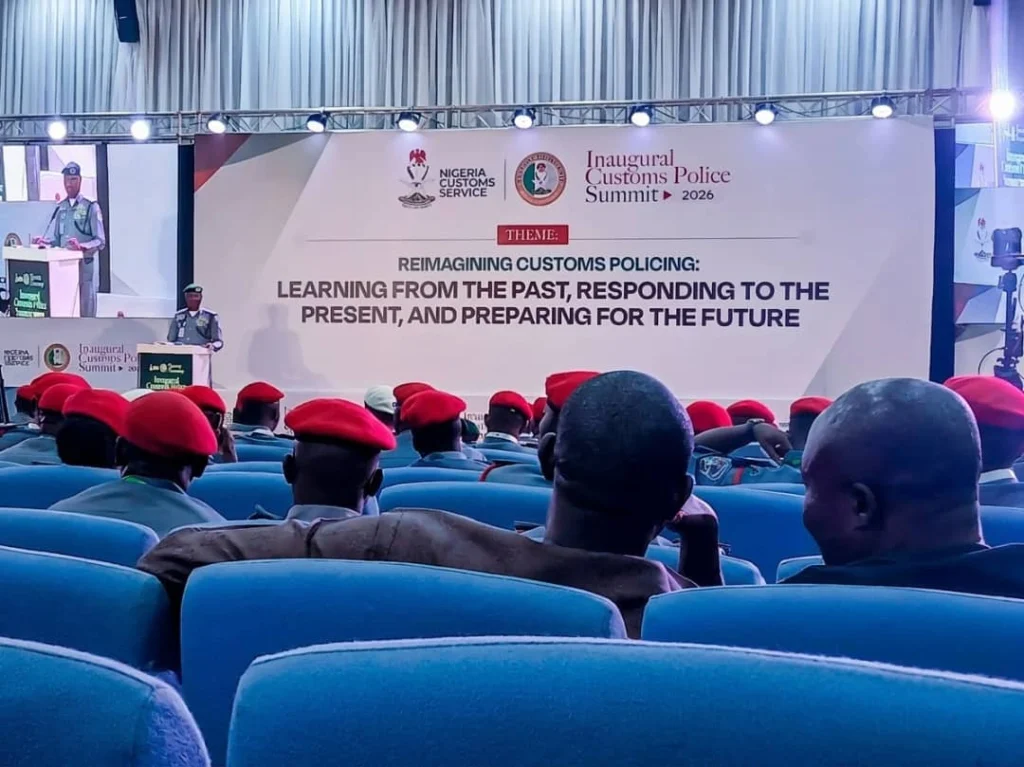
Adeniyi gave the warning on Thursday in Abuja at the opening of the inaugural Customs Police Summit, holding from Nov. 12 to Nov. 14.
The summit is themed, ‘Reimagining Customs Policing: Learning from the Past, Responding to the Present and Preparing for the Future’.
He said that service must facilitate legitimate trade and curb illicit trade, a responsibility that could not be fulfilled without a disciplined and trusted CPU to uphold its own standards.
“The CPU was established in 2019 with clear mandate to investigate errant personnel, prevent crime and ensure compliance.
“Its founding principle remains as true today as it was in 2019 and that is the fact that no officer is above the law.
“Our history teaches three lessons. The first is that charity begins at home, before we demand integrity from traders and the public, we must show it ourselves.
“The second lesson is that authority requires restraint.
The NCS Act 2023 gives us sweeping police powers, but every search, arrest and detention must rest on lawful grounds and withstand public and judicial scrutiny,
“The third lesson is that enforcement in isolation,” he said.
He commended officers who had built the unit over the past seven years, describing its development as evidence of the importance of institutional discipline and professional capacity.
The C-G, however, warned that criminal networks were becoming increasingly sophisticated, exploiting legitimate trade routes and digital platforms to move firearms components, narcotics, counterfeit medicines, protected wildlife and illicit funds.
According to him, addressing the threats requires intelligence-driven operations, stronger inter-agency cooperation and effective deployment of technology rather than excessive enforcement.
“Our answers must be smarter. They must not be harder,” he said.
Adeniyi, who is also Chairman of the World Customs Organisation (WCO), said global instruments, including SAFE Framework, Authorised Economic Operator programmes and Time Release Studies, had strengthened compliance and targeted security risks.
He identified data as one of the service’s most valuable assets, noting that digital platforms had improved declarations, valuation, risk management and audit processes.
The C-G also highlighted the importance of the Interpol Data Centre and Customs Equipment in providing access to global criminal databases to support intelligence-led operations.
Adeniyi said the CPU remained central to ensuring that enforcement discretion was exercised lawfully and that interceptions translated into successful prosecutions.
He identified consolidation, collaboration and innovation as the three pillars required to strengthen the unit and reposition its operations to address emerging security and trade challenges.
Adeniyi explained that consolidation would involve establishing clear procedures for arrests, detention and investigations, developing court-ready case files and strengthening professional development from recruitment to leadership.
On collaboration, the C-G urged the CPU to deepen cooperation with the Nigeria Police Force, the Armed Forces, Economic and Financial Crimes Commission (EFCC) and National Drug Law Enforcement Agency (NDLEA).
He also called for stronger partnerships with the National Agency for Food and Drug Administration and Control (NAFDAC), Department of State Services (DSS) and other relevant agencies.
“No single institution can defeat illicit trade alone, and partnership rests on trust that is earned through our conduct,” the C-G said.
Adeniyi advocated the deployment of artificial intelligence, advanced scanners, geospatial tools and electronic cargo tracking to improve investigations and enforcement.
He, however, cautioned that technology must operate within the law, stressing the need for data protection and human oversight in the deployment of artificial intelligence.
The C-G urged the conference to develop a Customs doctrine anchored on the NCS Act 2023 and the revised Arusha Declaration.
He also called for practical protocols for joint operations, evidence management and information exchange, alongside guidelines on the responsible use of data and artificial intelligence in investigations.
Adeniyi further urged participants to make recommendations on improving the training, welfare and recognition of CPU personnel.
He challenged the unit to review some of its traditional responsibilities in response to technological advancements, particularly the escorting of containers in transit.
Speaking at the event, the EFCC Chairman, Mr Ola Olukoyede, urged security agencies to strengthen intelligence sharing, enforce accountability and improve inter-agency collaboration to effectively combat organised crime and emerging security threats.
Represented by EFCC Head Provost, Mr Bala Mohamed, the chairman said that the Commission’s participation in the summit demonstrated the mutually beneficial relationship between the two institutions and their shared commitment to protecting Nigeria’s economic and security assets.
He urged the NCS and other military and paramilitary agencies to strengthen supervision, ensure lawful and clearly communicated orders, while promptly and impartially addressing breaches.
Also, speaking, the Provost Marshal of the Nigeria Army, Maj.- Gen. Mathias Erebulu said security threats increasingly crossed institutional boundaries, making joint training, timely intelligence sharing and operational cooperation imperative.
His message was delivered by Brig.-Gen. Sule Salihu, the Chief of Staff headquarters Nigerian Army Corps Military Police.
Erebulu said the summit’s theme was apt, given the evolving nature of law enforcement, increasing complexity of modern security threats and the need for professionalism, discipline and innovation in policing.(NAN)
Edited by Bayo Sekoni


Comments