


By Ismail Abdulaziz, News Agency of Nigeria (NAN)
With 133 million Nigerians living in multidimensional poverty, corporate investment in education, healthcare, water supply and economic empowerment remains an important complement to government development efforts.
The 2022 National Multidimensional Poverty Index (MPI) survey by the National Bureau of Statistics (NBS) found that 63 per cent of Nigeria’s population experienced multiple deprivations.
These included inadequate sanitation, limited access to healthcare, food insecurity and poor housing.
Similarly, the 2024 Nigeria Demographic and Health Survey (NDHS) found that only 38 per cent of households had drinking water on their premises, while 20 per cent of the household population practised open defaecation.
These figures underscore the development challenges confronting many communities and the need for sustained investment by government, development partners and the private sector.
Against this backdrop, Corporate Social Responsibility (CSR) has become an important instrument through which businesses can contribute to social development while building sustainable relationships with their host communities.
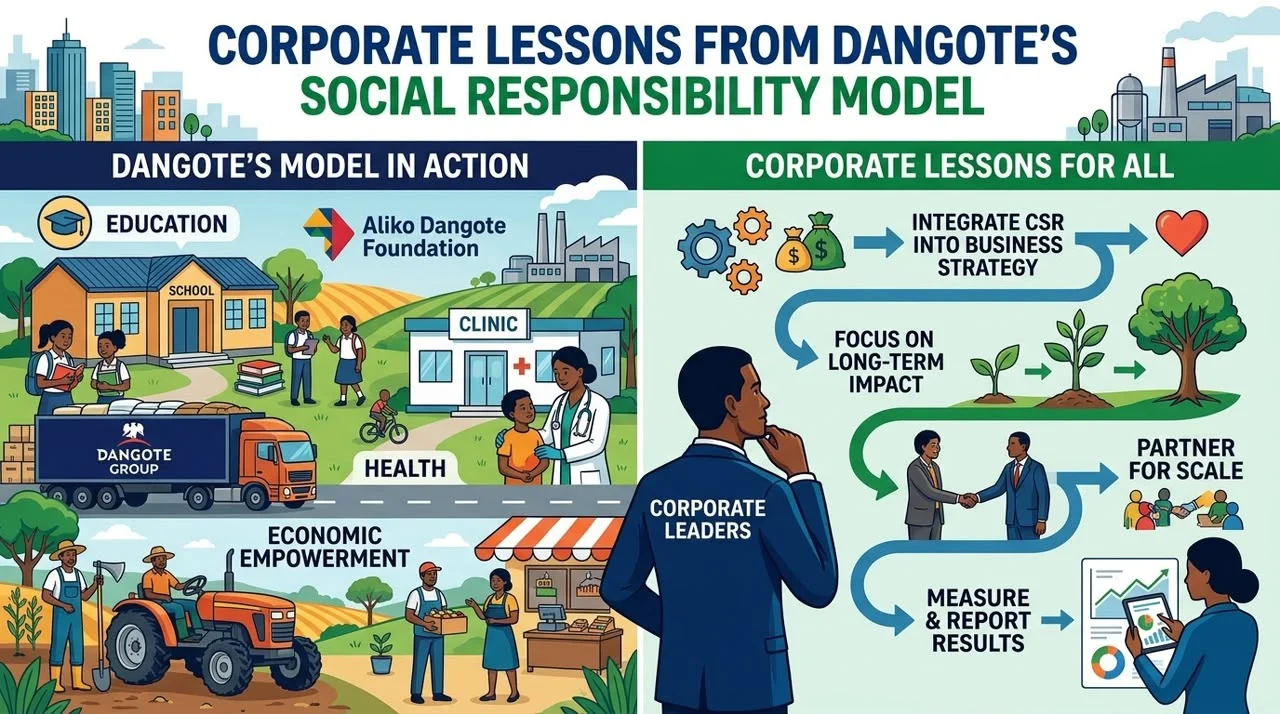
Among Nigeria’s prominent philanthropic initiatives is the Aliko Dangote Foundation (ADF), established by Africa’s industrialist, Aliko Dangote, to support health, education, economic empowerment and humanitarian interventions.
In March 2014, Dangote made an endowment of 1.25 billion dollars to the foundation to strengthen its capacity to expand its interventions in health, education and economic empowerment.
The foundation’s approach reflects a broader understanding of philanthropy, moving beyond occasional charitable donations towards structured investments in human development and poverty reduction.
However, beyond the foundation’s philanthropic activities, Dangote Group’s CSR programmes across its industrial locations provide another perspective on how businesses can contribute to community development.
For many rural communities hosting large industrial establishments, the arrival of a major company raises expectations that extend beyond employment opportunities and commercial activities.
Residents often look forward to improved infrastructure, access to social amenities, educational opportunities, healthcare services and greater participation in the local economy.
Across several of its host communities, Dangote’s CSR interventions have attracted commendations from traditional rulers, community leaders and beneficiaries, who say the initiatives have helped address some longstanding developmental challenges.
From scholarships and healthcare outreaches to boreholes, roads and skills-acquisition programmes, the interventions have provided support to residents in different locations.
In Ibeju-Lekki, Lagos, where the Dangote Petroleum Refinery is located, community stakeholders have reportedly welcomed interventions such as access-road rehabilitation, water provision, scholarships and technical training.
For residents, these initiatives are important in a rapidly developing industrial environment where population growth and increased economic activities can place additional pressure on existing infrastructure and social services.
Community leaders, including the traditional ruler of Magbon-Segun, Mufutau Dauda, have acknowledged the benefits of the company’s interventions.
Similarly, Shakiru Bello, the traditional ruler of Okeyanta, commended the scholarship programme, noting its relevance in supporting families and students.
Such interventions, especially in education, can reduce the financial burden on parents while expanding opportunities for children from disadvantaged backgrounds.
Beyond Lagos, communities hosting Dangote Cement’s operations in other parts of the country have also benefited from similar interventions.
In Obajana, Kogi, where Dangote Cement operates one of its major plants, community stakeholders have acknowledged the company’s contributions to educational development, healthcare, infrastructure and employment.
Scholarships, schools, healthcare facilities, concrete roads and skills-acquisition programmes have featured among the reported interventions.
For many residents of industrial host communities, access to these facilities represents practical improvements in their quality of life.
In Gboko, Benue, community feedback has similarly highlighted the importance of water provision, electricity and educational support.
Chief Zaki Anum, district head of Mbatyu, expressed satisfaction with the provision of a borehole in his community, describing the intervention as beneficial to residents.
The importance of such an intervention becomes clearer against the background of Nigeria’s water access challenges.
According to the 2024 NDHS, although 71 per cent of the household population had at least basic drinking water services, only 38 per cent of households had water on their premises.
A borehole, therefore, is more than an infrastructure project.
Where properly maintained and supported by effective water management, it can reduce the time spent fetching water, improve hygiene and contribute to better public health.
Similarly, in Okpella, Edo, beneficiaries of a free malaria treatment programme organised by Dangote Cement in May 2024 expressed appreciation for the intervention.
Mrs Adiza Aliu said the programme enabled her to receive treatment without payment, while Innocent Valetina described it as a relief for families struggling with the cost of medicines.
These experiences illustrate how community-based healthcare interventions can provide immediate support to households, especially those with limited access to affordable medical services.
The scale of such corporate interventions is also reflected in Dangote Cement’s 2024 Sustainability Report.
The company reported that it spent N12.421 billion on social investment projects in 2024, representing a 427 per cent increase from N2.356 billion recorded in 2023.
It also reported completing 71 community projects and engaging 773 community stakeholders during the year.
Furthermore, the company partnered with the New Nigeria Foundation in January 2024 to conduct a needs assessment across 17 host communities around its Ibese plant in Ogun.
The assessment identified healthcare, education, infrastructure and economic empowerment as priority areas for community development.
These figures provide an indication of the resources committed to social investment and the importance of identifying community needs before implementing development projects.
Nevertheless, the effectiveness of CSR programmes cannot be measured solely by the amount of money spent or the number of projects executed.
Rather, their impact depends on whether the interventions respond to residents’ priorities, reach intended beneficiaries and remain functional over time.
In spite of the reported achievements, community satisfaction with CSR programmes is not always uniform, as residents have different expectations from companies operating in their areas.
For communities hosting large industrial establishments, the presence of a company often creates expectations that qualified indigenes will enjoy greater access to employment and business opportunities.
Although companies may employ thousands of workers, perceptions of fairness in recruitment, especially for skilled and managerial positions, can significantly influence community relations.
Environmental concerns also remain central to the relationship between companies and their host communities.
Around cement manufacturing and mining operations, issues such as dust emissions, noise, land degradation, water pollution and pressure on local infrastructure can influence residents’ perceptions of corporate responsibility.
Dangote Cement’s 2024 Sustainability Report acknowledges the need to assess potential effects on soil, air quality, noise levels and water pollution before implementing projects.
The report also indicates that the company conducted stakeholder assessments involving 2,222 participants, including employees, customers, investors, suppliers and host communities.
This highlights the importance of incorporating environmental and social concerns into corporate development strategies rather than treating CSR as a separate charitable activity.
Consequently, while social investment is important, effective corporate responsibility must also involve responsible environmental management, transparent communication and continuous engagement with affected residents.
The challenge, therefore, is to ensure that CSR interventions are not only visible but also responsive to the broader and evolving needs of host communities.
From a development perspective, corporate social responsibility should go beyond philanthropic assistance to establish mutually beneficial relationships between businesses and the communities in which they operate.
For companies such as Dangote Group, whose operations involve substantial investments and extensive industrial activities, structured community engagement is particularly important.
The application of Community Development Agreements (CDAs) provides a framework for defining responsibilities, establishing priorities and improving accountability between companies and host communities.
When properly implemented, such agreements can help reduce misunderstandings, improve trust and ensure that interventions are aligned with the developmental needs of residents.
However, their effectiveness depends on the extent to which commitments are fulfilled, beneficiaries are fairly selected and completed projects are properly maintained.
The experiences of host communities across Dangote Group’s operational locations demonstrate how CSR can serve as an instrument for improving social welfare and strengthening corporate-community relations.
The reported investments in scholarships, healthcare programmes, water provision and infrastructure suggest that private-sector interventions can complement government efforts to address development challenges.
At the same time, concerns surrounding employment, environmental impact, project adequacy and sustainability highlight areas requiring continuous attention.
As Nigeria continues to pursue industrialisation and economic diversification, the relationship between major corporations and their host communities will remain an important component of sustainable development.
Dangote’s CSR programmes, therefore, offer an opportunity to examine how private-sector investments can contribute to addressing infrastructure and social development challenges while promoting peaceful coexistence.
Ultimately, the success of any corporate social responsibility model should be measured not only by the resources committed but also by the lasting improvements it brings to people’s lives.
Residents of communities hosting Dangote’s operations expect the gains recorded to be sustained and outstanding concerns addressed.
They also want stronger industry-community partnerships to promote inclusive and sustainable development. (NANFeatures)
****If used, credit the writer and the News Agency of Nigeria (NAN).
(NAN)

Comments