


By Aderogba George
Health experts have called for increased financing, stronger accountability and sustained media engagement to improve access to family planning services across the country.
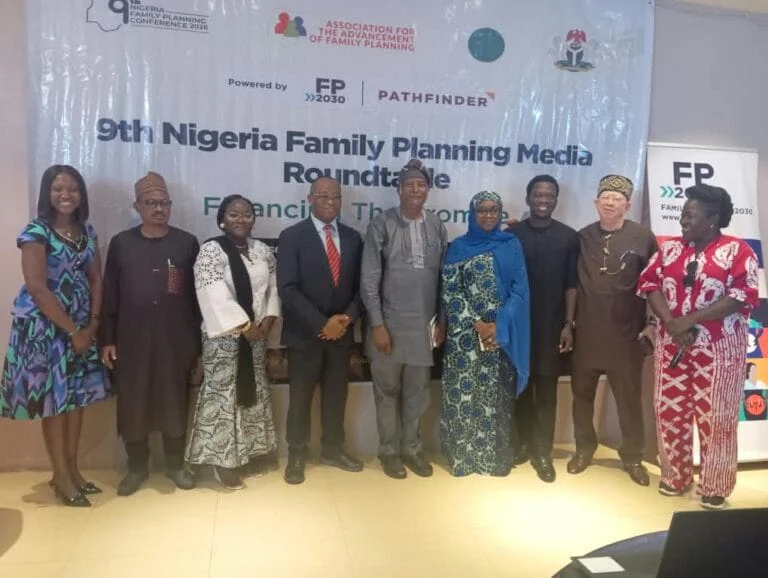
They made the call at a pre-conference media roundtable organised by the Association for the Advancement of Family Planning (AAFP), with support of Pathfinder International in Abuja ahead of the ninth Nigeria Family Planning Conference.
The roundtable themed “Financing the Promise” and focused on sustainable funding, domestic resource mobilisation and accountability for family planning commitments.
The ninth Nigeria Family Planning Conference is scheduled to hold from Nov. 30 to Dec. 4 in Abuja under the theme, “Securing the Future of Nigeria’s Family Planning Agenda for Sustainable Health and Development.”
Dr Ejike Oji, Chairman, Management Committee and Local Organising Committee of the conference, said Nigeria needed stronger domestic financing, effective partnerships and reliable contraceptive supply chains to sustain progress.
Oji said the country’s FP2030 commitments included expanding access and choice, strengthening supply chains, improving financing and reinforcing accountability mechanisms to achieve national family planning targets.
He said Nigeria aimed to attain at least 27 per cent modern contraceptive prevalence by 2030, stressing that achieving the target required sustained political commitment and adequate resources.
According to him, family planning is essential to informed decision-making, improved health outcomes and people’s ability to participate fully in social and economic development.
Oji said the conference would move discussions beyond commitments to implementation, with priorities including domestic resource mobilisation, innovative financing, public-private partnerships and local manufacturing of contraceptive commodities.
He added that equitable access to services, stronger data systems and accountability would also feature prominently in technical sessions, policy discussions and high-level plenaries during the conference.
Oji disclosed that 546 abstracts had been reviewed, with 109 oral presentations and 200 poster presentations selected for the conference, demonstrating significant research and programme experience.
He urged journalists to distinguish between announcements, pledges, confirmed commitments, funds released and actual results when reporting government and development partners’ family planning interventions.
The AAFP chairman also urged media practitioners to amplify the experiences of women, young people, persons with disabilities, healthcare providers and underserved communities in their reports.
Prof. Oladipo Oladapo, President of the Association for Reproductive Health and Family Planning (ARHF), said the media had a pivotal role in advancing Nigeria’s family planning agenda.
Oladapo, immediate past Chairman of AAFP, challenged journalists to give family planning issues greater prominence and consistently investigate government commitments, programme implementation and funding gaps.
He warned that Nigeria’s development prospects would remain constrained without deliberate efforts to address rapid population growth through improved access to reproductive health and family planning services.
Oladapo urged the media to scrutinise domestic resource mobilisation proposals and ensure that government financing commitments translated into effective programmes and accessible services for Nigerian women.
He said journalists possessed the influence to shape public understanding and encourage behavioural change through accurate reporting, sustained advocacy and constructive engagement with policymakers.
Dr Amina Dorayi, Regional Portfolio Director, Pathfinder International, said Nigeria must reduce dependence on external development assistance and make domestic resource mobilisation central to financing family planning programmes.
Dorayi said changing global development financing conditions presented an opportunity for African countries to rethink health financing and strengthen ownership of essential programmes through predictable domestic resources.
She stressed that domestic financing involved more than budgetary allocations, requiring timely releases, efficient expenditure and measurable results that improved access to reproductive health services.
According to her, accountability mechanisms should track family planning allocations, releases and expenditure at federal and state levels, including whether contraceptive commodities reached health facilities.
Dorayi urged journalists to investigate financing commitments, highlight experiences of women and healthcare workers, and sustain public attention on family planning beyond the conference.
She said family planning was an investment in human capital, women’s economic empowerment, education, household resilience and national development, extending benefits beyond individual health outcomes.
Dorayi said development partners should support governments through evidence, innovation and stronger health systems, while domestic leadership remained central to sustaining reproductive health programmes.
She urged stakeholders to ensure that family planning commitments translated into predictable financing, effective implementation and meaningful choices for every Nigerian woman and girl.
Dr Alain Damiba, Managing Director, FP2030, West and Central Africa, said Nigeria needed to diversify family planning funding sources and improve efficiency in the use of available resources.
Damiba said the country should move beyond donor-dependent financing by engaging federal and state governments, health insurance schemes, private sector actors and domestic institutions.
He urged the government to establish dedicated family planning budget lines, increase funding for contraceptive procurement and strengthen last-mile distribution through primary healthcare facilities.
Damiba also called for timely budget releases, transparent procurement, improved supply chain management and regular tracking of expenditure to reduce contraceptive stock-outs and improve service delivery.
He urged journalists to track budget allocations, releases and expenditure, stressing that the impact of financing should be measured by contraceptive availability and access to voluntary family planning services, particularly for women and girls in underserved communities. (NAN)
Edited by Maureen Atuonwu
======


Comments