


By Angela Atabo/Justina Auta
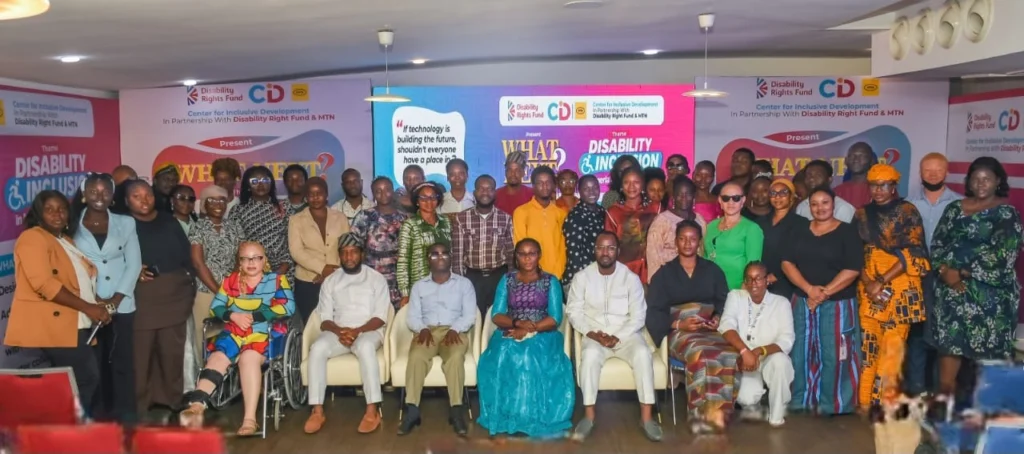
The Centre for Inclusive Development (CID), in partnership with the Disability Rights Fund (DRF) and MTN Nigeria, has called for deliberate efforts to ensure persons with disabilities benefit from Nigeria’s digital economy.
The stakeholders made the call in Abuja on Thursday at the third edition of the What Next Learning Series, themed “Disability Inclusion in Nigeria’s Digital Economy.”
The Co-Founder, CID, Mrs Yauri Aduak, said that digital inclusion required deliberate efforts to remove barriers preventing persons with disabilities from fully participating in the society.
“At CID, we believe that inclusion is not simply about creating opportunities for persons with disabilities to participate.
“It is also about deliberately removing the barriers that prevent their full and meaningful participation in the society, and this belief is what is the heart of the What Next Learning Series.
“The What Next Learning Series was conceived as a platform to move conversations beyond awareness, commitment, and good intention towards practical solutions and measurable change.”
Aduak said Nigeria’s rapid digital transformation was creating opportunities in education, employment, banking, e-commerce and access to public services.
She noted that inaccessible websites, digital platforms, applications and technologies continued to exclude many persons with disabilities from these opportunities.
According to her, findings from CID’s project on Enhancing Digital Accessibility for Persons with Disabilities in Nigeria, supported by DRF, have highlighted the opportunities and challenges associated with digital accessibility.
She said engagements with Organisations of Persons with Disabilities (OPDs), and other stakeholders showed that digital inclusion required institutional commitment, technical capacity and sustained collaboration.
Aduak therefore, urged stakeholders to translate discussions into practical actions, stressing that no single institution could achieve digital inclusion alone.
Also speaking, Mr Theophilus Odaudu, Programme Officer for Sub-Saharan Africa, DRF, said digital inclusion meant ensuring that everyone could access and use digital products and services independently without assistance from third parties.
Odaudu said many digital platforms remained inaccessible to persons with disabilities because developers often failed to consider their different needs.
He explained that blind persons encountered websites with unlabeled buttons and images without descriptions, making it difficult for screen readers to interpret information.
He said deaf persons required video captioning, while persons with intellectual disabilities needed simple, easy-to-read language instead of complex technical information.
Odaudu said Nigeria had laws and policies supporting inclusion, but lacked sufficiently specific standards mandating technology developers and companies to incorporate disability accessibility into their products from inception.
He identified weak enforcement of existing provisions and the absence of clear standards as major challenges to achieving digital inclusion.
He urged relevant government institutions to strengthen enforcement and ensure persons with disabilities participated in decisions affecting their rights.
He also called on technology companies to involve persons with disabilities in the design and testing of digital products to ensure accessibility across different disability categories.
In her remarks, Mrs Esther Akinnukawe, Chief Human Resource Officer, MTN Nigeria, said disability inclusion was both a moral responsibility and an important driver of national development.
Akinnukawe, represented by Mr Chikaodi Ofoegbu, Head, Customer Operations and Experience, North, MTN Nigeria, said MTN had introduced measures including ramps, modified workspaces, accessible fittings and emergency wheelchairs to improve workplace accessibility.
According to her, MTN Foundation and initiatives such as the MTN Skills Academy also support education, scholarships and digital training for persons with disabilities.
Akinnukawe also commended CID for developing MakeAm, an artificial intelligence-powered WhatsApp tool designed to empower persons with disabilities through accessible technology.
She said the initiative demonstrated how everyday digital platforms could be leveraged to break barriers and create equal opportunities.(NAN)
Edited by Deji Abdulwahab

Comments