


By Ismail Abdulaziz, News Agency of Nigeria (NAN)
Philosophers, politicians, and religious leaders have long spoken about the toll of war and conflict on human relationships across time and place.
Philosopher Bertrand Russell is quoted as saying “Mankind has become so much one family that we cannot ensure our own prosperity except by insuring that of everyone else. If you wish to be happy yourself, you must resign yourself to seeing others also happy.”
Similarly, jurist and philosopher of Islamic Spain, Abu Muhammad Ibn Hazm, believes that “Nothing destroys the soul of a people faster than turning their swords inward upon their own neighbours; in such ruin, even the victor inherits only ashes.”
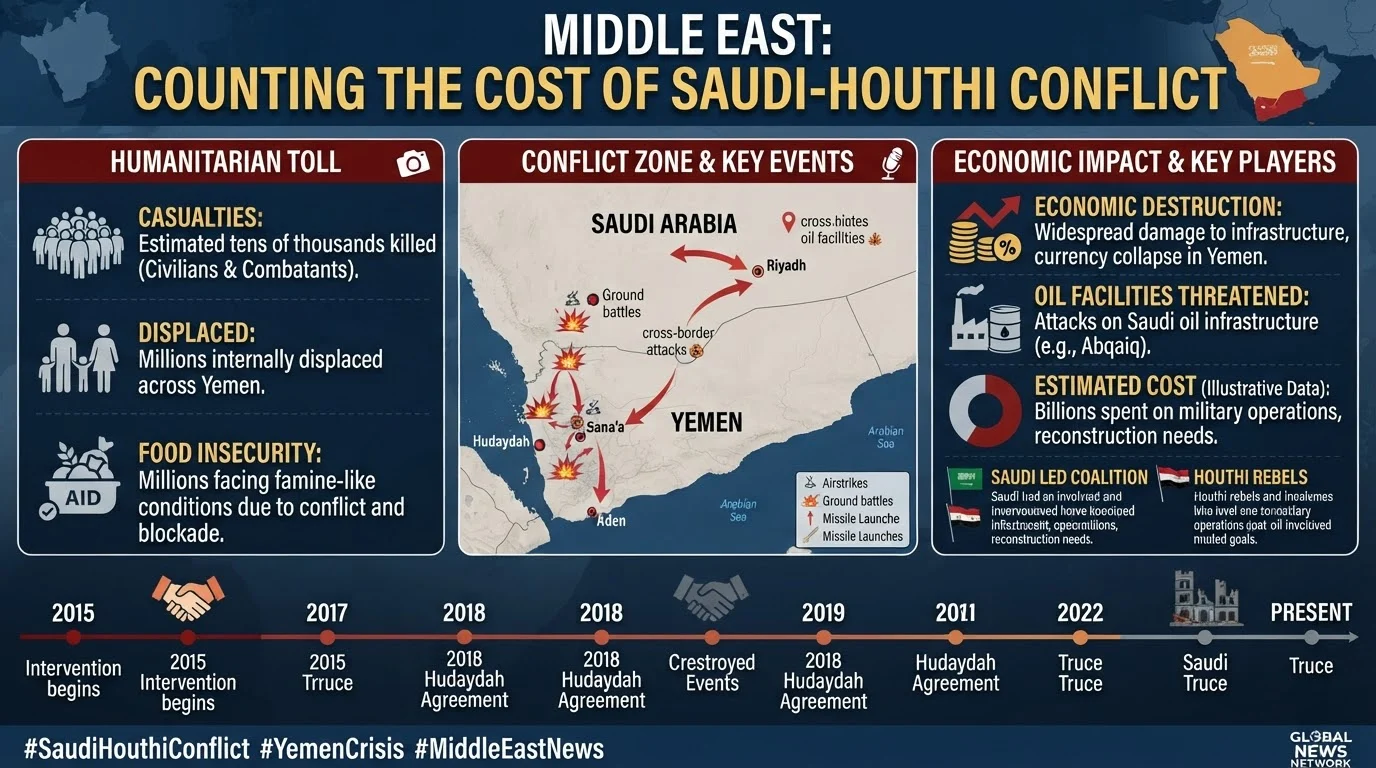
In the early hours of Nov. 19, air defence batteries around Riyadh lit up the night sky once again, intercepting a fresh wave of cross-border drones and ballistic missiles launched from northern Yemen.
Less than 24 hours later, Saudi-led coalition fighter jets struck infrastructure targets around Yemen’s Red Sea port of Hodeidah.
For millions of ordinary Yemenis and residents across the Arabian Peninsula, the back-and-forth exchanges felt grimly familiar—another violent chapter in a conflict that has resisted military resolution for more than a decade.
What began as a localised northern Yemeni insurgency in the early 2000’s has evolved into one of the Middle East’s most entrenched and economically punishing geopolitical crises.
Today, the confrontation between Saudi Arabia and Yemen’s Houthi movement—officially known as Ansar Allah—sits at the intersection of domestic Yemeni grievances, Red Sea maritime security, and wider regional rivalries.
It is worth recalling that Nigeria joined other like-minded nations in denouncing the escalation after the Sept. 7 Houthi attack on Saudi Arabia.
Nigeria’s stance was conveyed in a statement by the spokesperson for the Ministry of Foreign Affairs, Oluwafemi Adeniyi.
He said the attack led to scores of civilian injuries and damage to civil public infrastructure.
“Nigeria regards the fresh hostilities as a serious threat not only to the security and sovereignty of Saudi Arabia, but also to regional stability in the Middle East.
“Nigeria, therefore, calls on all parties to uphold international law, exercise maximum restraint, and refrain from further actions that could escalate the situation, endanger civilian lives, undermine regional security, and further disrupt the flow of much-needed global energy supplies.
“Nigeria stands in solidarity with the government and people of Saudi Arabia at this difficult time, and prays for speedy recovery for those injured in the attack,” Adeniyi said.
As diplomatic envoys from Oman and the United Nations scramble to contain the escalation, the human, financial, and strategic toll continues to mount on both sides of the border.
More than 11 years after Operation Decisive Storm began, the economic fallout of the crisis weighs heavily on both Riyadh and Sanaa, albeit in starkly different ways.
For Saudi Arabia, the conflict represents a sustained drain on public finances and a major obstacle to its Vision 2030 economic transformation agenda.
Maintaining one of the world’s largest defence budgets—exceeding 83 billion dollars annually, or roughly 6.5 per cent to 7.2 per cent of Gross Domestic Product—Riyadh faces a punishing cost-exchange imbalance.
Intercepting low-cost Houthi drones priced between 2,000 and 20,000 dollars requires sophisticated air-defence interceptors by Saudi costing upward of 2 million dollars each.
The resumption of cross-border missile and drone attacks this year has further widened Saudi Arabia’s fiscal deficit.
International Monetary Fund assessments project a 3.3 per cent contraction in Saudi GDP amid war spillovers and elevated security expenditures.
Every billion dollars diverted towards air-defence procurement and border security represents capital pulled away from Vision 2030 megaprojects, industrial diversification, and tourism infrastructure.
Moreover, direct strikes near Riyadh’s financial district and commercial aviation hubs heighten risk premiums for domestic enterprises and dampen foreign direct investment sentiment.
Maritime disruptions have compounded these pressures. With Persian Gulf shipping routes strained in 2026, Saudi Arabia has relied heavily on its Red Sea coastline—channelling crude exports through Yanbu via the East-West Pipeline and commercial imports through Jeddah Islamic Port.
Persistent Houthi threats near Red Sea shipping lanes have driven up war-risk insurance premiums and freight rates, squeezing Saudi export margins while raising the landed cost of imported goods.
Yet if Saudi Arabia’s economy is strained, Yemen’s formal economy has been hollowed out entirely.
Over a decade of conflict has greatly reduced Yemen’s economic output and devastated its financial institutions between rival central banks in Houthi-controlled Sanaa and the internationally recognised government’s base in Aden.
That institutional split has crippled monetary policy and left hundreds of thousands of civil servants without regular salaries for years.
Today, youth unemployment in Yemen exceeds 32 per cent, roughly half of all families live in multidimensional poverty, and more than 23 million people depend on humanitarian aid to survive.
Due to the fact that Yemen imports approximately 90 per cent of its food, coalition airstrikes and port disruptions at Hodeidah trigger immediate spikes in the prices of wheat, cooking oil, fuel, and medicine.
With power grids and water networks battered by years of bombardment, ordinary households are forced to rely on costly informal black markets for basic utilities.
Against this backdrop of escalating violence and deepening economic hardship, Oman and the United Nations have pursued parallel, mutually reinforcing diplomatic tracks to pull the warring parties back from the brink.
Leveraging its long-standing foreign policy neutrality and direct channels to Houthi leaders in Sanaa, Oman has remained the indispensable backchannel between Riyadh and Ansar Allah.
In September, Omani mediators in Muscat relayed Saudi proposals for a temporary two-week ceasefire alongside direct talks aimed at halting attacks on vital energy infrastructure.
Even after the Nov. 19 strikes inside Saudi territory, which prompted Oman’s Foreign Ministry to issue a rare public condemnation, Muscat quietly worked behind closed doors to keep communication lines intact so localised clashes would not escalate into a total regional blockade.
Omani diplomats argue that their past maritime truce between Washington and Sanaa proves Red Sea shipping security can be separated from Yemen’s broader territorial disputes.
Meanwhile, UN Special Envoy Hans Grundberg is mediating across Riyadh, Cairo, and Muscat to halt western coast fighting and cross-border strikes.
His strategy aims to separate the bilateral Saudi–Houthi ceasefire from the wider 2026 regional conflict involving Iran, resolving Yemen’s internal issues step-by-step instead.
Following the Nov. 20 strikes on Hodeidah port and Houthi threats against Jeddah, which displaced more than 130,000 people, UN officials reiterated that there is no military solution and urged the protection of civilians and humanitarian routes.
In spite of intense diplomatic activity, a durable settlement remains elusive due to three major obstacles.
First, formal UN-backed peace negotiations have been suspended since October without a breakthrough, complicated by fierce internal pushback within Yemen.
Yemen’s UN-led peace talks are stalling due to resistance from factions aligned with the country’s recognised government, who fear mediation will legitimise Houthi control, as well as hardened Houthi demands for major payouts and political recognition following advances near the Bab el-Mandeb Strait, demands Saudi Arabia rejects amid ongoing missile threats.
Additionally, Houthi detentions of UN staff, including a worker’s death in custody, have broken trust and severely disrupted humanitarian coordination.
As 2026 draws towards a close, the Saudi–Houthi crisis stands at a precarious crossroads.
Riyadh seeks border security and regional stability to safeguard its economic transformation, while the Houthi leadership demands political recognition and economic concessions backed by military leverage.
Late Maulana Wahiduddin Khan, a renowned modern Islamic scholar and peace activist, had argued that ending war is the prerequisite for all human progress.
“Scholars have defined peace as the absence of war. However, putting an end to war and violence is only its initial phase.
“Whenever peace prevails in a society in the real sense, its members will channel their energies towards constructive activities. Peace in a society can be likened to removing a dam from a river,” he said
Foreign affairs analysts warn that until Omani backchannels and UN mediation bridge that divide, millions of people across Yemen and the wider Gulf will remain caught between fragile truces and the constant threat of renewed escalation.
***If used, please credit the writer and the News Agency of Nigeria.(NAN)



Comments